Quick Answer
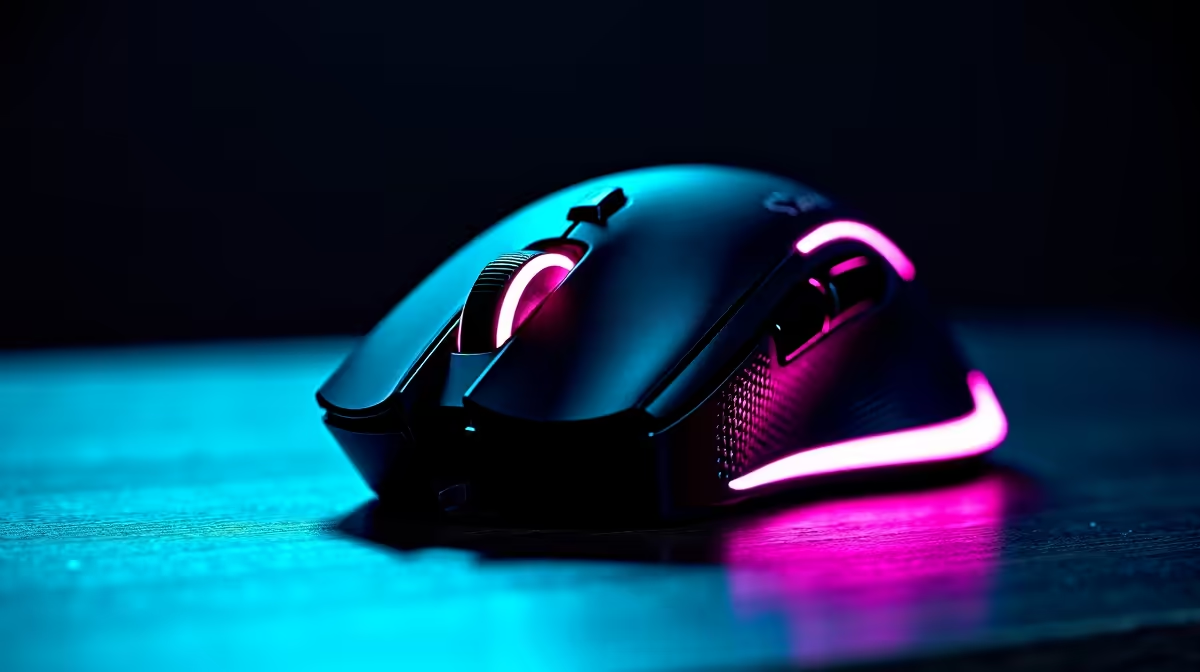
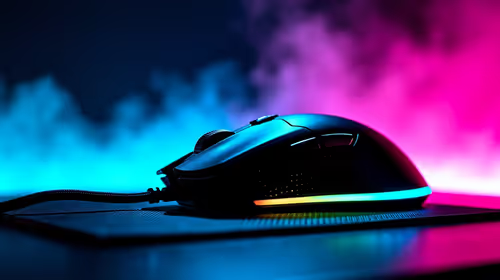
Mouse weight affects three distinct areas: wrist fatigue accumulates over multi-hour sessions with heavier mice, travel convenience is impacted when carrying peripherals daily, and fast-aim precision improves with lighter mice in FPS titles where quick direction changes matter. A 60g mouse requires noticeably less force to accelerate and stop than a 110g mouse across thousands of movements per gaming session.
Wrist Fatigue: The Cumulative Effect Over Sessions 🖥️
The forearm muscles guiding mouse movement perform hundreds of small contractions per minute during an active gaming or work session. A heavier mouse requires more force per movement to overcome inertia, and while any single movement is trivial, the load across a two-hour FPS session or eight-hour work day compounds into measurable tension. Physiotherapists at SA sports clinics note that repetitive low-force movements with heavy tools are a common precursor to forearm tendinopathy in competitive gamers. Moving from a 110g mouse to a 70g mouse reduces per-movement force by roughly 36 percent, translating to less end-of-session forearm fatigue even when total movement distance is the same.
Travel and Portability: Grams Add Up in a Bag 🎒
For SA students commuting between home and campus, or professionals travelling between Johannesburg and Cape Town, a 50g difference between a travel mouse and a standard gaming mouse is small in isolation but real across a full kit. A 14-inch laptop, charger, cable, and mousepad already weigh 2.5 to 3 kg. Adding a 110g mouse versus a 65g mouse saves 45g, modest but present over five days of campus carrying. More practically, compact lightweight mice fit into tighter bag pockets without creating asymmetric pressure on the bag fabric, improving both comfort and bag longevity.
Fast Aim: The Physics of Direction Change 🎯
In FPS gaming, the ability to abort a swipe mid-motion and redirect the crosshair depends partly on the mouse's inertia. A 110g mouse at speed requires more deceleration force to stop than a 65g mouse moving at the same velocity. This manifests as the heavy-mouse overshoot problem in close-range duels: the crosshair overshoots the target because the wrist cannot decelerate quickly enough. Competitive FPS players at SA LAN events consistently favour mice under 80g, with many top players selecting sub-65g designs for their main setup. The weight advantage is most pronounced in titles with fast time-to-kill where accuracy in the first 150 ms of an engagement is decisive.
Try Different Grip Styles as You Go Lighter ⚡
Switching from a heavy palm-grip mouse to a sub-70g mouse often requires transitioning from palm to claw or fingertip grip. The lighter mouse does not provide the same palm support, and using a palm grip on a lightweight shell can feel unstable initially. Give yourself one to two weeks of deliberate claw grip practice after switching before concluding the weight change is not working for you.
FAQ
At what weight does a gaming mouse stop being portable?
Above 100g, a gaming mouse starts to feel noticeably heavy in a laptop bag when carried daily alongside other gear. Most travel-oriented gaming mice target 60 to 80g to stay below the threshold where weight becomes a conscious inconvenience during commuting.
Does mouse weight affect accuracy for productivity tasks?
Yes, marginally. Lighter mice require less force for fine cursor movements on small targets like spreadsheet cells, reducing the overshoot problem when moving across a multi-monitor setup. The benefit is smaller than in gaming but present.
What is the lightest category of wireless gaming mouse available in SA?
Ultra-lightweight wireless gaming mice, typically 50 to 70g, are available at Evetech from brands including Razer and Logitech, priced between R1,200 and R2,500 depending on the sensor and wireless protocol included.
Ready to try a lighter mouse?
Browse gaming mice at Evetech sorted by weight to find a lightweight option suited to your gaming style, desk setup, and daily commute.