Wireless PC VR lives or dies on a clean radio link. Your headset is streaming a compressed video feed back from the PC in real time, and any hiccup in that link shows up instantly as stutter, blur or a dropped frame mid-swing. Wi-Fi 6 versus Wi-Fi 6E for Air Link comes down to one thing: whether you can move that feed onto the uncongested 6GHz band, away from the crowded airwaves every other device in the building is fighting over.
Quick Answer
Wi-Fi 6E is the better choice for wireless PCVR because it adds a clean 6GHz band on top of the bands Wi-Fi 6 already uses. In a dense Cape Town flat or Joburg complex where the 5GHz band is packed with neighbours, that exclusive 6GHz lane keeps Air Link bitrates steady. On a quiet 5GHz channel, plain Wi-Fi 6 can already be enough.
How Air Link Streaming Actually Works
Air Link does not send raw VR frames. The PC renders each frame, encodes it into a compressed video stream on the graphics card, fires it to the headset over Wi-Fi, and the headset decodes and displays it, all within a few milliseconds. The whole illusion of presence depends on that round trip staying fast and consistent. The headset connects to your router, the router connects to the PC, and the streaming feed rides that wireless link the entire time.
Two numbers govern the experience: bitrate and latency. Higher bitrate means a sharper image, but it needs more clean bandwidth to sustain. Latency is the delay between turning your head and seeing the result; spikes in latency are what break immersion. Both get worse the moment your wireless channel is sharing space with other traffic, which is exactly the problem the 6GHz band solves.
What Wi-Fi 6E Adds Over Wi-Fi 6
Wi-Fi 6 operates on the established 2.4GHz and 5GHz bands. They are capable, but in any built-up area they are crowded. Every router, phone, smart plug and TV in range is competing for the same airspace, and that congestion is invisible until it ruins your bitrate at the worst moment.
Wi-Fi 6E opens up the 6GHz band on top of all that. It is wide, currently uncongested, and short-range, which works in your favour here: it does not punch through walls into neighbouring flats, so your headset and router get a private lane almost no one else is using. For a streaming feed that demands steady throughput, an empty band is worth more than raw peak speed on a busy one.
Why 6GHz Matters in Dense SA Housing
The 6E advantage is biggest exactly where most South African gamers live: townhouse complexes, sectional-title blocks and apartment buildings where dozens of 5GHz networks overlap. In that environment, 5GHz can be saturated through no fault of your own. The 6GHz band sidesteps the whole crowd. In a freestanding house on a large stand with few neighbours, the difference shrinks, because your 5GHz channel may already be clear enough.
The Catch: Range and Coverage
The same short range that keeps 6GHz private also means it weakens faster through walls. For VR this is fine, the ideal setup puts the router in the same room as the play space anyway, with line of sight to where you stand. If you intend to roam to another room while streaming, the longer reach of 5GHz on Wi-Fi 6 can actually be more reliable. Match the band to your room, not just the spec sheet.
What to Buy for a Smooth Air Link Setup
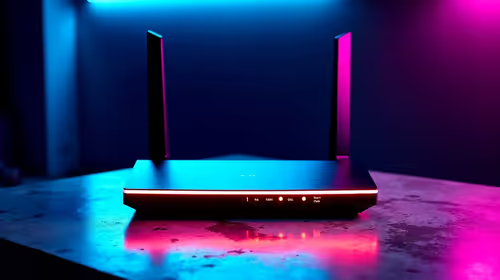
The headset, the router and the PC all have to support the band you are betting on. A Wi-Fi 6E headset gains nothing if your router only does Wi-Fi 6, and vice versa, so check both ends. The most robust arrangement is a dedicated 6E router for the play room, with the PC on a wired connection straight to that router so only the headset link travels over the air. Wiring the PC removes half the wireless variability in one move.
Position the router high, in the open and close to your play area, and keep its 6GHz network on its own SSID so devices commit to it. For the supporting hardware that rounds out a wireless setup, the VR and PC accessories at Evetech cover the headset-side and link gear, while buyers comparing add-ons often check the accessories people are buying most to see what pairs well. Get the placement and the wiring right and the band choice becomes the final polish rather than a rescue.
Wi-Fi 7 on the Horizon
While Wi-Fi 6E remains the current sweet spot for wireless PCVR, Wi-Fi 7 (802.11be) is starting to appear in high-end routers. It introduces Multi-Link Operation, which can bond channels across two bands simultaneously, and supports wider 320MHz channels in the 6GHz space. In practice for Air Link today, a well-configured Wi-Fi 6E setup already delivers close to wired-like latency -- the upgrade to Wi-Fi 7 is a marginal improvement unless your environment is extraordinarily congested. For most SA gamers, 6E is the right investment now.
Latency Numbers in Practice
Under clean conditions, Wi-Fi 6E can sustain motion-to-photon latency in the low single-digit milliseconds over the wireless link itself. That is close enough to wired performance to be unnoticeable in fast VR. The bottleneck at that point is usually the encoder on the GPU or the network stack on the PC, not the radio link. This is why the PC being wired to the router matters so much: it removes the second wireless variable entirely, leaving only the headset hop over the air.
Frequently Asked Questions
Will Wi-Fi 6E make Air Link look noticeably sharper than Wi-Fi 6?
It can, in a congested area, because a clean 6GHz band lets you push and sustain a higher bitrate without dropouts. On an already-quiet 5GHz channel the visual difference is smaller, since the limiting factor was never the standard.
Do I need both a 6E headset and a 6E router?
Yes. The 6GHz band only works if both ends support it. A 6E headset on a Wi-Fi 6 router falls back to 5GHz, and a 6E router gains you nothing if the headset cannot use the band.
Should the gaming PC be wired or wireless for Air Link?
Wired, every time. Connecting the PC to the router by cable means only the headset link travels over the air, which removes a major source of latency and interference and gives the cleanest, most stable stream.
Is the 6GHz band's short range a problem for VR?
Not for a fixed play space. You want the router in the same room with line of sight anyway, and the short range keeps neighbours off your band. If you plan to walk to other rooms while streaming, 5GHz on Wi-Fi 6 may reach further.
Is Wi-Fi 6E worth it if I live in a freestanding house with few neighbours?
The benefit is smaller there, because your 5GHz channel is probably already clear. In dense complexes and apartment blocks, where 5GHz is saturated, 6E's private band is where the real gain shows up.