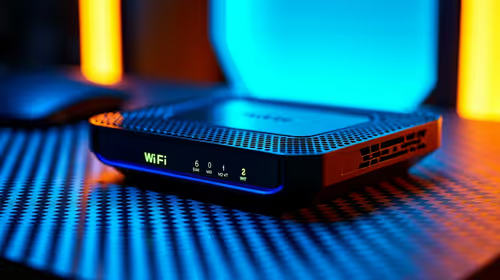
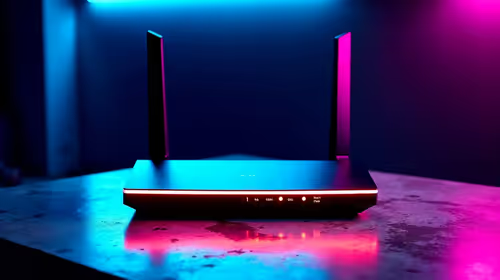
If your router is on Wi-Fi 6E, the temptation is to leapfrog Wi-Fi 7 entirely and hold out for Wi-Fi 8, skipping a generation to land on something newer. It sounds efficient. It is also a mistake of timing. Wi-Fi 8 hardware is not expected to ship in certified form until late 2027, which means skipping means running ageing 6E gear for years to reach a standard whose headline benefit is reliability, not the speed most people are chasing.
Quick Answer
Wi-Fi 6E added the 6GHz band on top of 2.4 and 5GHz. Wi-Fi 8 (802.11bn) uses that same three-band trio but layers on coordinated multi-access-point techniques and enhanced Multi-Link Operation for reliability that 6E cannot match. Since certified Wi-Fi 8 products are not due until December 2027, anyone on Wi-Fi 6E should upgrade to Wi-Fi 7 now rather than wait two-plus years to skip a generation.
What Wi-Fi 6E actually gave you
Wi-Fi 6E's single defining change was the 6GHz band. It took the Wi-Fi 6 feature set and opened a clean, wide swathe of new spectrum, free of the legacy traffic clogging 2.4 and 5GHz. For a congested flat or a device-heavy home, that fresh band was a real and immediate win, which is why 6E sold well to people who felt their network straining.
What 6E did not change was how access points behave toward one another, or how cleanly a device roams between bands and nodes. Each access point still largely fends for itself. That is the limitation both Wi-Fi 7 and Wi-Fi 8 set out to address, and it is the reason a 6E owner has a genuine upgrade case.
The current-generation hardware that closes that gap today is grouped in the networking range at Evetech, which is where the practical upgrade from 6E actually starts.
What Wi-Fi 8 adds over Wi-Fi 6E
Wi-Fi 8 keeps the same 2.4, 5 and 6GHz bands as 6E, so it is not opening new spectrum. Its gains are architectural. The standard introduces coordination between neighbouring access points, including coordinated beamforming and coordinated spatial reuse, so multiple access points share the airwaves cooperatively rather than each grabbing what it can. It also brings enhanced Multi-Link Operation, building on the multi-band approach Wi-Fi 7 started, to make roaming between bands and nodes seamless.
The design goal is ultra-high reliability: lower worst-case latency, fewer dropped packets and steadier throughput when signal conditions are poor or the air is crowded. Notably, Wi-Fi 8 does not raise the peak speed. Its theoretical maximum stays around the same 23Gbps as Wi-Fi 7, and it keeps 4K-QAM and 320MHz channels rather than introducing faster modulation. So a 6E owner skipping to Wi-Fi 8 would be buying consistency, not a bigger speed number.
Why skipping to Wi-Fi 8 backfires
The whole skip-a-generation logic falls apart on the calendar. The Wi-Fi Alliance is planning to launch Wi-Fi 8 certification in December 2027, with the standard published in early 2028. Certified, mature, well-priced Wi-Fi 8 routers will arrive some time after that, not the moment certification opens.
That leaves a 6E owner with two poor options if they insist on waiting. Run a 6E network that already lacks the coordination and roaming improvements, deep into 2027 and likely 2028, or buy first-wave Wi-Fi 8 gear at launch premiums with early-adopter quirks. Neither is sensible when Wi-Fi 7 is here today, mature, and already delivers most of what makes the newer standards worth having.
The SA context sharpens this further. Consumer electronics in South Africa typically arrive several months after launch in the US or Europe, and first-wave pricing on import hardware sits at a notable premium before the market settles. A Wi-Fi 8 router that costs R2,000 in the US in late 2027 will land locally later and at a higher price, then drop significantly within twelve months as supply increases. Buying Wi-Fi 7 today, at proven local pricing with established stock, avoids exactly that premium and puts a genuinely capable network in your home now rather than in two-plus years.
The Wi-Fi 7 middle path
Wi-Fi 7 is the answer to the skip question. It already brings Multi-Link Operation, 320MHz channels and 4K-QAM, giving a real, immediate jump over 6E in both speed and the multi-band behaviour that improves stability. It is shipping now in a wide range of routers and mesh systems, and prices have settled out of launch territory. Upgrading to Wi-Fi 7 today and treating Wi-Fi 8 as a refresh several years out is the upgrade path that actually serves you, rather than a two-year holding pattern.
When you do upgrade, the surrounding hardware matters too, and the accessories best sellers at Evetech cover the cabling and extras that keep a fast network from being held back by a weak link.
Frequently Asked Questions
Should I skip Wi-Fi 7 and wait for Wi-Fi 8?
No. Wi-Fi 8 is not expected in certified hardware until late 2027, so skipping means years on ageing Wi-Fi 6E. Upgrade to Wi-Fi 7 now and consider Wi-Fi 8 a later refresh.
Does Wi-Fi 8 use new spectrum compared to 6E?
No. Wi-Fi 8 keeps the same 2.4, 5 and 6GHz bands that 6E uses. Its improvements come from access-point coordination and better roaming, not new frequencies.
Is Wi-Fi 8 faster than Wi-Fi 6E?
At the physical layer Wi-Fi 7 and 8 are faster than 6E thanks to wider channels and 4K-QAM, but Wi-Fi 8's own focus is reliability, not raising the peak above Wi-Fi 7's roughly 23Gbps.
What is the single biggest reason to upgrade from 6E now?
Multi-Link Operation and the steadier multi-band behaviour of Wi-Fi 7. They improve real-world stability and roaming in ways the 6E generation simply does not offer.
Will Wi-Fi 8 features work on my old 6E devices?
No. The coordination and reliability features need Wi-Fi 8 radios on both ends. Older 6E phones and laptops will not gain them from a newer router alone.
Skipping a generation only sounds smart until you check the calendar. Browse the networking range at Evetech and move from Wi-Fi 6E to Wi-Fi 7 today, then let Wi-Fi 8 be a refresh when it genuinely arrives in 2028.