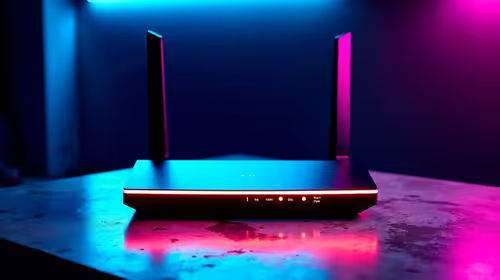
Every new Wi-Fi generation arrives with the same hopeful question: can a firmware update unlock it on the router already sitting in the cupboard? For most upgrades the honest answer involves caveats. For Wi-Fi 8 the answer is blunt. Its headline features lean on chipset capabilities that no software patch can conjure, so an existing router will not become a Wi-Fi 8 router. The good news is that you are in no rush, because the first certified hardware is still a fair way off.
Quick Answer
Yes, Wi-Fi 8 needs a new router. Its core features, coordinated multi-AP and an enhanced version of Multi-Link Operation, depend on new 802.11bn-certified silicon that firmware cannot add to current hardware. The earliest Wi-Fi 8 chipsets are expected from 2026, with consumer routers arriving late 2026 into 2027 and the standard itself likely finalised around 2028. Your current Wi-Fi 7 or Wi-Fi 6 gear stays fully usable in the meantime.
What Wi-Fi 8 is actually trying to fix
Wi-Fi 8, the marketing name for IEEE 802.11bn, breaks from tradition in a telling way. Where most generations chase a bigger headline speed number, 802.11bn is built around reliability. Its formal name is Ultra High Reliability, and the goal is steadier, lower-latency connections, especially in crowded environments where many devices compete for airtime.
The two features that define it are coordinated multi-AP and an enhanced form of MLO. Coordinated multi-AP lets several access points work together rather than fighting over the same spectrum, scheduling traffic so devices get a cleaner shot at the air. This is a big deal for homes and offices running mesh systems, where today the access points largely operate independently. The enhanced MLO builds on the multi-link operation introduced in Wi-Fi 7, aiming for seamless, ultra-reliable handoffs as you move around.
The thread tying these together is that they are coordination and scheduling features baked into the radio hardware. That is precisely why they cannot be retrofitted. To get a sense of the current networking landscape these standards build on, browsing the Evetech networking range gives a clear picture of what is shipping today.
Why firmware can't bridge the gap
It is reasonable to ask why software cannot just enable these features. The answer comes down to where the work happens. Coordinated multi-AP and the new MLO behaviours require the radio chipset itself to schedule and time transmissions across access points with precision. That scheduling logic, and the radio circuitry it controls, has to be physically present in the silicon.
A firmware update can change how existing hardware behaves within its limits. It cannot add a capability the chip was never built to perform. This is different from, say, a feature that is purely about software handling of data the radio already captures. Wi-Fi 8's signature features are hardware-level by design, so a router shipped before 802.11bn silicon existed simply has no path to them. When a manufacturer says a product is Wi-Fi 8 certified, it is telling you the right chipset is inside.
The difference from past upgrades
Some past Wi-Fi improvements did arrive partly through software, which is where the confusion comes from. But the marquee features of a full generational jump have always needed new radios. Wi-Fi 8 is firmly in that category. Treat any claim that an old router can be patched up to Wi-Fi 8 with deep suspicion.
The timeline: there's no need to rush
Here is the part that should take the pressure off. Wi-Fi 8 is genuinely early. Chipsets based on draft specifications are expected to start appearing from 2026, with the first consumer routers likely landing in the late 2026 to 2027 window. The 802.11bn amendment that underpins the standard is not expected to be ratified until around 2028.
What that means in practice is that buying a router today does not leave you stranded. Anyone shopping now is choosing between Wi-Fi 6, Wi-Fi 6E, and Wi-Fi 7, all of which are mature, widely supported, and will keep serving you for years. Wi-Fi 7 in particular is the current high end and a sensible ceiling for a future-minded purchase.
Backward compatibility and what to buy now
Wi-Fi standards are designed to be backward compatible, and Wi-Fi 8 will be no exception. A future Wi-Fi 8 router will still talk to your current phones, laptops, and smart devices, and your current router will keep working with future devices, just at the older standard's speeds. Nothing you own becomes obsolete the day Wi-Fi 8 arrives.
So the practical guidance is simple. If your network is creaking now, do not wait years for Wi-Fi 8. Buy the best current-generation router that fits your home and budget, lean toward Wi-Fi 7 if you want the most headroom, and revisit Wi-Fi 8 once certified hardware actually ships and the benefits are proven in real homes. For accessories like Ethernet cabling and adapters that get the most out of any router, the Evetech accessories best sellers have the Ethernet cabling and supporting kit worth pairing with any new router.
Frequently Asked Questions
Can I update my current router to Wi-Fi 8?
No. Wi-Fi 8's main features, coordinated multi-AP and enhanced MLO, require new 802.11bn-certified chipsets, and firmware cannot add hardware capabilities that the radio was never built to perform. A genuine Wi-Fi 8 connection needs a router with the right silicon inside.
When will Wi-Fi 8 routers be available?
The first Wi-Fi 8 chipsets are expected from 2026, with consumer routers likely arriving late 2026 into 2027. The full 802.11bn standard is not expected to be ratified until around 2028, so widely available, mature products will take time.
Is Wi-Fi 8 mainly about faster speeds?
Not primarily. Wi-Fi 8 is built around reliability rather than raw speed, hence its name Ultra High Reliability. It focuses on steadier, lower-latency connections in crowded environments through better coordination between access points, rather than chasing a bigger top-line speed figure.
Will my current devices work with a Wi-Fi 8 router?
Every Wi-Fi generation maintains backward compatibility, and Wi-Fi 8 is no different. A future Wi-Fi 8 router will connect to your existing phones, laptops, and smart devices, while your current router keeps serving newer Wi-Fi 8 devices at today's speeds.
Should I wait for Wi-Fi 8 before buying a router?
If your network is struggling now, no. Wi-Fi 8 hardware is still a couple of years from being mature and proven. A current Wi-Fi 7 or Wi-Fi 6E router is a strong, well-supported choice that will serve you well for years, and you can reassess Wi-Fi 8 when it actually arrives.
Wi-Fi 8 is coming, but it is not here yet, and a struggling network does not need to wait. Browse the networking range at Evetech to find a current-generation router that fixes your coverage today.