Quick Answer
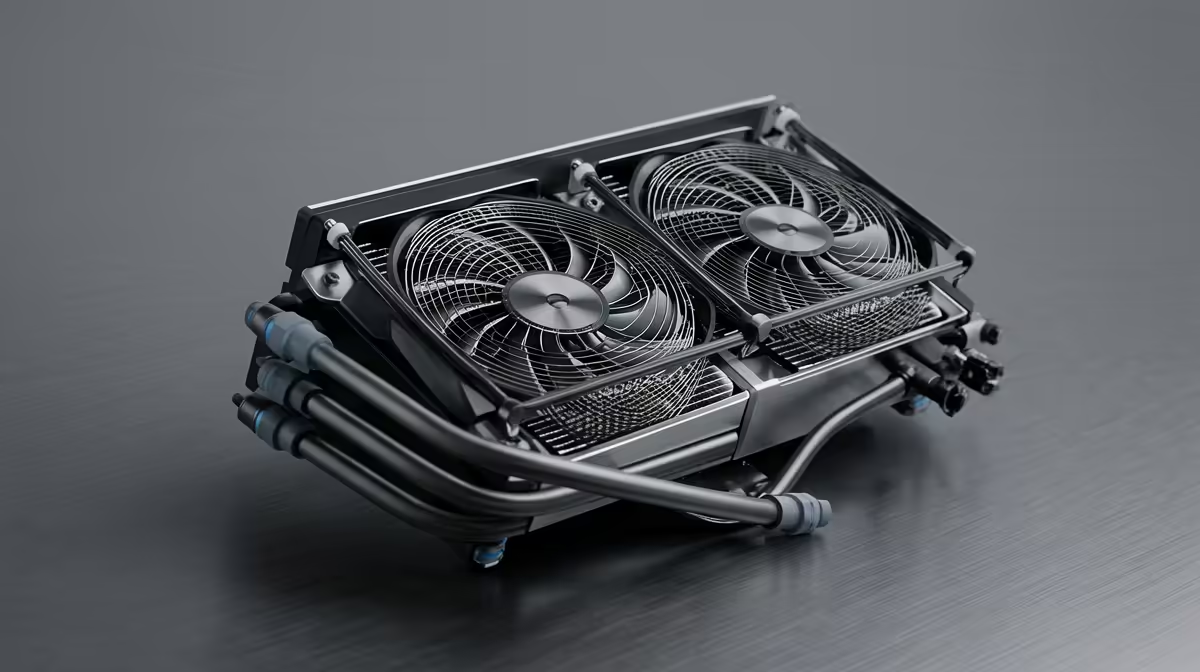
A 360mm AIO makes financial sense in SA when your CPU costs R5,000 or more, sustains over 150W during real workloads, or when your use case involves sustained rendering or streaming where thermal throttling directly costs you time. For a mid-range gaming-only build under R15,000 total, a quality 240mm AIO or premium air cooler is more efficient rand-for-rand.
Matching Cooler Spend to CPU Value 💰
A useful rule of thumb for SA PC builders: the cooler budget should sit at roughly 5 to 10% of total CPU cost. If your processor is a Ryzen 5 9600X at around R4,000, a cooler in the R400 to R600 bracket from a reputable brand handles stock gaming loads without issue. If you're running a Ryzen 9 9950X or Core i9-14900KS, both of which cost R8,000 to R12,000 in SA retail, a 360mm AIO at R2,500 to R3,500 represents less than 35% of the CPU's value and is a reasonable investment to protect and extract full performance from the processor.
Use-Case Scenarios Where a 360mm Adds Real Value 🖥️
For a content creator in Durban running DaVinci Resolve colour grading alongside Premiere Pro proxy transcoding, the CPU sustains near-maximum TDP for hours, and a 360mm AIO prevents the clock speed throttling that adds minutes to every export job. On a 20-export working day, that accumulated time loss is tangible. Similarly, a student at UCT or Wits running architecture or engineering CAD simulations overnight benefits from a 360mm AIO because thermal throttling on an unsupervised overnight render can corrupt output files or extend render time past the submission deadline.
Where a 360mm Does Not Add Proportional Value 🔧
For a dedicated gaming-only build paired with a Ryzen 7 9800X3D, which is architecturally power-efficient and rarely sustains peak TDP during gaming, a quality 240mm AIO at R1,600 to R2,200 handles the thermal requirement at lower cost. The temperature difference between a 240mm and 360mm on this specific CPU during gaming peaks at 5 to 7 degrees Celsius under extended sessions, which does not cause throttling and does not affect frame rates in any measurable way. Redirecting R800 to R1,200 of potential cooler budget upgrade into a faster NVMe drive or a higher-capacity memory kit produces a more noticeable improvement in daily use on a gaming-primary build.
Factor in Warranty Length When Calculating Value ⚡
A 360mm AIO with a five-year warranty at R2,800 and a comparable three-year unit at R2,400 carry different total cost calculations over a five-year build lifecycle. If the shorter-warranty unit requires replacement in year four, the total outlay exceeds the five-year model by R800 or more. Calculate warranty lifespan cost, not just purchase price.
FAQ
Is the price gap between 240mm and 360mm AIOs significant in SA?
For equivalent-tier products from the same brand, the gap is typically R600 to R1,200 in SA retail. This is meaningful on a mid-range build budget but represents a smaller percentage of a high-end build. The decision should be driven by CPU TDP requirements rather than the absolute rand difference.
Does building a smaller, more efficient PC avoid the need for a 360mm altogether?
For most gaming-focused builds, yes. Pairing an efficient gaming CPU like the Ryzen 7 9800X3D with a mid-range 240mm AIO and a case with good airflow produces a quiet, thermally stable build without the size, weight, and cost of a 360mm unit. Efficiency-first CPU selection reduces cooler requirements significantly.
How long should a R2,500 to R3,000 360mm AIO last in a South African build?
A quality 360mm AIO in this price bracket, operated in a well-maintained case with regular dust cleaning, should last five to seven years before the pump approaches end-of-life. The fans typically last as long as the pump if bearing quality is good. Annual dust cleaning of the radiator fins is the primary maintenance task required to achieve this lifespan.
Working out whether a 360mm AIO fits your build budget?
Browse the 360mm AIO range at Evetech to compare options across the entry, mid and premium tiers.