

Storage Specs Explained for Beginners
Storage Specs Explained for Beginners. Plain-English explanation of what it means, why it matters & how it affects your buying decisions in SA.
Read moreA head-to-head look at Wi-Fi 7: real-world performance, ZAR pricing and which option delivers better value for SA builders. The clear answer — no fluff.
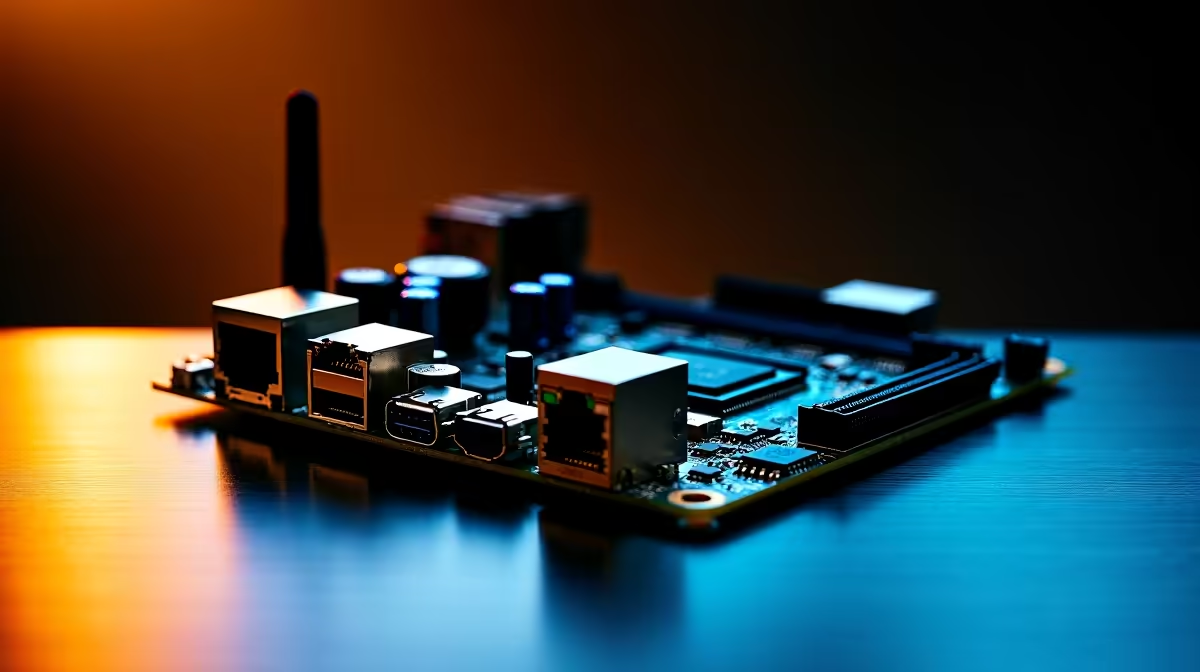
Load-shedding might be taking a break, but your latency should never spike when the neighbourhood logs on. Upgrading your rig locally always comes down to balancing your hard-earned ZAR vs features. Wondering when a Wi-Fi 7 and 2.5 Gb Ethernet motherboard makes sense in South Africa? You are not alone. Let us unpack whether this next-gen connectivity is actually worth your money. 🚀
South African fibre networks are getting seriously fast. ISPs are rolling out gigabit lines across major suburbs. A standard gigabit port on an older board might bottleneck your local network transfers. This is exactly when a Wi-Fi 7 and 2.5 Gb Ethernet motherboard makes sense in South Africa.
Wi-Fi 7 brings massive channel widths and lower latency. It is perfect for gamers who cannot run a cable to their router. Meanwhile, 2.5 GbE guarantees blazing-fast wired speeds for streamers and content creators. If you frequently move massive video files to a local NAS, that extra bandwidth saves hours.
When you start looking at premium motherboard upgrades, check the networking specs closely. Spending a little extra ZAR now prevents a costly upgrade later.
South African gamers face unique challenges. We often connect to European servers for competitive matches. Every single millisecond of ping matters when you are playing online. While a motherboard cannot fix international routing... it can absolutely eliminate local network delays.
If your household has multiple people streaming 4K content, older Wi-Fi standards struggle with congestion. Wi-Fi 7 uses Multi-Link Operation to connect over multiple bands simultaneously. This keeps your connection stable even when the family is binge-watching series.
Connectivity is only half the battle. You also need to choose your CPU camp. Both major brands support these ultra-fast network standards on their latest chipsets.
If you prefer Team Blue, you will find fantastic options among ASUS Intel motherboards. These boards often pair Wi-Fi 7 with robust power delivery for intense gaming sessions.
On the flip side, Team Red fans are fully covered too. The latest ASUS AMD motherboards offer incredible longevity. AMD has a history of supporting sockets for years... making your ZAR stretch even further. 🔧
To actually experience Wi-Fi 7 speeds, you need a compatible Wi-Fi 7 router. If you are still using the default ISP router, stick to the 2.5 Gb Ethernet port for your heavy downloads and competitive gaming.
A premium motherboard needs matching components to truly shine. High-speed networking pairs beautifully with fast storage and RAM. You will want to invest in high-speed memory kits to ensure your CPU processes data as fast as it downloads.
Your motherboard acts as the central nervous system of your entire gaming rig. When you prioritise bandwidth, every other component performs better. Downloads finish faster, streams look crisper, and your overall system responsiveness improves dramatically.
Sometimes, building from scratch is daunting. If you want guaranteed compatibility without the hassle of cable management, we have you covered. You can explore our range of pre-built gaming PCs that already feature these cutting-edge motherboards.
Balancing your ZAR vs features does not have to be a guessing game. If you plan to keep your PC for five years or more... investing in Wi-Fi 7 and 2.5 GbE is a smart move. It ensures your rig stays relevant as local internet speeds continue to climb. ✨
Ready to Upgrade Your Connectivity? Do not let outdated network ports bottleneck your gaming experience. Whether you are building from scratch or upgrading an existing rig, we have the perfect foundation for your build. Explore our massive range of tech specials and step into the future of high-speed gaming today.
Wi-Fi 7 is available at Evetech.co.za with local SA warranty, Rand pricing and nationwide delivery. Stock and pricing is updated in real time on the product page.
It depends on your workload and budget. We break down the key performance differences, SA pricing gap and the scenarios where each one is the smarter buy.
Real-world gaming performance varies by title and settings. The article covers head-to-head FPS benchmarks and the resolutions where the gap actually shows up.
We compare current Rand pricing from trusted SA retailers and show which option delivers more performance per Rand for your build tier.
Each option has clear wins and compromises covered in the article — from power draw and thermals to platform cost, upgrade path and feature set.
Storage Specs Explained for Beginners. Plain-English explanation of what it means, why it matters & how it affects your buying decisions in SA.
Read more
Will RDNA 5 Use the Same Silicon as the Next. Plain-English explanation of what it means, why it matters & how it affects your buying decisions in SA.
Read more
Google Workspace on Mac: Drive, Docs, Sheets and. Everything you need to know with SA pricing, step-by-step instructions & expert recommendations.
Read more
Back-to-School Parent Guide: Storages. Everything you need to know with SA pricing, step-by-step instructions & expert recommendations.
Read more
to Esports Tournaments. Everything you need to know with SA pricing, step-by-step instructions & expert recommendations.
Read more
Easter Storage Buying Guide. Hand-picked gift ideas at every budget tier. SA pricing & Evetech availability included.
Read more
AMD RX 9050 XT: Rumoured Specs, Price & Release. SA-focused analysis with local pricing data, real-world insights & actionable buying advice.
Can RTX 4080 Super Run AI Workloads for SA Developers Detailed answer with SA data, expert analysis & practical recommendations for local buyers.
Can RTX 4090 Run AI Workloads for SA Developers Detailed answer with SA data, expert analysis & practical recommendations for local buyers.
Top Settings for Intel Arc B580 at Ultrawide 1440p picks evaluated on performance, value & SA availability with current Rand pricing from Evetech.

RTX 4060 CS2 Low Settings at 1080p: FPS Results. Real-world benchmark data, FPS numbers & performance analysis. What SA gamers can actually expect.

Visual Artifacts: Possible GPU Issue Issue #1. Diagnosis steps, proven fixes & when to seek professional help. SA-specific support info included.
Can the RTX 4090 Handle 1440p 144Hz Gaming. Performance testing verdict with real data & practical recommendations for SA buyers.

Top ASUS GPU Under R15000 picks evaluated on performance, value & SA availability with current Rand pricing from Evetech.
GTA 6 Max Settings on RTX 5070. Tested & verified settings for best FPS and visual quality on SA hardware budgets.
Cyberpunk 2077 Max Settings on RTX 5080. Tested & verified settings for best FPS and visual quality on SA hardware budgets.
Starfield Max Settings on RTX 5070 Ti. Tested & verified settings for best FPS and visual quality on SA hardware budgets.
Top RTX 5090 Under R5000 picks evaluated on performance, value & SA availability with current Rand pricing from Evetech.