Quick Answer
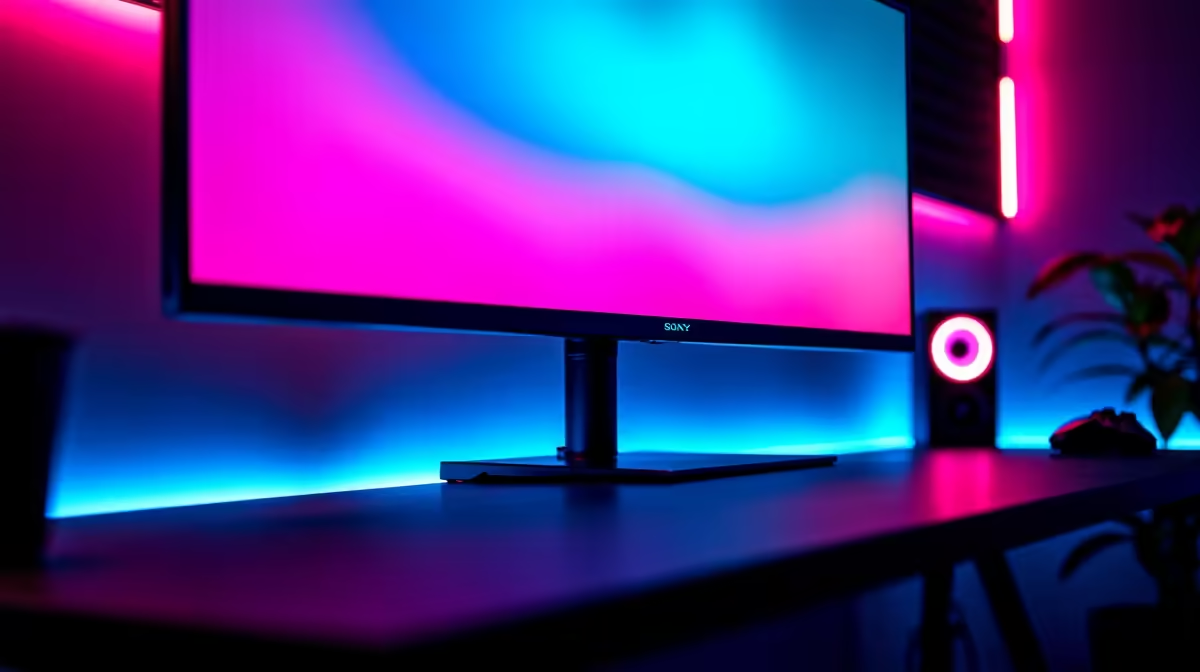
The best monitor upgrade path for SA gamers in 2026 depends on your current setup, but the clearest progression is from 1080p 60Hz to 1080p 144Hz, then to 1440p 144Hz or 165Hz, with 1440p 240Hz or 4K as the top tier. Budget your GPU upgrade alongside your monitor, since a new panel without matching GPU performance delivers diminishing returns.
Understanding Where You Are on the Monitor Upgrade Ladder
Before spending, it is worth mapping exactly where your current monitor sits and what the realistic next step looks like. The upgrade ladder for SA gamers in 2026 looks like this:
Tier 1: 1080p at 60Hz. This is the entry point. Games are playable but motion feels choppy in fast titles. Input lag is perceptible in competitive gaming. Tier 2: 1080p at 144Hz or 165Hz. A significant jump in fluidity. Fast-paced games like Valorant, CS2, and Apex Legends feel dramatically more responsive. This is where competitive gaming starts becoming enjoyable. Tier 3: 1440p at 144Hz or 165Hz. The sweet spot for 2026. Enough pixels to make environments look detailed and immersive, with a refresh rate that still keeps up with competitive play. Demanding on GPU. Tier 4: 1440p at 240Hz. For dedicated competitive players who want both image sharpness and extreme fluidity. Tier 5: 4K at 144Hz or higher. Content creators, sim racers, and gamers who prioritise visual fidelity above frame rate. GPU requirements are significant. In South Africa, monitor pricing in 2026 puts a solid 1440p 144Hz panel in the R4,500 to R7,000 range, making it accessible alongside a GPU upgrade without breaking a mid-range build budget. ## The GPU Question: Matching Your Monitor to Your Card
Upgrading your monitor without upgrading your GPU is a common mistake. A 240Hz 1440p monitor connected to an RTX 3060 will spend most of its time below 100 FPS in demanding titles, wasting the panel's capability. Here is a practical GPU-to-monitor matching guide for SA gamers:
RTX 4060 / RX 7600: Best paired with a 1080p 144Hz or 165Hz monitor. These cards can push 1440p at medium settings in many titles but are not optimised for high-refresh 1440p in demanding games. RTX 4070 / RX 7700 XT: The natural pair for 1440p 144Hz to 165Hz. This combination handles AAA titles at high settings with frame rates well above 100 FPS in most scenarios. RTX 4070 Ti Super / RX 7900 XT: Ideal for 1440p 240Hz or pushing into 4K at 60 to 90 FPS in demanding titles. RTX 4080 Super / RX 7900 XTX: The 4K 144Hz tier. These cards drive ultra-high-resolution panels in most titles without significant compromises. If your GPU does not match your monitor's capability, upgrade both simultaneously or hold off on the monitor upgrade until you can. ## Panel Technology: IPS vs VA vs OLED in 2026
Panel type is as important as resolution and refresh rate. In 2026, three panel technologies dominate the gaming monitor market:
IPS (In-Plane Switching): The best all-rounder. Excellent colour accuracy, wide viewing angles, and fast response times. Slight backlight bleed is possible but well-controlled on quality panels. Best for gamers who also do creative work or content creation. Most 1440p 144Hz panels in the SA market use IPS. VA (Vertical Alignment): High contrast ratios that make dark scenes look dramatically better than IPS. Slower pixel response in some transitions creates ghosting in very fast games. Best for sim racing, RPGs, and games with cinematic presentation where contrast matters more than pure speed. OLED: Perfect blacks, infinite contrast, and near-zero response times. OLED gaming monitors are increasingly available in SA in 2026, though pricing remains premium. QD-OLED panels offer OLED's contrast advantages with better brightness and colour volume. Watch burn-in risk for gamers who display the same HUD elements for many hours. For competitive gaming in SA, a fast IPS or OLED panel at 1440p 144Hz or higher is the recommended upgrade for 2026. ## Adaptive Sync and HDR: What Actually Matters
Two features often appear on spec sheets but vary wildly in quality: Adaptive Sync and HDR. Adaptive Sync: G-Sync Compatible or FreeSync Premium Pro certification ensures the monitor works properly with NVIDIA or AMD GPUs to eliminate screen tearing without introducing input lag. Confirmed certification matters more than the brand name on the box. If your GPU is NVIDIA, look for G-Sync Compatible certification. AMD GPU owners should look for FreeSync Premium or Premium Pro. HDR: True HDR gaming requires a monitor with peak brightness above 600 nits and local dimming zones. Many budget monitors carry an HDR badge but deliver peak brightness below 400 nits with no local dimming, which produces flat, washed-out HDR that looks worse than SDR. In SA at 2026 pricing, genuine HDR performance starts around R8,000 and up. Below that, HDR certification is largely marketing. For most SA gamers, a high-refresh 1440p IPS panel with FreeSync Premium Pro or G-Sync Compatible certification delivers a better experience than a budget HDR panel with poor implementation. ## Frequently Asked Questions
Is it worth upgrading from 1080p 144Hz to 1440p 144Hz in South Africa? Yes, if your GPU supports it. Other local retailers may also carry similar options. Other local retailers may also carry similar options. What is the best monitor size for 1440p gaming in a typical SA student res room or small apartment? 27 inches is the ideal size for 1440p. It hits the pixel density sweet spot where individual pixels are not visible at a normal desktop viewing distance of 60 to 70cm. Going larger with 1440p at 32 inches starts to show lower pixel density. Do I need a 240Hz monitor for competitive Valorant or CS2? For casual and semi-competitive play, 144Hz is sufficient and most players cannot reliably distinguish 144Hz from 240Hz in controlled tests. Dedicated ranked grinders and players performing at high competitive levels benefit from 240Hz, particularly if their frame rates are consistently above 200 FPS. How does loadshedding affect gaming monitor choice in SA? A UPS running a gaming monitor during loadshedding draws significant power. Modern IPS monitors at 27 inches typically consume 25 to 40 watts, which is manageable on most UPS units. OLED panels often draw less power at moderate brightness, making them slightly more UPS-friendly despite their premium positioning.
Ready to Find Your Perfect Match? Browse gaming monitors at Evetech and find the right panel for your 2026 upgrade.