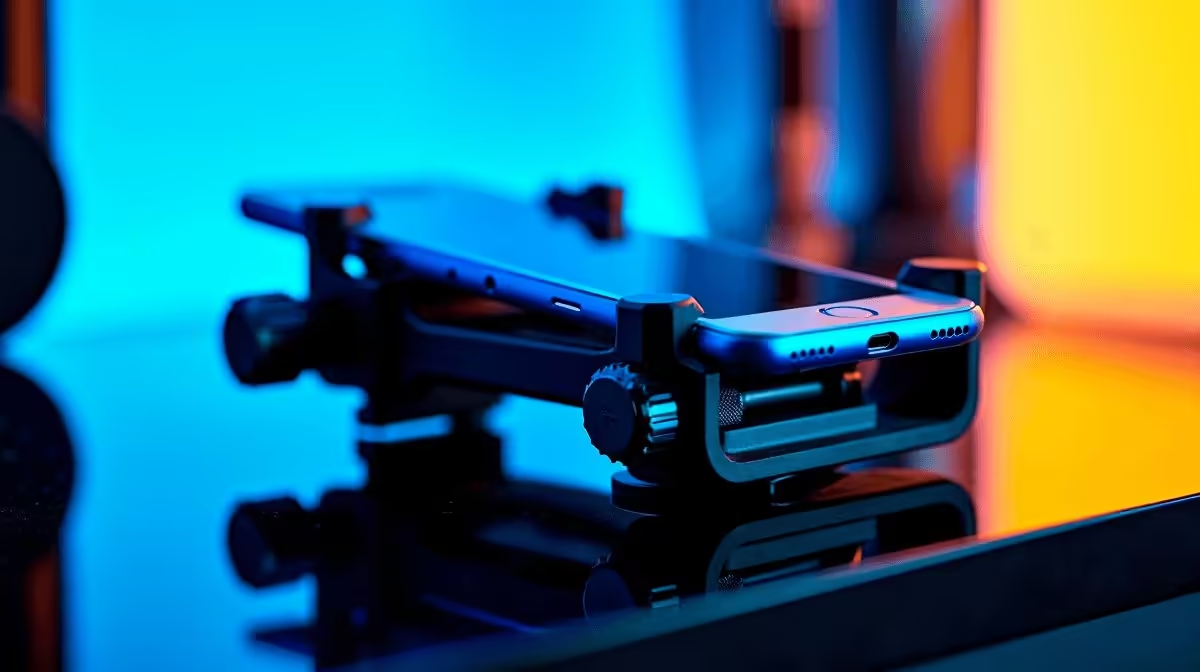
Price and quality do not scale linearly for smartphone holders, and the gap between a R100 holder and a R350 one is often the difference between a mount that rattles loose by month two and one that still holds firm after a year of daily use. Knowing what each ZAR tier actually buys lets you target the right shelf rather than guessing from packaging alone.
Quick Answer
Entry-tier phone holders run R100 to R250 and cover basic vent clip or suction designs for light use. Mid-tier sits at R250 to R450 and adds metal joints, wider grip ranges, and better build quality. Premium holders from R450 to R650 include heavy-duty mechanisms, wireless charging compatibility, and materials that hold up in SA's heat. Anything above R650 is typically a branded mount with an integrated wireless charger or a specialised design for commercial use.
💰 Entry Tier: R100 to R250
At this price level you are buying a functional hold, not a precision product. Vent clip designs dominate the entry tier. They fit most standard-size phones in a slim or no case, and they work adequately on smooth urban roads. The compromises show up in the plastic ball joint, which tends to allow angle drift after a few months of SA summer temperatures, and in spring mechanisms that weaken after several hundred dock-undock cycles.
Entry mounts are a reasonable choice for occasional drivers, second-car use, or as a trial to confirm which mount position works for you before committing to a better unit. Buy two or three at this tier and you are spending roughly what a single mid-tier mount costs, but you may go through them faster.
🔧 Mid Tier: R250 to R450
The mid tier is where build quality becomes meaningfully better without a steep price jump. Metal ball joints replace plastic pivots, holding viewing angles securely for longer. Grip ranges expand to 90 mm or more, which matters if you use a thick protective case. Gravity-lock cradle mechanisms appear in this tier, offering faster one-hand docking than spring clips.
Most mid-tier mounts also include better rubberised contact points that protect your phone's frame from scuffs over months of daily use. The vent clip base tends to use a wider fin bracket that distributes grip across more of the vent, reducing fatigue on the fin itself. For daily commuters in Cape Town or Joburg who dock and undock at least once per trip, this tier is the practical sweet spot.
🏆 Premium Tier: R450 and Above
Premium holders justify their cost through materials and additional functionality. Cast aluminium arms, dual-lock suction cups with an extra locking lever, and hardened steel pivot points all appear at this level. Some mounts in this tier incorporate Qi wireless charging, eliminating the cable entirely while keeping the phone topped up on long drives.
For delivery drivers or road-trippers putting 50,000+ km a year on their vehicle, a premium mount pays back its cost in longevity alone. These mounts also tend to carry formal product certifications and include a warranty, which entry-tier products rarely offer. If you are mounting an expensive flagship phone, the extra R200 to R300 for a premium holder is a sensible safeguard.
Frequently Asked Questions
Is a more expensive phone holder always more stable?
Not always, but premium and mid-tier mounts use metal joints and stronger locking mechanisms that resist loosening under heat and vibration far better than entry-tier plastic. Price generally does predict stability more reliably than brand name for phone holders.
Do cheaper mounts damage phone cases or screens?
Entry-tier cradles with bare hard plastic arms can leave marks on phone frames over time. Rubberised inserts on the contact points prevent this. If your holder lacks padding on the side arms, a strip of adhesive felt resolves the problem inexpensively.
At what price does wireless charging become available in phone holders?
Wireless charging integration typically appears from around R400 to R500 for standard Qi output and R550 and above for faster 15W wireless charging. These mounts require USB power input and a wireless charging-compatible phone.
Is it worth paying premium tier for a second car I rarely use?
An entry or lower mid-tier mount suits an occasional-use vehicle well. The degradation from heat cycles and UV exposure still occurs, but lower docking frequency means the mechanism lasts longer. Budget R150 to R250 for that second car and allocate more for the daily driver.
Do mid-tier mounts handle heavier phones like large-format flagships?
Most mid-tier mounts specify a maximum weight of around 180 to 200 grams. Current large-format flagships fall within that range. Confirm the weight rating on the product listing, particularly if your phone has a heavy battery or is paired with a thick case.
Spend what your daily use actually demands. Compare the full range of phone holders at Evetech across entry, mid, and premium tiers and choose based on build quality, not just price.