ViewSonic's XG2738 QD-OLED monitor joins a South African shelf where 27-inch OLED gaming displays already start at R9,999. Its 240Hz refresh rate, 0.03ms response claim and automatic panel-care tools are competitive on paper. The buying question is whether the complete monitor, warranty and room fit justify its eventual rand price.
Quick Answer
The XG2738 is a 27-inch 2560x1440 QD-OLED gaming monitor rated for 240Hz and 0.03ms GTG. No exact local price is confirmed, while the checked in-stock OLED comparison range ran from R9,999 to R22,999.
🖥️ What the XG2738 brings
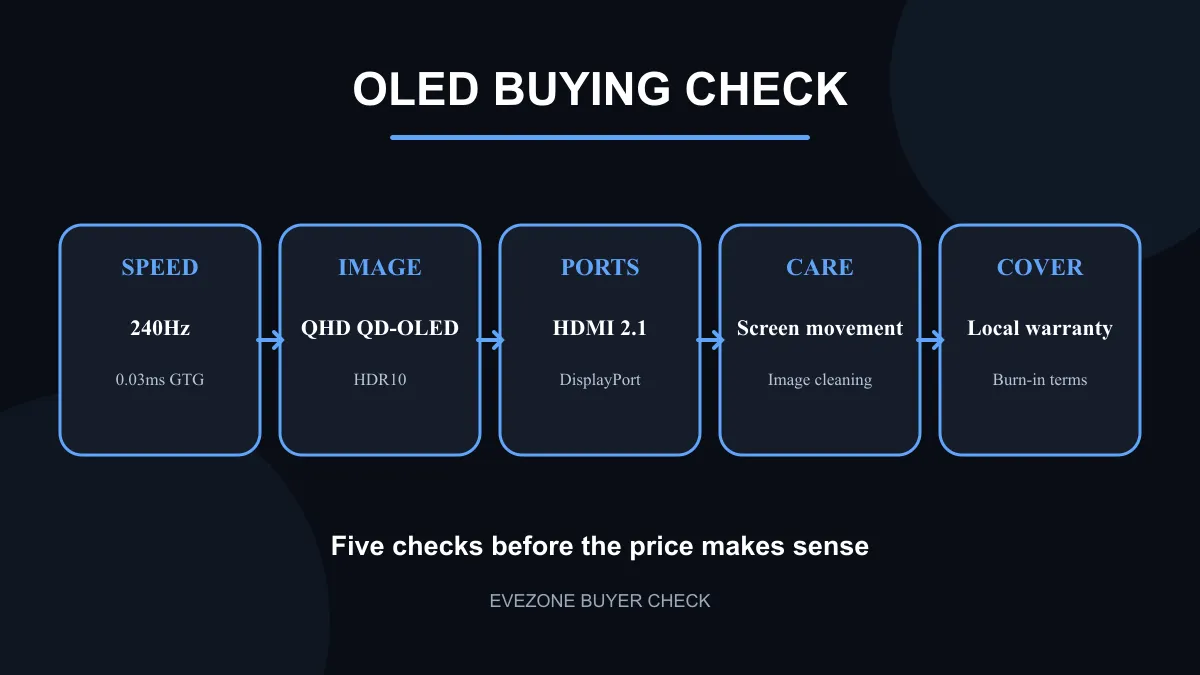
The core specification is familiar but strong: QHD resolution, a flat 27-inch QD-OLED panel and 240Hz over HDMI 2.1 or DisplayPort 1.4. ViewSonic lists adaptive-sync support for both major GPU ecosystems, HDR10, true 10-bit colour and 98 percent DCI-P3 coverage.
An esports mode can reduce the active view to 24.5 inches. That is useful for players who want a smaller competitive field without moving the display, but it does not create extra pixels or a faster panel. It is a layout choice inside the existing screen.
The gaming monitor category gives the wider context. IPS and VA displays can deliver high refresh rates for far less, while OLED earns its premium through pixel-level contrast, response behaviour and image quality.
💰 The R9,999 OLED floor changes the comparison
The live check found a 27-inch QHD 240Hz WOLED at R9,999 and another 27-inch 240Hz WOLED at R10,999. A further QHD OLED option appeared at R13,999. The sample then moved to a 27-inch 4K QD-OLED at R15,499 and a 34-inch ultrawide OLED at R22,999.
That range means the XG2738 cannot win through panel type and refresh rate alone. If it lands near the entry end, its panel-care suite and flexible esports view could be meaningful. If it arrives much higher, buyers should compare resolution, USB features, stand quality, warranty and the exact panel-generation differences.
Browse the dedicated OLED monitor selection to compare like with like. Do not compare a QHD 240Hz model directly with a cheaper LCD without first deciding whether OLED contrast and motion handling matter to the games and work on the screen.
🛡️ Panel care is part of ownership
ViewSonic lists screen movement, average-picture-level control, static-icon detection and a user-triggered image-cleaning cycle. Those features help manage image retention risk. They do not make an OLED panel immune to uneven wear.
A desktop user should let the screen sleep, avoid leaving high-brightness static windows open for unnecessary hours and allow scheduled cleaning cycles to finish. Hiding taskbar elements can help, but the best routine is simply to stop treating the display as a permanent notice board.
Warranty wording matters because panel coverage can differ by market. Confirm the South African term, whether burn-in has specific conditions and how a claim is handled before treating an overseas policy as local protection.
🎯 Who should buy and who should wait
Buy an OLED now if deep contrast, fast pixel response and HDR scenes materially improve the games or media you use, and the R9,999-plus budget is comfortable. A 240Hz target also needs a GPU and CPU combination that can reach suitable frame rates in the titles where speed matters.
Wait for the XG2738 listing if its 24.5-inch view, ViewSonic panel-care tools or brand preference are important. The ViewSonic monitor page is the right place to watch for a confirmed local model and price. Do not convert a foreign launch price into rand and treat it as a retail promise.
Frequently Asked Questions
What resolution does XG2738 use?
It uses 2560x1440 QHD resolution on a 27-inch QD-OLED panel.
What is the maximum refresh rate?
ViewSonic specifies up to 240Hz over its supported HDMI 2.1 and DisplayPort connections.
Does it support variable refresh rate?
Yes. The product specification lists FreeSync Premium and G-SYNC compatibility.
What is the 24.5-inch esports mode?
It reduces the active viewing area to a size familiar to competitive players while using the same physical panel.
Is there a South African launch price?
No exact local listing or rand price was confirmed in the captured catalogue read.
What did current OLED gaming monitors cost?
The checked in-stock sample ranged from R9,999 to R22,999 across QHD, 4K and ultrawide models.
Ready to compare OLED on the facts that last? Check current gaming monitors by resolution, refresh rate, ports, warranty and panel-care features, then decide whether OLED earns its place in your setup.