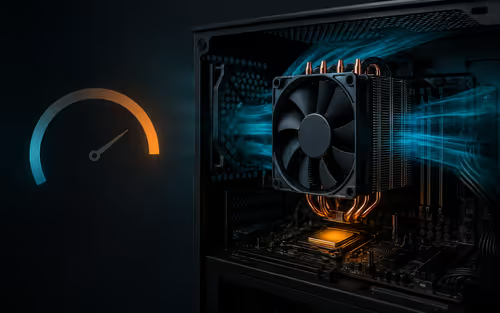
Staring at a 'compiling...' progress bar in your IDE, watching your laptop's fans spin up like a jet engine? We get it. For a developer in South Africa, your laptop isn't just a tool; it's your entire workshop. Choosing the right machine is critical, and it all starts with the CPU. This guide will help you find the best laptops for programming by demystifying the processor, ensuring your next build is fast, fluid, and frustration-free.
Why Your CPU is Critical for Coding
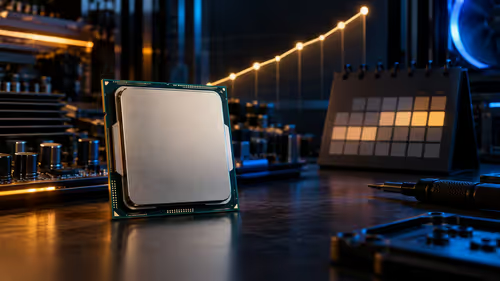
While RAM and a speedy SSD are important, the Central Processing Unit (CPU) is the brain of your operation. It dictates how quickly you can compile complex code, run virtual machines, and multitask between your editor, browser, and local server. A slow CPU means a slow workflow... and nobody has time for that.
For developers, three key CPU specs matter most:
- Cores & Threads: More cores mean more tasks can be handled simultaneously. This is a massive win for modern development, from running multiple Docker containers to compiling large C++ or Rust projects.
- Clock Speed (GHz): This measures how many cycles a CPU can execute per second. Higher clock speeds lead to snappier performance in single-threaded tasks, like navigating your IDE or running simple scripts.
- Cache Size: This is super-fast memory right on the CPU chip. A larger cache allows the processor to access frequently used data instantly, significantly speeding up repetitive tasks common in programming.
Intel vs. AMD: The Programmer's Showdown
The age-old "blue vs. red" debate is more relevant than ever for developers. Both brands offer fantastic options, but they excel in slightly different areas, making the choice for the best laptops for programming a nuanced one.
Intel: The Single-Core Champion ⚡
Intel Core processors, especially their high-performance H-series, have historically offered incredible single-core speeds. This makes them exceptionally responsive for general-purpose development, web development, and tasks that don't always take advantage of dozens of cores. Their architecture, often featuring a mix of Performance-cores and Efficient-cores, provides a great balance of power and battery life. For a reliable workhorse, explore our range of powerful Intel laptops.
AMD: The Multi-Core Powerhouse 🚀
AMD Ryzen processors have become a favourite for developers with demanding workloads. They often pack more cores and threads at competitive price points, making them ideal for heavy multitasking, video encoding, 3D rendering, and data science. If your day involves compiling massive codebases or running multiple virtual machines, the exceptional multi-core performance in AMD's lineup of laptops can save you a significant amount of time.
CPU Pro Tip: H vs. U Series 🔧
When browsing laptops, look for CPUs ending in 'H' (e.g., Core i7-13700H) for high performance. CPUs ending in 'U' (e.g., Ryzen 7 7730U) are designed for ultra-low power consumption and better battery life but offer less sustained power for heavy tasks like compiling. For serious programming, an H-series CPU is almost always the better choice.
Matching the CPU to Your Coding Stack
Not all programming is created equal. The ideal CPU for a front-end web developer is different from what a game developer using Unreal Engine 5 needs.
Web & App Development
For stacks like JavaScript (React, Node.js), Python (Django), or PHP, you don't need a top-of-the-line CPU. A modern Intel Core i5 or AMD Ryzen 5 with at least 4-6 cores will provide a smooth and responsive experience. Your focus here should be a good balance of performance and portability.
Game Dev, Data Science & Machine Learning
This is where CPU power becomes non-negotiable. Compiling C++ in Unreal Engine, training machine learning models in Python, or processing large datasets requires immense multi-threaded performance. Here, you should be looking at an Intel Core i7/i9 or an AMD Ryzen 7/9. Often, the best laptops for these programming tasks are marketed as high-performance gaming laptops because they pair these powerful CPUs with robust cooling systems.
More Than Just a Processor
While the CPU is the star, don't forget the supporting cast. A fast NVMe SSD will slash your project loading and build times, and 16GB of RAM should be your absolute minimum—32GB is the sweet spot for professional developers. A comfortable, backlit keyboard and a high-resolution screen also make a world of difference during those long coding sessions. Finding a machine that balances all these elements is key to building the perfect developer setup. Before you decide, be sure to check out our wide range of laptop specials to see all the available configurations.
Ready to Find Your Perfect Match? The Mac vs Windows debate is complex, but for maximum power, choice, and value in South Africa, Windows is hard to beat. Explore our massive range of laptop specials and find the perfect machine to conquer your world.