Quick Answer
In 2026, the Lenovo Legion Go 2 leads for raw performance and screen quality among Windows handheld PCs, the ASUS ROG Ally 2 offers the best gaming ecosystem integration, while the Steam Deck OLED remains the best value if your library is primarily Steam. For South African buyers, the Steam Deck OLED is the most accessible price-to-performance option given its lower import cost.
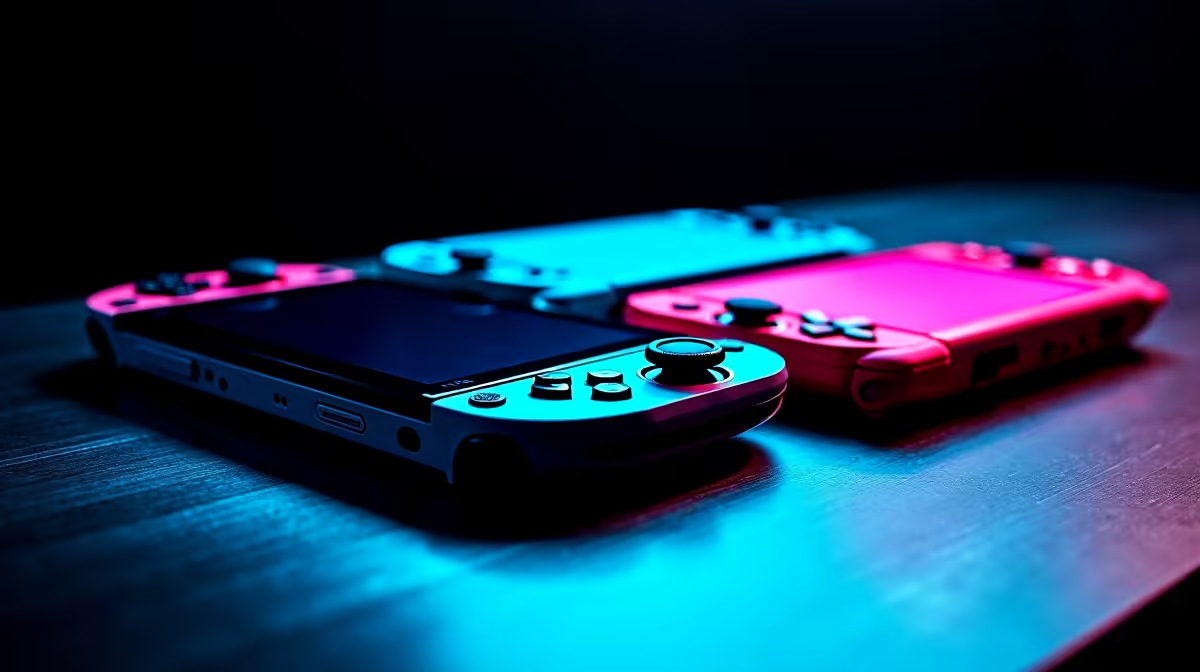
The gaming handheld market has exploded, and 2026 sees three serious contenders vying for your gaming bag. The Lenovo Legion Go 2, ASUS ROG Ally 2, and Steam Deck OLED each target slightly different buyers, and choosing the right one depends heavily on your game library, how you plan to use it, and what you are willing to spend in South Africa where all three are import purchases. Here is the breakdown.
Performance and Hardware
The Legion Go 2 and ROG Ally 2 both run AMD's latest Ryzen Z2 series APU (or equivalent), which represents a significant generational leap over the original chips in their predecessors. These Windows-based handhelds can handle 1080p gaming at medium to high settings in most titles and 60 fps in older or well-optimised games. The Legion Go 2 uses an 8.8-inch display at 2560x1600 resolution with a 144Hz refresh rate - the largest and highest resolution screen of the three, which is excellent for strategy games and anything with fine UI detail. The ROG Ally 2 comes in at a more compact 7-inch 1080p 120Hz panel, prioritising portability over screen real estate. The Steam Deck OLED uses a 1280x800 OLED panel at 90Hz - the resolution is lower but the OLED technology delivers black levels and colour vibrancy that the LCD panels in the Legion and Ally cannot match, and the 90Hz feels smooth in the 800p target resolution.
Software Ecosystem and Game Library Access
This is where the devices diverge most sharply. The Steam Deck OLED runs SteamOS, Valve's Linux-based operating system, which is optimised for handheld gaming with Proton compatibility for a huge portion of the Steam library. If most of your games are on Steam, the Deck's interface is purpose-built and highly polished. The Legion Go 2 and ROG Ally 2 both run Windows 11, which gives access to every PC gaming platform - Game Pass, Epic Games Store, GOG, Ubisoft Connect, and Steam - but Windows on a handheld has more friction. Both Lenovo and ASUS ship their own launcher overlays (Lenovo Legion Space and ASUS Armoury Crate) that smooth the experience, but Windows still shows its non-handheld origins in some menus and edge cases. For South African gamers with Game Pass subscriptions, the Windows handhelds have a meaningful advantage through access to Microsoft's first-party catalogue.
Battery Life and Practicality
Battery life is a real differentiator. The Steam Deck OLED typically delivers 5 to 8 hours in lighter workloads and 2 to 4 hours in demanding titles. The Legion Go 2 and ROG Ally 2, running more powerful hardware at higher resolutions, tend to sit at 2 to 3 hours under gaming load in their performance modes - though power-saving modes can extend this significantly at the cost of performance. For backup-power gaming, the Steam Deck's more conservative power draw is a genuine advantage in a South African context. All three devices support USB-C charging, and a 65W charger can top up any of them reasonably quickly.
Price and Availability in South Africa
None of these three devices have official South African distribution channels, so all three are grey market or international purchases. The Steam Deck OLED has historically been the most affordable of the three at its price point in USD, translating to roughly R12,000 to R16,000 depending on storage tier and exchange rate at time of purchase. The Legion Go 2 and ROG Ally 2 sit higher, typically R18,000 to R25,000 when imported. Customs duties, shipping, and the rand-dollar exchange rate significantly affect final pricing - factor in a buffer of 20 to 30 percent over the listed USD price when calculating your actual cost.
Frequently Asked Questions
Q: Which gaming handheld is best for playing Game Pass titles in South Africa? A: The Legion Go 2 or ROG Ally 2, both running Windows 11, support the Game Pass app natively. The Steam Deck can run Game Pass via Xbox Cloud Gaming in a browser, but local game installation from Game Pass requires workarounds that are not officially supported.
Q: Can the Steam Deck OLED run Windows games that are not on Steam? A: Not natively. The Steam Deck runs SteamOS and Proton compatibility covers Steam games. Non-Steam game stores require additional setup and are not officially supported, though the community has developed methods for running other launchers.
Q: Is the Legion Go 2 better than the ROG Ally 2 for productivity use? A: The Legion Go 2's larger 8.8-inch screen and detachable controllers (a feature carried over from the original Go) give it an edge for productivity use cases. The ROG Ally 2's more compact form factor makes it easier to carry in a bag for pure portable gaming.
Q: Will a South African warranty apply to imported gaming handhelds? A: No. Grey market imports do not carry local warranty coverage. If the device fails you will need to rely on the retailer you purchased from internationally or arrange your own repair. Factor this risk into the purchase decision.
Ready to Find Your Perfect Match? Explore Evetech's gaming PC deals for desktop and laptop gaming alternatives built for the SA market