Quick Answer
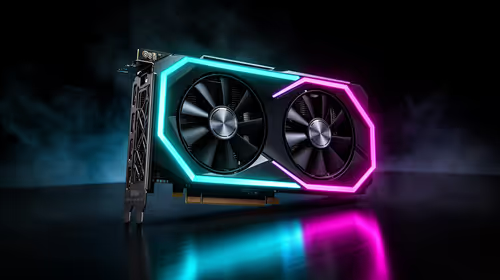
The RTX 5060 Ti launches with 8GB or 16GB VRAM depending on the variant, and while 8GB is enough for most 1080p and 1440p gaming in 2026, the 16GB version provides meaningful headroom for higher-resolution textures, modded games, and future-proofing that SA gamers should factor into their buying decision.
RTX 5060 Ti VRAM Configurations Explained
NVIDIA's RTX 5060 Ti follows the same dual-variant approach seen with the RTX 4060 Ti - an 8GB version at a lower price point and a 16GB version for buyers who want maximum memory capacity. The GPU core itself (Blackwell architecture, GB206 die) is identical between both variants; the difference is entirely in VRAM quantity and the resulting memory bandwidth, since 16GB configurations typically use a wider effective bus.
For most gaming at 1080p in 2026, 8GB of GDDR7 VRAM remains functional. Modern AAA titles at 1080p Ultra settings typically consume 6-8GB, meaning the 8GB RTX 5060 Ti runs at the edge of its VRAM capacity in demanding scenarios. DLSS 4 with Frame Generation is NVIDIA's answer here - the RTX 5060 Ti supports the full Multi Frame Generation feature of DLSS 4, which means you can lower internal render resolution (reducing VRAM usage significantly) while maintaining or exceeding native resolution image quality and boosting frame rates substantially.
At 1440p, the VRAM calculation shifts meaningfully. High texture quality settings at 1440p push VRAM consumption up by 20-40% compared to 1080p in the same scenes. The 8GB variant begins to show memory pressure in texture-heavy titles, leading to VRAM spill into system RAM which causes stuttering and frame time spikes rather than a gradual frame rate reduction. The 16GB version avoids this cliff entirely.
Real-World Performance in 2026 Games
The RTX 5060 Ti with DLSS 4 enabled is a different proposition from raw rasterisation numbers suggest. In titles supporting DLSS 4 Multi Frame Generation, the GPU effectively multiplies its output frame rate, meaning the 8GB variant can maintain smooth 60fps+ at 4K in supported games that would otherwise demand far more GPU horsepower.
However, VRAM consumption doesn't decrease with DLSS enabled - you still need to hold the full texture and geometry data for the scene in VRAM regardless of what upscaling does to the output resolution. This is the key point SA gamers should understand: DLSS improves frame rates but doesn't address VRAM limitations. A game with high-resolution texture packs or heavy modding will still consume the full 8GB regardless of DLSS settings.
For modded games - particularly Skyrim with ENB and 4K texture mods, or GTA V with visual overhaul mods - 8GB becomes a hard limitation that causes stability issues and stuttering. The South African modding community is active, and buyers who plan to play heavily modded titles should weight this consideration heavily toward the 16GB variant.
SA Market Pricing and Value Considerations
In the South African market, the price gap between the 8GB and 16GB RTX 5060 Ti variants is typically R2,000-R4,000 depending on board partner and import timing. Over a 3-4 year ownership period, this premium amounts to roughly R50-100 per month - a relatively modest cost for significantly extended useful life and the peace of mind of not hitting VRAM limits in current games.
For SA buyers on a tight budget who primarily play esports titles (Valorant, CS2, Apex Legends, Fortnite) at 1080p, the 8GB variant is completely sufficient - these games use well under 8GB even at high settings. For buyers playing single-player AAA titles at 1440p or higher, or who plan to keep the GPU for 4+ years, the 16GB variant is the more defensible long-term choice.
Loadshedding considerations apply here too - both RTX 5060 Ti variants have TDP ratings in the 165-185W range, which is manageable on a quality 650W PSU and keeps the card compatible with mid-range UPS units for short outage bridge periods.
Frequently Asked Questions
Q: Is 8GB VRAM enough for 1440p gaming on the RTX 5060 Ti in 2026?
A: For most titles at 1440p High settings, 8GB functions but sits close to the limit in demanding games. You may need to reduce texture quality settings from Ultra to High in some titles to avoid stuttering caused by VRAM overflow. The 16GB variant handles 1440p with full Ultra textures comfortably and is the better choice for 1440p gaming.
Q: How does DLSS 4 affect VRAM usage on the RTX 5060 Ti?
A: DLSS 4 upscaling reduces the GPU's rendering resolution, which can marginally reduce geometry and render target VRAM usage, but texture VRAM consumption remains determined by the game's texture quality settings regardless of DLSS. DLSS improves frame rates dramatically but does not solve VRAM limitations in texture-heavy scenarios.
Q: Is the RTX 5060 Ti 8GB or 16GB better for SA buyers planning to upgrade in 2 years?
A: If you plan to upgrade in 2 years, the 8GB variant makes more financial sense - you'll sell it before VRAM limitations become critical and buy the then-current generation. If you keep GPUs for 4-5 years as many SA buyers do given hardware costs, the 16GB variant is worth the premium to avoid VRAM obsolescence before the card is otherwise outdated.
Q: Can the RTX 5060 Ti handle 4K gaming?
A: The RTX 5060 Ti handles 4K gaming in supported titles with DLSS 4 Multi Frame Generation enabled, achieving playable frame rates in many scenarios. Without DLSS, native 4K performance is limited to medium-quality settings in demanding titles. It's a mid-range GPU positioned primarily for 1080p and 1440p gaming rather than native 4K.
Also at Evetech: RTX 5060 Ti Gaming PCs | RTX 5060 Gaming PCs
Ready to Find Your Perfect Match? Shop at Evetech