Quick Answer
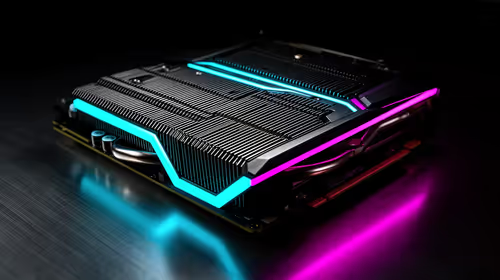
The RTX 5070 and Intel Arc A770 sit in very different performance tiers. The RTX 5070 is a high-end card targeting 1440p and 4K gaming, while the Arc A770 is a budget-to-mid-range option better suited to 1080p. For SA gamers weighing price against performance, understanding the gap is key before spending serious rands.
How These Two GPUs Compare on Paper
The NVIDIA RTX 5070 uses the Blackwell architecture with a 12 GB GDDR7 VRAM configuration and a significantly wider compute pipeline compared to its predecessors. It supports DLSS 4 with Multi Frame Generation, which is a major advantage for pushing high frame rates at demanding resolutions.
The Intel Arc A770 launched on the Alchemist architecture with 16 GB GDDR6 on the higher VRAM model. On paper that extra VRAM looks appealing, but raw shader throughput and rasterisation performance fall well short of what the RTX 5070 delivers. Intel has improved Arc drivers considerably since launch, and the card now performs more reliably in DirectX 12 and Vulkan titles.
In direct gaming benchmarks at 1080p, the A770 handles mainstream titles well. Titles like Fortnite, Valorant, and older AAA games run smoothly. The RTX 5070, however, operates in a different league entirely, being competitive at 1440p ultra settings and capable 4K gaming in most titles.
Real-World Gaming Performance for SA Players
SA gamers typically game on 1080p 144Hz or 1440p 165Hz monitors. At 1080p, the Arc A770 is genuinely capable and represents strong value. At 1440p, the A770 starts to struggle in demanding titles like Cyberpunk 2077, Alan Wake 2, and Hogwarts Legacy at high settings.
The RTX 5070 at 1440p is a dominant performer. With DLSS 4 Quality mode enabled, it can push frame rates well above 100fps in virtually any current title. At 4K it holds its own in most games, though ray tracing at 4K will tax even this card in the most demanding scenarios.
For content creators who also game, the RTX 5070's hardware encoder (NVENC) is far superior to Intel's Arc encoder for streaming and video export workflows. If your rig doubles as a workstation, this matters.
SA Pricing and Value Consideration
In South Africa, the pricing gap between these two cards is substantial. The Arc A770 has historically been available at the R6,000-R8,000 range, making it one of the more accessible discrete GPUs on the local market. The RTX 5070, sitting in the premium tier, carries a price tag several times higher.
For students on a tight budget or NSFAS recipients looking to stretch allowances into a gaming build, the Arc A770 provides a real GPU upgrade path without breaking the bank. If you are building a serious gaming rig and can afford the premium, the RTX 5070 offers generational performance that will remain relevant for years.
Evetech ships both cards nationwide, with delivery to major cities typically within a few business days. Stock levels on flagship NVIDIA cards do fluctuate, so checking live availability is always advisable.
Loadshedding Resilience: Power Draw Matters
South Africa's loadshedding reality makes power draw a meaningful spec. The Arc A770 has a TDP around 225W, while the RTX 5070 sits higher at approximately 200-220W depending on the variant and board partner. Both are manageable on a quality UPS setup.
If you are running a full gaming PC on a UPS during loadshedding, the total system draw matters. A mid-range CPU paired with an Arc A770 can run on a 1500VA UPS more comfortably than a high-end build with an RTX 5070 and a power-hungry processor. Factor your UPS capacity into your GPU choice.
Frequently Asked Questions
Is the Intel Arc A770 still worth buying in 2026?
Yes, for budget-conscious 1080p gaming it remains a solid option. Driver maturity has improved significantly, and the 16 GB VRAM version is especially compelling for future-proofing at that price point.
Does the RTX 5070 support ray tracing well?
Yes. The RTX 5070 handles ray tracing far better than the Arc A770, particularly when combined with DLSS 4 to recover frame rates lost to the ray tracing workload.
Which card is better for streaming and content creation?
The RTX 5070 is the clear winner for streamers. NVENC on Blackwell produces excellent quality at low CPU overhead, and CUDA acceleration benefits many creative applications.
Ready to Find Your Perfect Match? Find your next GPU upgrade at Evetech. Browse graphics cards