Hitting 'Go Live' in South Africa shouldn't be a gamble. Yet, we've all been there: your stream looks like a pixelated mess, your frames drop, and the chat is full of 'lag' comments. The culprit isn't always our internet... it's often poor compression. Mastering a few key video compression techniques is the secret to delivering a crisp, flawless broadcast to your audience, even on a typical SA connection. Let's get your stream looking sharp. ✨
Understanding the Basics of Video Compression
So, what exactly is video compression? Think of it like vacuum-packing your clothes for a trip. You're taking a large, bulky item (your raw gameplay footage) and intelligently removing unnecessary data to make it much smaller and easier to send over the internet.
The goal of any good video compression technique is to shrink the file size dramatically without your viewers noticing a major drop in visual quality. This process is handled by a "codec" (coder-decoder), which is essentially the language your PC uses to compress and decompress the video. Getting this right is the first step to a pro-level stream.
Key Video Compression Techniques for Streaming
For a smooth broadcast, you need to focus on two main elements: the codec you use and the bitrate you send. Nailing these settings in your streaming software (like OBS or Streamlabs) is crucial for optimising your output.
Choosing Your Codec: H.264 vs. AV1
The world of codecs can seem complex, but for streaming, you'll mainly encounter two:
- H.264 (AVC): This is the old faithful. It's supported by virtually every device and platform, offering a great balance of quality and performance. For most streamers, it's the go-to choice for its reliability.
- AV1: This is the new kid on the block. AV1 is significantly more efficient, meaning it can deliver the same or better quality than H.264 at a much lower bitrate. The catch? It requires powerful, modern hardware to encode in real-time without hurting your game's performance. Processors with strong multi-core capabilities are essential, making a rig from our AMD Ryzen PC deals an excellent choice for future-proofing your stream.
Bitrate: The Secret to Stream Quality
Bitrate is the amount of data you send to the streaming service (like Twitch or YouTube) every second, measured in kilobits per second (kbps). A higher bitrate means more data and better quality, but it also requires a more stable internet upload speed.
For South African conditions, it's wise to be conservative.
- For 720p at 60fps: Aim for 3,500 - 4,500 kbps.
- For 1080p at 60fps: Aim for 4,500 - 6,000 kbps.
Always run a speed test to check your upload speed and leave a buffer of about 25% to ensure stability.
Streaming Pro Tip ⚡
Use Constant Bitrate (CBR) for live streaming. While Variable Bitrate (VBR) is great for recorded videos, CBR provides a more stable and predictable data stream, which streaming platforms like Twitch strongly prefer. This consistency helps prevent buffering for your viewers, even if the on-screen action gets intense.
Hardware's Role in Flawless Video Compression 🚀
Your PC's components play a massive role in how effectively you can apply these video compression techniques. The encoding process is demanding, and you have two main options for how your PC handles it:
- CPU Encoding (x264): This method uses your processor to compress the video. It can produce very high-quality results but places a heavy load on your CPU. If your processor is busy encoding, it has fewer resources left for your game, which can lead to lower FPS.
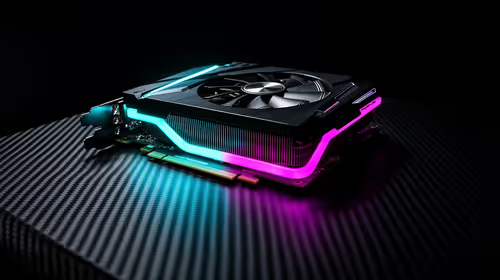
- GPU Encoding (NVENC/AMF): This method uses a dedicated chip on your graphics card. NVIDIA's NVENC and AMD's AMF encoders are fantastic for streamers because they handle the compression workload with minimal impact on gaming performance. This is why a modern GPU is so important. Many of our all-Intel PC deals feature powerful NVIDIA cards perfect for the job.
You don't need to break the bank to get a machine that can handle both gaming and streaming well. Many modern systems are built for this dual purpose, and you can find excellent value in our range of PCs under R20k, which offer a great entry point into quality broadcasting.
Putting It All Together for the Perfect SA Stream
Mastering streaming in South Africa is a balancing act. It's about finding the sweet spot between visual quality and performance that your PC and internet connection can sustain.
Start with the H.264 codec, set a conservative CBR based on your upload speed, and use your GPU's dedicated encoder. This setup provides the most reliable foundation. From there, you can experiment with slightly higher settings to see what your system can handle. Ultimately, the best video compression technique is one that is powered by solid, dependable hardware. For those who want to skip the guesswork, our pre-built PC deals are configured and tested to deliver an exceptional gaming and streaming experience right out of the box.
Ready to Go Live Without the Lag?
The right video compression techniques make a huge difference, but they work best on a capable machine. If your PC is struggling to keep up with both gaming and encoding, it's time for an upgrade. Explore our massive range of gaming PCs and find the perfect rig to make your stream shine.