


Quick Answer
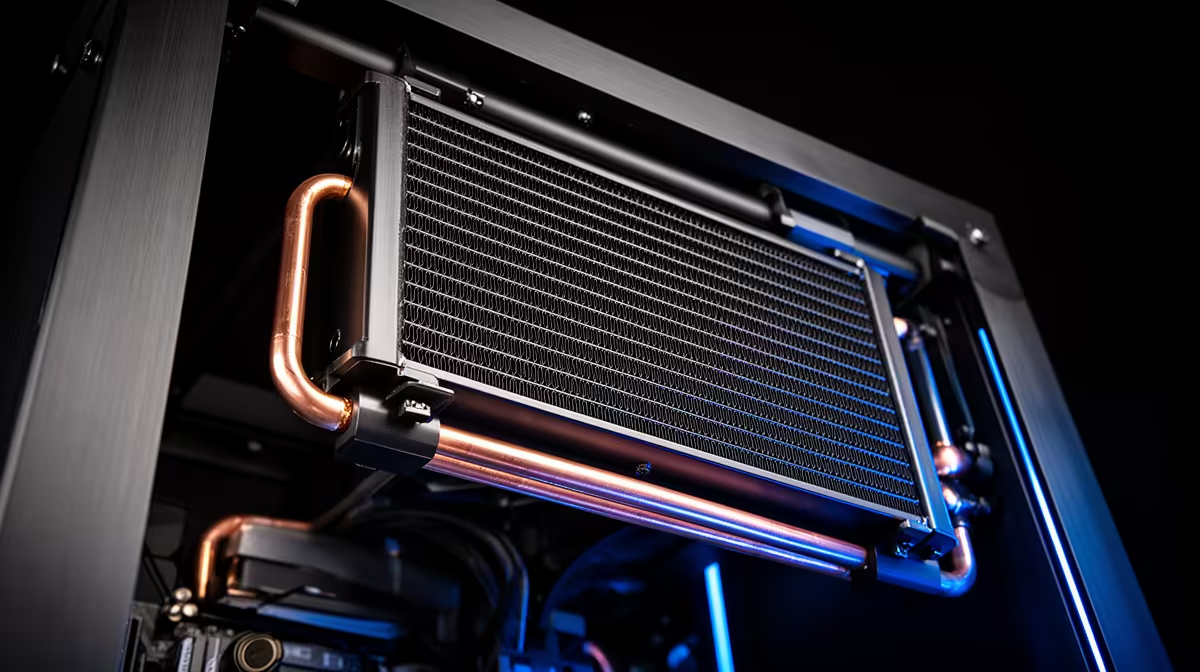
A case with 420 mm radiator support accepts a radiator that uses three 140 mm fans in a single mount position, providing roughly 40 percent more heat rejection surface than a 360 mm unit. For liquid-cooled gaming builds using an overclocked Ryzen 9 9950X or Core Ultra 9 285K, or for workstation PCs running multi-threaded rendering workloads at 200 watts plus, 420 mm support delivers noticeably lower temperatures at quieter fan speeds.
The Thermal Case for 420mm Radiator Support 🌡️
Radiator performance is proportional to the coolant-to-air surface area. At a constant fan speed of 1,000 RPM, a 420 mm radiator rejects approximately 350 watts of heat before coolant temperature rises more than 10 degrees Celsius above ambient, compared to 250 watts for a 360 mm unit. For gaming, this difference is most apparent during extended streaming sessions where both the CPU encoder and GPU are simultaneously loaded. A Ryzen 9 9950X encoding at 180 watts while an RTX 5080 draws 320 watts creates a chassis heat load that a 420 mm radiator manages without fan ramp-up, while a 360 mm unit typically drives fans to audible levels to maintain acceptable coolant temperatures.
Case Requirements and Compatibility for 420mm Mounts 🔧
Supporting a 420 mm radiator requires a case with three aligned 140 mm fan mount holes in a single location, either at the front or top. The front mount is thermally preferable as it draws ambient air before it is warmed by other components. Top mounts are more common in ATX mid-towers but require VRM heatsink clearance of at least 40 mm from the board's top edge to the radiator bracket underside. For South African workstation builders pairing an EATX board like the ASUS Pro WS W790E-SAGE with an Intel Xeon W7-3500 series CPU, the extended top heatsink array often blocks top 420 mm mounting, making front placement the only viable option. Cases supporting 420 mm at the front typically require an internal depth of 220 mm or more.
Workstation vs. Gaming Use Cases 🖥️
In gaming builds, 420 mm radiator support provides thermal insurance: the system runs cooler and quieter at all times, which is pleasant but not always critical. In a workstation context, the calculus changes. A 3D rendering workflow on a Threadripper PRO 7985WX running at 350 watts sustained over 6 to 8 hours demands cooling that never throttles. A 420 mm AIO sustains this load with fans at 1,100 RPM to 1,300 RPM, maintaining a stable clock frequency throughout the render. With a 360 mm AIO, the same workload pushes fans to 1,700 RPM to 2,000 RPM after 30 minutes, which is both noisier and indicative of marginal thermal headroom. SA content creators and engineers who run heavy workloads between gaming sessions benefit the most from this form factor.
Custom Loop Upgrade Path ⚡
If you buy a case with 420 mm radiator support but start with a 360 mm AIO, leave the third fan position filled with an intake fan in the interim. When you upgrade to a custom loop later, the 420 mm radiator slot is ready, the fan cables are already routed, and the upgrade requires only swapping the cooling hardware rather than remounting brackets.
FAQ
Can I use a 420 mm radiator in a standard ATX mid-tower?
Rarely. Standard ATX mid-towers typically support 360 mm maximum. Only a small number of XL mid-towers and full-towers with triple 140 mm front or top positions support 420 mm. Check the exact specification rather than assuming.
Is a 420 mm AIO worth the cost for a gaming-only build?
For gaming-only with a non-overclocked mid-range CPU, a 360 mm AIO is sufficient and costs less.
Are 420 mm AIOs available with local SA warranty support?
Yes, several brands stock 420 mm AIO coolers locally with full South African warranty coverage, available through Evetech. Lead times from local stock are typically two to five business days.
Liquid cooling a gaming or workstation build? Evetech stocks 420 mm-compatible cases and a full range of AIO coolers with local SA warranty support for gaming and professional builds.










