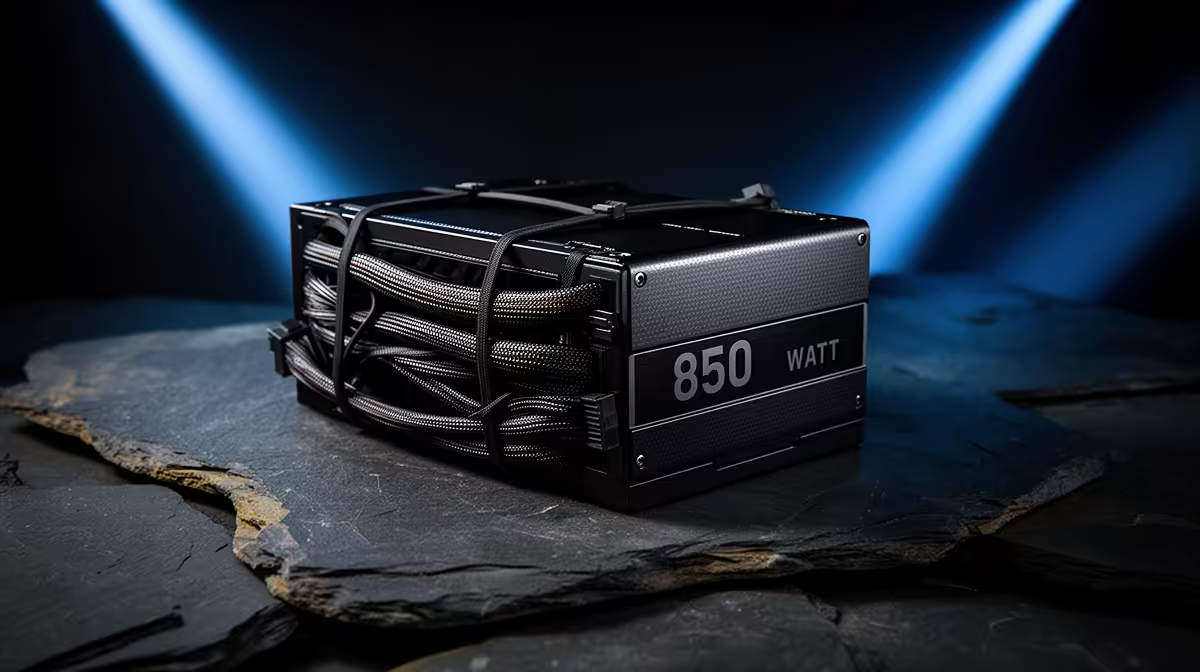
An 850W power supply is worth considering for a Docker host only when the physical components require that capacity. Containers do not draw a fixed wattage class. A host with integrated graphics and several drives may need far less, while a system that also performs GPU compute can demand more power and specialised connectors.
Size for the hardware, not the service count
List the processor, graphics card, motherboard, drives, fans and expansion cards. Check peak guidance for the graphics hardware, connector type, supply dimensions and the case airflow path. The factpack prices the Cooler Master MWE Gold 850 V3 at R930. Compare its current warranty and included cabling with the exact build rather than assuming unused wattage guarantees reliability. Never mix modular cables between different power-supply models.
Plan for dependable service operation
Measure wall power and component temperatures during image builds, backups and the heaviest scheduled jobs. A quality unit should operate comfortably without forcing an inefficiently oversized purchase. Remember that 80 PLUS describes efficiency, not surge protection or runtime. Use suitable electrical protection and a separate backup-power design where service continuity matters.
Container reliability also depends on storage health, memory capacity, updates and tested recovery. Back up compose files, secrets and persistent volumes through an independent process. A smaller reputable supply can be the better host component when it meets measured demand with sensible headroom and the right connectors.
Specifying a Docker host? > Ask Evetech to match power capacity, connectors and protection to the complete hardware configuration.