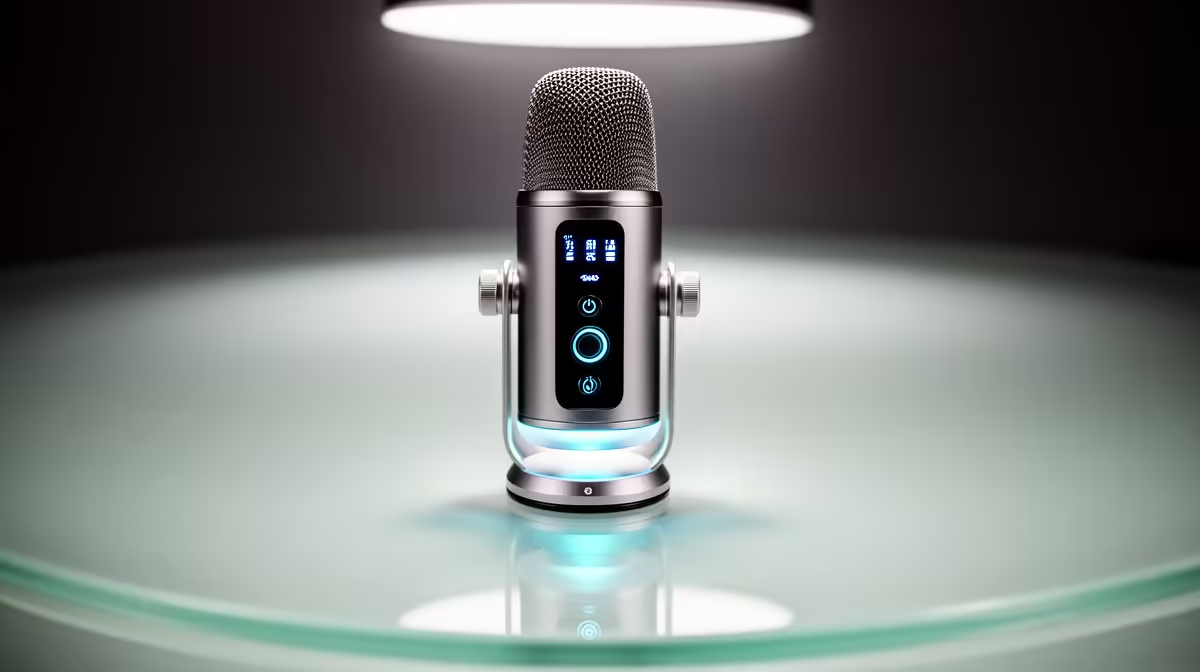
A wireless lav clipped to your shirt should sound like a studio, not like the street corner you filmed on. That gap is exactly what AI noise canceling closes. Instead of a simple filter that guesses what is noise, a trained model learns the shape of a human voice and rebuilds it cleanly while peeling away the traffic, fans and crowd chatter around you. Here is how it actually works inside a modern wireless mic.
Quick Answer
AI noise canceling in a wireless microphone uses a neural model trained on speech to lock onto your voice and strip steady background noise in real time. It runs on a chip in the transmitter, so it adds almost no delay and no load on your phone or camera.
🧠 How the Model Tells Voice From Noise
Older noise reduction worked on a crude rule: anything quiet and constant is probably noise, so duck it. That fails the moment a fan and a voice overlap, because the filter cannot tell them apart and starts chewing into your words.
An AI system is trained differently. It has heard millions of examples of speech mixed with noise, so it has learned the fingerprint of a human voice: how vowels move, how consonants snap, how pitch rises and falls. When audio comes in, the model predicts which parts are voice and rebuilds those, while discarding the rest.
That is why AI canceling can sit under a roaring minibus taxi or a buzzing aircon and still hold your words intact, where an old gate would have left you sounding underwater.
⚡ Why It Runs on Hardware, Not Your Phone
The clever part of a wireless content creator mic is where the processing happens. The noise model runs on a dedicated chip inside the transmitter, the little box clipped to you, not on the phone or camera receiving the signal.
This matters for two reasons. First, latency. Because the audio is cleaned at the source before it is sent, there is no round trip to an app, so the delay stays near zero and your lips stay in sync with your words. Second, load. Your phone is already working hard to record video, so offloading the audio cleanup to the mic keeps everything smooth.
It also means the cleaning happens whether you record to a phone, a mirrorless camera or a laptop. The intelligence travels with the mic.
🔧 What It Handles Well, and What It Misses
AI canceling shines on steady, predictable noise. Traffic hum, fan whirr, aircon drone and distant crowd murmur are its home turf, and it can lift a voice out of all of them.
Sudden, sharp sounds are harder. A car hooter, a slammed door or a dog bark happens too fast for the model to predict, so a frame or two can slip through before it reacts. Wind is its own category, which is why a foam muff still earns its place on outdoor shoots even with AI switched on.
Most good systems let you toggle the strength or turn it off entirely. On a quiet interview you may want it light, so the voice keeps its natural room tone instead of sounding processed.
Frequently Asked Questions
Does AI noise canceling work without an internet connection?
Yes. The neural model is stored on the chip inside the microphone, so all processing happens on the device itself. There is no cloud lookup and no data sent anywhere, which means it works the same whether you are filming in a studio with fibre or out in a field with no signal at all.
Will it make my voice sound robotic?
Good systems rebuild the voice naturally, but heavy settings on cheaper models can add a slightly processed edge, especially on quiet passages. If you notice it, drop the canceling strength a level. On calm shoots with little background noise, a lighter setting keeps your natural tone while still cleaning up the worst of the room.
Does AI noise canceling add delay to my recording?
Almost none. Because the cleanup runs on the transmitter before the signal is sent, there is no trip to an app and back. The processing happens in real time at the source, so your audio stays in sync with the video and you avoid the lip-sync drift that software plugins on a phone can introduce.
Can it remove wind noise outdoors?
Only partly. Wind hitting the capsule creates a low rumble that AI models struggle with, because it is unpredictable and overwhelming. For outdoor shoots in windy coastal spots, fit the foam windscreen that ships with most wireless mics and keep AI canceling on as a second layer. The two together give the cleanest outdoor result.
Should I leave AI noise canceling on all the time?
Not always. In a quiet, treated room the noise floor is already low, so heavy canceling can strip useful room tone and flatten the voice. Use a lighter setting or switch it off indoors, and save the stronger modes for busy streets, events and noisy venues where the trade-off clearly favours a cleaner voice.
Ready to record clean audio anywhere? Explore the wireless microphone range made for South African creators, and capture interviews and vlogs that sound studio-clean even on a busy street.