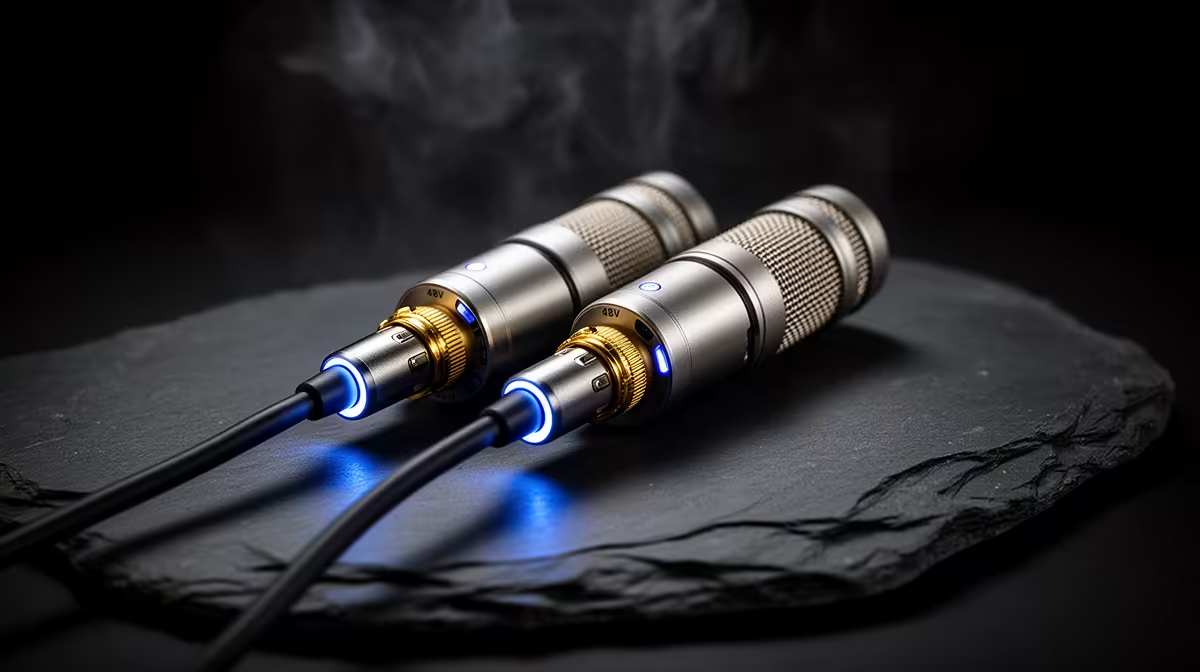
Plug in a pair of XLR condenser mics, hit record, and get silence. The usual reason is 48V phantom power, the voltage condenser capsules need to function, sitting switched off. Get the order of operations wrong and you can also get a nasty pop or, over time, a stressed capsule. Configuring it for two mics at once is simple once you know the sequence, so here is the safe way to do it.
Quick Answer
To set up 48V phantom power for dual XLR condenser mics, connect both mics first with faders down, then switch on 48V and wait about ten seconds for the voltage to settle. Power down in reverse: 48V off, wait, then unplug. This protects your capsules and avoids loud pops.
🔧 Why Condenser Mics Need 48V in the First Place
A condenser microphone is an active device. Its thin diaphragm sits next to a charged backplate, and the gear inside needs power to hold that charge and drive the signal. Dynamic mics do not need this, which is why they work straight out of the box, but condensers stay silent without it.
Phantom power solves this elegantly. The same XLR cable that carries your audio also delivers 48 volts up to the mic, so you need no extra battery or power lead. The mics that require it will not respond at all until that voltage arrives, which is exactly why a dead-quiet condenser is usually a phantom-power problem, not a faulty mic.
The "phantom" name comes from the fact that the voltage is invisible to gear that does not need it, like a dynamic mic, which simply ignores it.
⚡ The Safe Power-On Sequence for Two Mics
Order matters, and the rule is the same whether you run one mic or two. Connect everything before you energise anything.
Start with your mixer or interface switched on but faders or gain knobs pulled down. Plug both condenser mics into their XLR inputs fully, until each connector clicks home. A loose connector that seats while 48V is already live is a classic cause of the loud thump that can startle you and stress the capsule.
With both mics seated, flick the 48V switch. Many compact mixers use a single global phantom button that feeds all XLR inputs at once, so one press powers both mics together. Give it about ten seconds to stabilise, then raise your gain and check levels on each channel.
If your unit has separate switches per channel, the same logic applies: connect first, then switch on.
✨ Powering Down Without the Pop
Shutting down is the power-on steps in reverse, and skipping this is where most people send a bang through their monitors or headphones.
Pull your faders or gain down first so nothing is amplified. Switch the 48V off and wait several seconds for the voltage stored in the mics to drain. Only then unplug the XLR cables. Disconnecting a live phantom circuit is the surest way to fire a loud transient that, repeated daily, is hard on both your gear and your ears.
One more habit worth keeping: never plug or unplug a condenser while 48V is live. If you need to swap a mic mid-session, drop the phantom power first, make the change, then switch it back on.
Frequently Asked Questions
Can 48V phantom power damage a dynamic microphone?
Modern balanced dynamic mics are designed to ignore phantom power safely, so running them alongside condensers on a shared 48V bus is generally fine. The real risk is ribbon mics and damaged or unbalanced cables, which can be harmed. If you mix mic types, check that your dynamics are balanced and your cables are in good condition first.
Why is my condenser mic completely silent?
The most common cause is phantom power being switched off. A condenser cannot produce any signal without its 48V supply, so check that switch first. If it is on, confirm the XLR cable is fully seated at both ends and that the channel gain is raised. A faulty cable is the next thing to rule out before suspecting the mic.
Do both mics need separate phantom power switches?
No. Many compact mixers and interfaces use a single global 48V button that feeds every XLR input at once, so one press powers both condensers together. Units aimed at pro studios sometimes offer per-channel switches for flexibility, but for a dual-mic podcast a shared switch is perfectly safe and simpler to manage.
How long should I wait after switching on 48V?
Give it around ten seconds before raising your gain or speaking into the mics. The voltage needs a moment to reach the capsules and stabilise, and recording during that ramp can capture clicks or uneven levels. The same patience applies on shutdown: wait several seconds after switching 48V off before unplugging anything.
Does phantom power affect my recording volume?
Not directly. Phantom power is what makes a condenser work at all, but it does not set your level. Volume is controlled by the gain knob on each channel. If a powered condenser is too quiet, raise the channel gain rather than touching the 48V, which should simply stay on at a steady voltage throughout the session.
Ready to run a dual-mic setup the right way?
Browse the audio mixer and interface range for South African podcasters, and pair it with XLR condensers built for clean, professional voice work.