Quick Answer
Fast IPS panels are the most versatile choice across FPS, racing, and open-world games because they combine 0.5ms to 1ms GTG response times with accurate colour and wide viewing angles. They outperform VA in motion clarity and outperform TN in image quality, making them the dominant panel type on competitive and all-around gaming monitors above R5,000.
Fast IPS Characteristics That Benefit Every Genre 🖥️
Fast IPS uses the same in-plane switching liquid crystal alignment as standard IPS, but with refined overdrive algorithms and higher-speed backplane electronics. The result is pixel transitions that complete within the frame window at 240Hz and above, rather than persisting into the next frame and creating ghosting.
Colour volume on fast IPS is typically 95 to 100 percent sRGB and 90 to 95 percent DCI-P3, producing saturated, accurate colours in-game without the over-sharpened neon effect of some VA gaming panels.
Genre-Specific Benefits Across FPS, Racing, and RPG 🎮
In FPS games like Valorant, CS2, and Apex Legends, the fast pixel response eliminates the trailing smear behind moving enemies during strafe duels. At 240Hz or 300Hz, fast IPS panels display each frame cleanly within its 4.2ms or 3.3ms window, keeping crosshair movement aligned with what the game engine is computing.
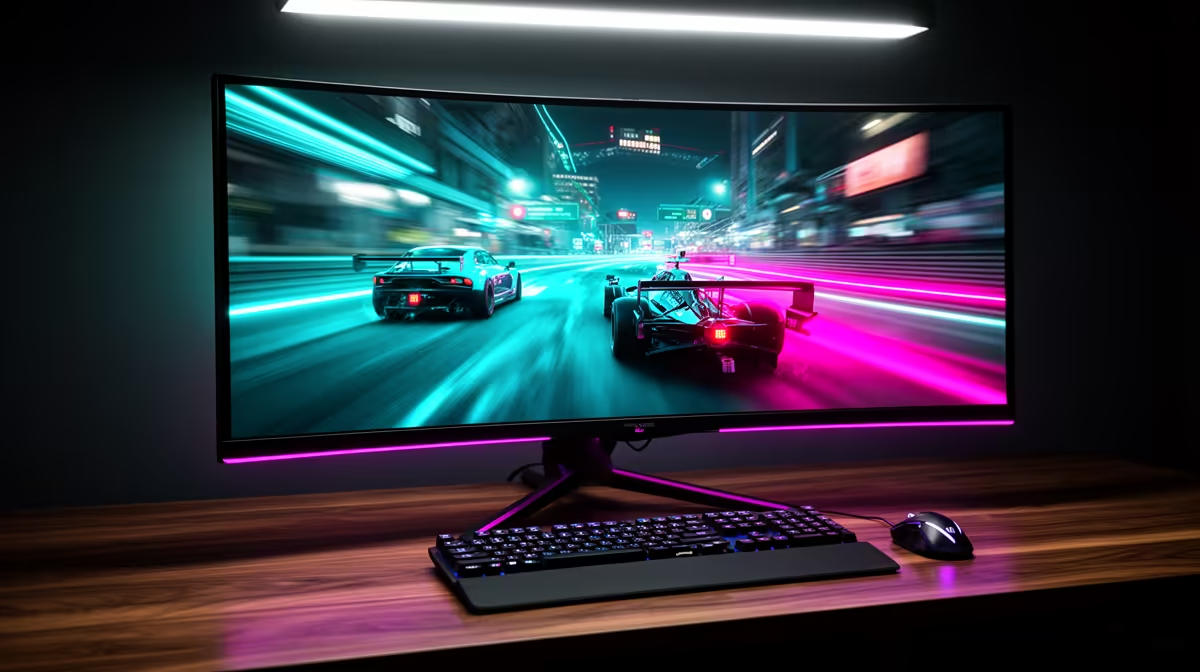
In racing games like Gran Turismo 7 on PC (via PlayStation Now streaming) or Forza Motorsport, fast IPS panels render motion along the horizontal axis cleanly at high frame rates, keeping barrier edges and competitor cars readable during high-speed cornering.
For open-world games like Cyberpunk 2077 or Elden Ring at 1440p, fast IPS panels at 144Hz or 165Hz deliver excellent visual fidelity. Most open-world games target 60 to 120 fps at QHD on mid-range GPUs, well within IPS motion-handling capability at these refresh rates.
How Fast IPS Compares to OLED and VA at Similar Price Points 💡
At R5,000 to R12,000, fast IPS dominates the market. OLED monitors start at R8,000 locally for the smallest sizes and offer superior contrast and response times, but carry burn-in risk for static HUD elements common in all three game genres.
For a SA buyer choosing between a fast IPS at R9,000 and an OLED at R12,000, the OLED wins on paper specifications but the fast IPS wins on risk-free everyday use. If the monitor is on for eight or more hours daily and includes static health bars, mini-maps, or ammo counters, fast IPS avoids the burn-in conversation entirely.
Enable sRGB Mode for Accurate Colour in Non-Gaming Use ⚡
Most fast IPS gaming monitors arrive with a wide colour gamut mode active by default, which oversaturates images in productivity apps and video editing software. Switch to the monitor's native sRGB mode for non-gaming work. This keeps colour accurate for any content you produce and avoids presenting edited photos with inflated saturation that will not match output on other displays.
FAQ
Does fast IPS have worse black levels than VA?
Yes. IPS panels have a characteristic backlight bleed in very dark scenes, producing greyish blacks. VA panels achieve deeper blacks due to their panel structure. For gaming in a dark room where shadow detail and contrast matter most, VA is preferred.
What refresh rate of fast IPS should I buy for FPS games?
For competitive FPS at QHD, aim for a 240Hz minimum with a 300Hz preferred if your GPU supports it. For casual or mixed-genre gaming, 144Hz or 165Hz fast IPS at 1440p is excellent value and widely available locally at R5,000 to R9,000.
Is fast IPS the same as Nano IPS, IPS Black, or IPS Ultra?
No, these are brand-specific variants. Nano IPS (LG) adds quantum dot colour enhancement. IPS Black improves contrast ratio above standard IPS. IPS Ultra is a marketing term used by some brands.
Looking for a fast IPS gaming monitor for your genre? Evetech carries fast IPS gaming monitors across FPS, all-rounder, and creative-use categories, with options at 144Hz, 240Hz, and 300Hz. Check the monitors section for current stock and pricing.