


Quick Answer
Fully modular PSU cables are detachable power leads that connect at both the PSU end and the component end, unlike fixed cables permanently wired into the unit. They matter most in glass-panel builds where routing is visible, in compact cases where space is limited and in builds where future component additions are planned.
How Modular Cable Systems Are Structured 🔌
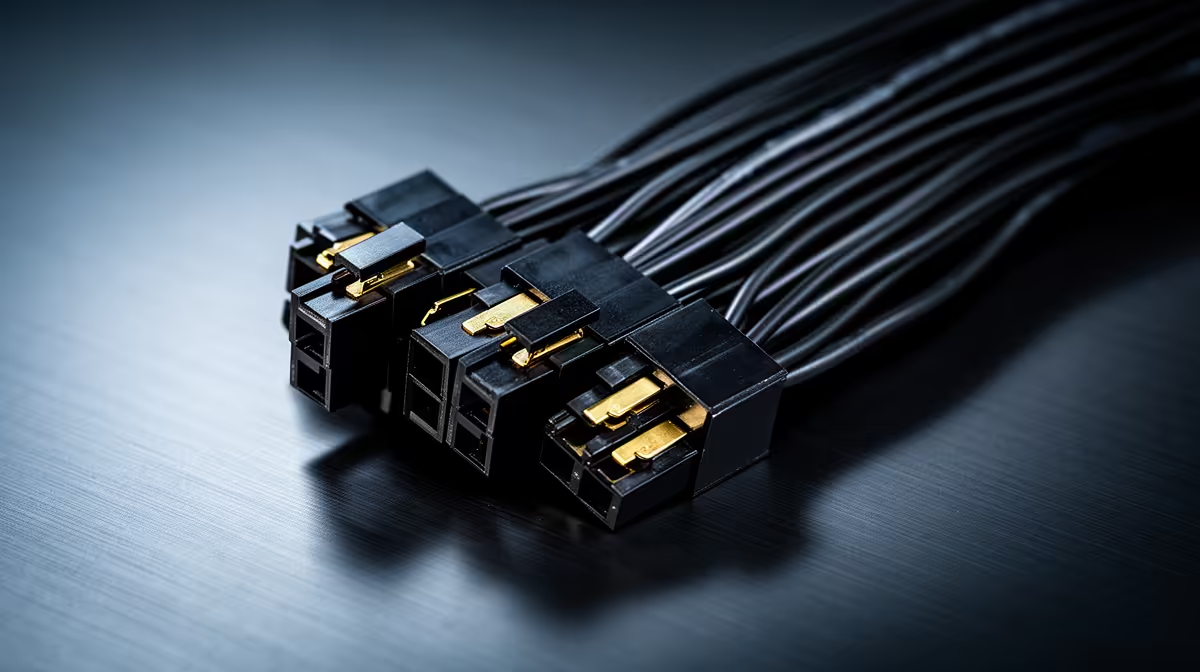
A fully modular PSU ships with cables stored separately. The 24-pin ATX motherboard cable, EPS CPU power cable, PCIe GPU cables and SATA peripheral cables all plug into labelled ports on the PSU's rear face. These ports are proprietary to each PSU model and not interchangeable across brands. A single GPU build with two M.2 NVMe SSDs requires the 24-pin ATX, one or two EPS leads and one or two PCIe cables. Every cable not needed stays in the box, removing it entirely from the case interior and reducing the wiring volume to manage during the build.
When Modular Cabling Makes a Measurable Difference 🖥️
Modular cabling matters most in three scenarios. Compact ATX and mATX builds benefit from removing three to four unused cable bundles that would otherwise consume physical space. Tempered glass side panel builds benefit aesthetically from clean routing using only necessary cables. Builds planned for future expansion benefit because adding a SATA SSD or second GPU later means simply pulling the required cable from storage. In South Africa, where many builders upgrade components incrementally over two to three years due to hardware costs, this future-proofing aspect is particularly relevant.
Cable Quality Differences to Look For 🔧
Premium units ship with individually sleeved cables that bend smoothly around case edges without kinking. Budget modular PSUs sometimes supply thick, rigid cables that resist the bends required for real case routing. EPS CPU cables in full-tower builds need to reach from a bottom-mounted PSU to a CPU socket near the top of the case, often 600mm or more. A cable reaching only 550mm is a genuine problem in certain case configurations. Confirming cable length in product specifications before ordering is worthwhile for larger cases.
Never Cross-Use Modular Cables Between PSU Brands ⚡
The plug at the PSU end of a modular cable looks similar across brands but carries a completely different pin assignment. Connecting a Corsair cable to a Seasonic PSU sends voltage to the wrong wires and can permanently damage components on first power-up. Keep each PSU's cables in its own clearly labelled bag.
FAQ
What happens if I plug in a modular cable incorrectly at the component end?
Component-end connectors are keyed so they physically cannot be inserted backwards or into the wrong socket type. The risk of incorrect connection at the component end is minimal; the PSU-end connection is where brand-specific pin assignment matters.
Do modular cables add electrical resistance that affects performance?
The additional contact points add a very small resistance measured in milliohms. This is imperceptible in real-world component performance and does not affect GPU framerates or storage speeds.
Can I buy premium sleeved cable upgrades for a budget modular PSU?
Only if the cable manufacturer offers a kit specifically compatible with your exact PSU model. Confirm your PSU model is supported before ordering, as compatibility is model-specific.
Want clean, flexible cable management in your next build? Browse Evetech's fully modular power supply range for options that simplify your build and keep your case looking sharp.










