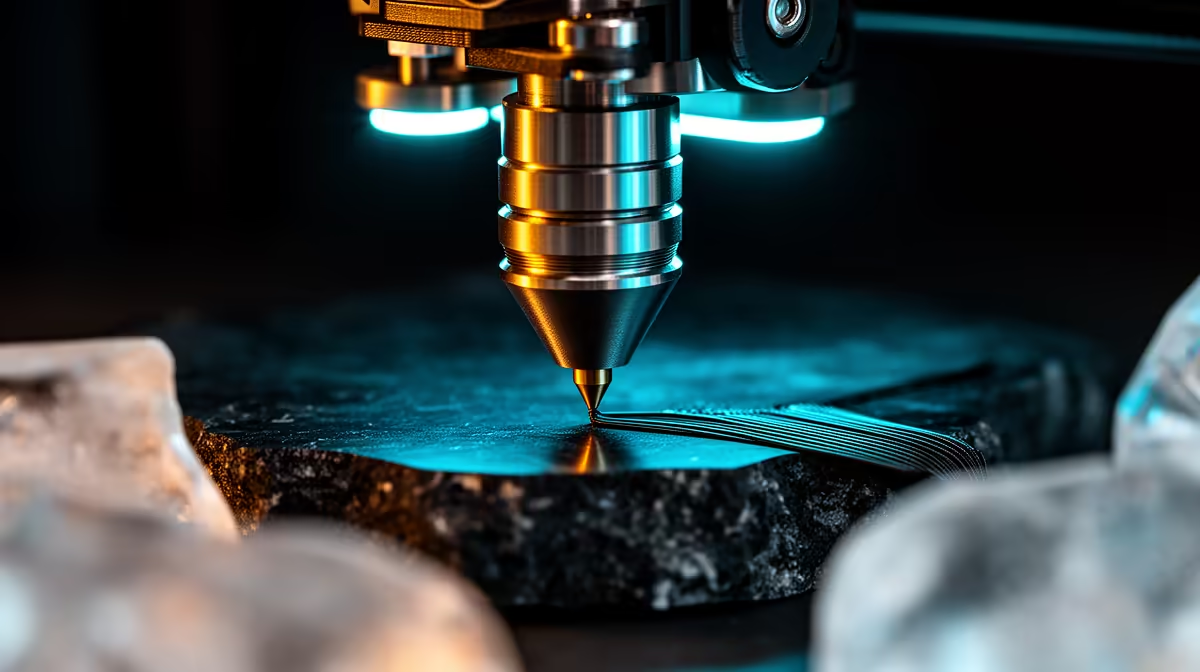
Look closely at a print just past a sharp corner and you may see the detail repeat itself in faint, fading ridges, like an echo pressed into the plastic. Those ripples are ghosting, also called ringing, and they are not a slicing mistake. They are vibration. When the print head changes direction quickly, the frame flexes and rings like a struck bell, and the nozzle traces that wobble onto the wall. The cure is to damp the resonance, and modern firmware makes that practical.
Quick Answer
Enable input shaping in your firmware and lower your acceleration and jerk values. Input shaping issues counter-pulses that cancel the printer's own vibration, and dropping acceleration to roughly 500 to 1000 mm/s squared with jerk around 5 to 10 mm/s lets the head change direction gently enough to stop the ringing. Together they remove the echo without gutting print speed.
What Causes the Echo
Every printer has parts that can flex, the gantry, the bed, the frame itself, and each has a natural frequency at which it likes to vibrate. A fast direction change at a corner gives the structure a sharp shove, and it responds by oscillating at that frequency. The nozzle keeps extruding while the frame is still ringing, so the wobble gets laid into the surface as evenly spaced ripples that fade as the vibration dies down. The faster and more abrupt the motion, the stronger the ringing.
That is why ghosting shows up worst after sharp features and at high speeds. It is a mechanical resonance problem, which means the answer is to either feed the printer gentler motion or actively cancel the vibration, ideally both.
Input Shaping: Cancelling the Vibration
Input shaping is the heavier-hitting fix. Firmware such as Klipper splits each movement command into a series of precisely timed pulses that are tuned to cancel the printer's resonance, so the frame never builds up the oscillation in the first place. The clever part is that it does this without forcing you to crawl through every corner, which is why it has become the standard answer to ghosting on faster machines.
To set it up properly you measure your printer's actual resonant frequencies, usually with a small accelerometer that bolts to the toolhead and reports how the frame vibrates. The firmware then calculates the right compensation for your specific machine and applies it automatically. Different shaper types trade surface finish against dimensional sharpness, so you pick the one that suits whether you care more about smooth walls or crisp dimensions.
Lower Acceleration and Jerk
If you are not ready to add an accelerometer, the simpler lever is motion tuning. Reduce your acceleration to somewhere around 500 to 1000 mm/s squared and keep jerk, the instantaneous speed change at a corner, low at roughly 5 to 10 mm/s. Both changes make the head speed up and slow down more gradually, which means smaller, softer shoves to the frame and far less ringing. The cost is a slightly slower print, but the surface improvement on visible parts is usually worth it. Pairing input shaping with sensible acceleration limits gives the cleanest result of all.
For anyone chasing flawless surfaces, a printer with a rigid frame and firmware that supports resonance compensation out of the box makes this far easier, and the current 3D printing machines increasingly ship ready for it. The dryers, accelerometer kits, and tuning extras that round out a serious setup sit among the most popular accessories.
Frequently Asked Questions
What is the difference between ghosting and ringing?
They are two names for the same artefact, faint repeated ripples in the print surface after a sharp feature, caused by frame vibration. Some people also call it echoing or rippling.
Do I need an accelerometer to fix ghosting?
Not strictly. Lowering acceleration and jerk reduces ringing on its own. An accelerometer lets input shaping measure your printer's exact resonance and cancel it precisely, which gives the cleanest result and keeps speeds higher.
Will lowering acceleration ruin my print speed?
It slows things modestly, not drastically. Dropping acceleration to the 500 to 1000 mm/s squared range trades a little speed for noticeably smoother walls, and combining it with input shaping recovers much of that pace.
Why does ringing appear after corners specifically?
A sharp corner forces a sudden change of direction, which shoves the frame and sets it vibrating. The nozzle prints that fading oscillation into the wall just after the corner, producing the echoed ridges.