


Quick Answer
Vapor chambers spread heat across the full GPU die surface instantly using phase-change fluid, making them superior to heat pipes for high-TDP flagship GPUs. Composite heat pipes use a refined wick structure for faster wicking at lower cost. Air deflectors within the heatsink redirect airflow to prevent hot spots and direct exhaust out of the case rather than recirculating warm air inside.
Vapor Chambers: How They Work and When They Matter 🔧
A vapor chamber is a flat, sealed copper enclosure filled with a small amount of fluid. Heat from the GPU die vaporises the fluid at the hot spot, vapour then spreads across the entire chamber surface where it condenses into the heatsink fins above, then wicks back. This cycle moves heat far faster than solid copper conduction. On a flagship GPU like the RTX 5090 with a 575W TDP, a vapor chamber ensures heat from the small GPU die spreads across the full heatsink footprint immediately. High-end RTX 50-series and RX 9000-series models using this design retail in South Africa from around R25,000 to R70,000.
Composite Heat Pipes and Their Role 🌡️
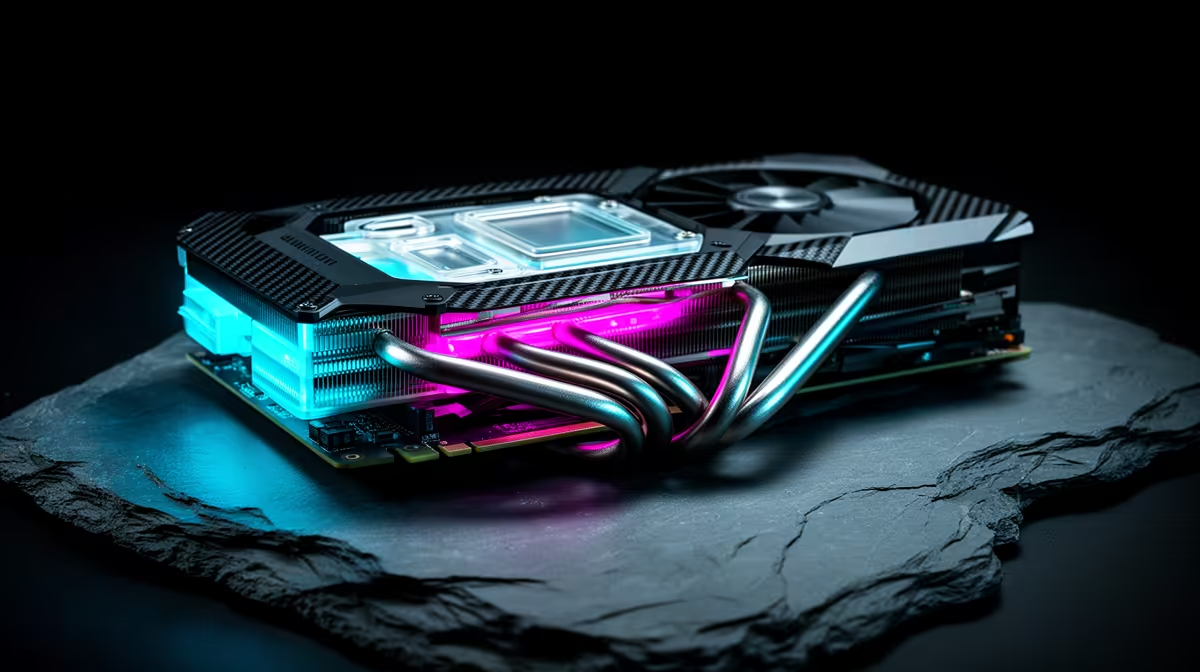
Composite heat pipes are found on mid-range and some high-end GPUs as a cost-effective alternative to vapor chambers. The composite design uses a sintered wick structure with higher capillary pressure than a standard grooved wick, improving fluid return speed. In a GPU cooler, multiple heat pipes run from the copper base plate near the GPU die across the heatsink fin array. The RTX 5070 Ti and RX 9070 XT tier of cards in South Africa, priced roughly R15,000 to R22,000, predominantly use composite heat pipe designs to achieve excellent thermal performance at a more accessible cost.
Air Deflectors and Their Effect on GPU Temperature 🌬️
Air deflectors are fins positioned within the heatsink assembly or around the fan shroud to control airflow direction. Without deflectors, fans push air into the fin array and it expands outward in all directions with significant turbulence and recirculation at the card's edges. Deflectors channel airflow along the fin array and direct exhaust toward the rear I/O bracket and out of the case. This recirculation prevention can reduce GPU peak temperatures by 4 to 7 degrees Celsius under full load, directly increasing sustainable boost clock frequency.
Clean Heatsink Fins Every Six Months ⚡
Dust buildup in GPU heatsink fins is the most common cause of temperature creep. In South African coastal cities like Durban and Cape Town where humidity and fine dust accumulate faster, compressed air directed between fins every six months maintains factory cooling performance. Remove the GPU before cleaning to avoid blowing dust onto surrounding components.
FAQ
Can you tell from the GPU spec sheet whether it uses a vapor chamber or heat pipes?
Manufacturers usually specify vapor chamber cooling in their marketing materials for flagship models. If the cooling solution description mentions only heat pipes or copper pipes, it is a composite heat pipe design. Vapor chamber is highlighted as a premium feature and is almost always explicitly named.
Does ambient temperature in South Africa significantly affect GPU cooling performance?
Yes. GPU coolers are designed to maintain a temperature delta above ambient. If your room reaches 30 degrees Celsius in a Johannesburg summer, a GPU that runs 60 degrees above ambient hits 90 degrees Celsius under load, which may trigger thermal throttling. Proper case airflow and room ventilation become essential in warm South African climates.
Are triple-fan GPU coolers always better than dual-fan designs?
Not always. A well-designed dual-fan cooler with a vapor chamber and efficient fin density can match or outperform a budget triple-fan design with heat pipes only. Judge by thermal test results for the specific model rather than fan count alone.
Looking for a GPU with top-tier thermal management? Evetech stocks a range of graphics cards from dual-fan mid-range to triple-fan flagship designs with vapor chamber cooling, all with local warranty. Browse the GPU range at Evetech.










