


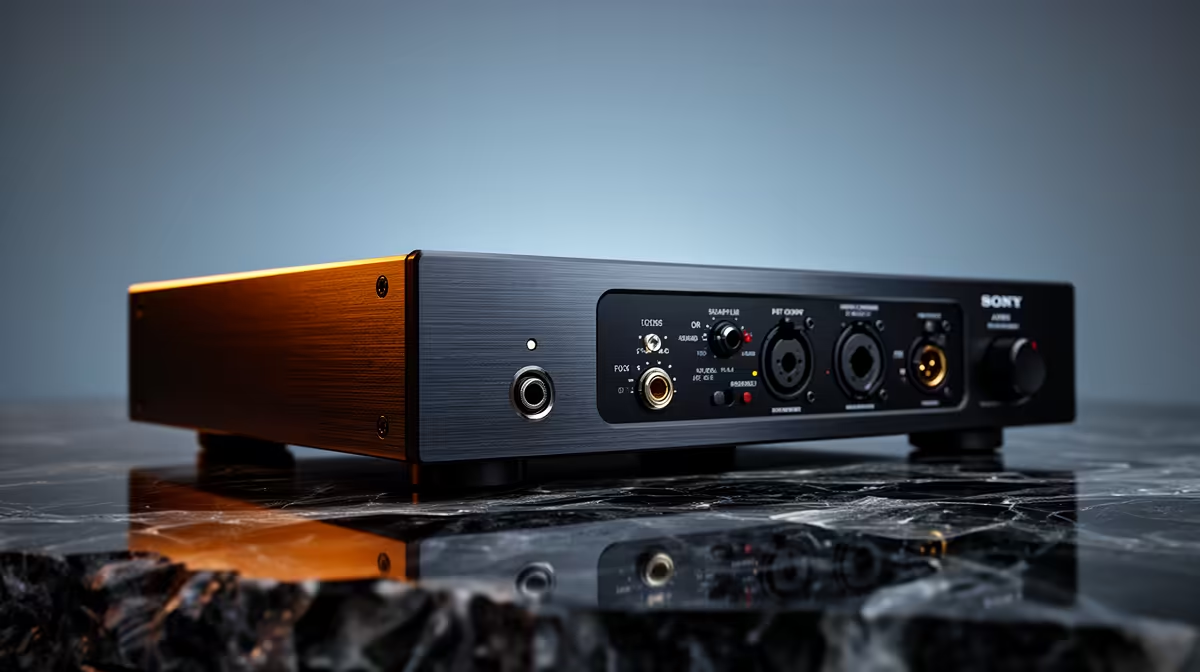
Viewers tolerate a slightly soft image far more readily than a voice that sounds like it was recorded in a stairwell. Stream audio that is hissy, thin, or buried under noise signals amateur production regardless of how sharp the camera is. High-gain preamps address the root cause at the source, lifting the quiet output of a dynamic microphone with clean analogue amplification before any noise has a chance to compound.
Quick Answer
High-gain preamps matter for streaming because they amplify a dynamic mic's signal in the analogue domain, where gain is clean, rather than in software, where every decibel of boost also raises the noise floor. A preamp rated to 65dB with near -128dB equivalent input noise keeps stream audio quiet and full even in an untreated room.
🔧 Why Streaming Dynamic Mics Need More Gain Than Interfaces Provide
The most popular streaming microphones are cardioid dynamic designs. Their directional pickup pattern focuses on the presenter and ignores the room, but the trade-off is a quiet output voltage around -55 to -60 dBu at normal speaking distance, substantially below the line level downstream equipment expects.
Getting to a usable signal requires 55 to 65dB of gain. A basic interface offers around 45 to 50dB of clean amplification, which sounds sufficient until you factor in that self-noise increases toward the top of any gain range. The last 10dB on a budget interface often adds audible hiss sitting under the voice on stream.
A preamp built for high-gain work is engineered to stay quiet across its full range. The circuit prioritises low equivalent input noise and delivers 65dB of clean amplification rather than running out of headroom partway up the dial.
⚡ The Digital Boost Trap
Streamers who discover their voice is too low in OBS commonly drag the audio filter gain upward in software. The voice gets louder. The noise floor gets louder by exactly the same amount. There is no recovery from this on a live stream.
Digital boost occurs after analogue-to-digital conversion. At that point, noise present in the signal is already encoded as data. Scaling every sample value upward raises signal and noise together in the same ratio. More software gain is the same as telling the noise to speak up.
A high-gain preamp amplifies before conversion. The voice climbs in the analogue domain where a well-designed circuit maintains a strong signal-to-noise ratio. By the time audio enters OBS, the voice is already at a healthy level and the noise floor is the best the hardware can deliver.
🎯 How EIN Figures Translate Into Stream Quality
Equivalent input noise tells you how much hiss a preamp adds at maximum gain. It is always a negative dBu figure. A preamp at -128dB EIN adds vanishingly small self-noise across its full range. A unit at -118dB adds ten times more noise energy, which becomes audible when gain is pushed high.
For streaming, where gain is often set close to maximum for a quiet dynamic mic, a preamp near -128dB EIN is measurably better than one at -120dB. The difference is clearest during silences between sentences. Viewers do not register an EIN figure; they simply hear whether the stream sounds clean or whether there is a steady hiss behind the voice.
Pro Tip ⚡
After setting gain, record 30 seconds of silence in OBS with the mic in position but nobody speaking. Play it back at your normal monitoring volume. What you hear is the combined noise floor of your mic, preamp, room, and PC fan. If it is clearly audible, the hardware chain rather than a software setting is the problem. A high-gain, low-noise preamp reduces that floor significantly.
Frequently Asked Questions
What gain level do most streaming dynamic mics need?
Common broadcast-style dynamics need 55 to 65dB of gain at a standard speaking distance of 15 to 20cm. Below 55dB the voice sounds thin and distant. Below 45dB the signal is too quiet for most streaming platforms to process cleanly without the viewer adjusting their own volume.
Will a high-gain preamp help if my streaming room is noisy?
Partially. A clean preamp reduces the hardware contribution to the noise floor. It does not change acoustic noise in the room. A cardioid dynamic placed 10 to 15cm from the mouth, combined with a clean high-gain preamp, is the most effective combination before any software noise reduction enters the chain.
Is a USB audio interface preamp the same as a dedicated high-gain preamp?
Not always. Many interfaces are designed for a broad range of use cases. A dedicated high-gain preamp or interface specifically rated for high-gain work treats 65dB as the primary design target, which typically produces a quieter circuit at full gain than a general-purpose unit reaching the same nominal figure.
Does more gain always produce more noise?
For a well-designed preamp, no. A unit rated at -128dB EIN can deliver 65dB while remaining quieter at maximum than a budget preamp rated at -115dB EIN at half its range. Gain range and noise performance are separate engineering goals, not a fixed trade-off.
Ready to give your stream the clean, broadcast-level audio it deserves? Browse the audio interface and preamp range at Evetech to find a high-gain option that matches your dynamic microphone and streaming setup.










