You are mid-match on a 5G fixed-wireless connection, your ping sits at a fine 30 milliseconds, and then it leaps to 300 for a second and your shot misses. High ping and latency spikes on 5G while gaming are rarely about your average speed; they are about jitter, the sudden variable delay that wireless links throw in when the cell gets busy or your signal wavers. The fix is less about raw bandwidth and more about stabilising the path between your gateway and the tower.
Quick Answer
5G fixed-wireless latency spikes during gaming come mainly from cell congestion and weak-signal retransmissions, both of which add variable delay you feel as jitter. The most effective fixes are connecting your gaming device by wired Ethernet to the gateway, positioning the gateway for the strongest, most stable signal, and locking to your carrier's best NR band where your hardware allows it.
Why 5G Spikes, Even When Speed Looks Fine
A good 5G fixed-wireless link can sit comfortably below 30 milliseconds of latency. The trouble for gamers is not that average, it is the spikes around it. Two causes dominate.
First, congestion. A 5G cell is shared among everyone connected to that tower. During busy evening hours, contention for airtime grows and your packets wait their turn, producing intermittent delay that lands right when the network is busiest.
Second, weak-signal retransmissions. When your signal is marginal, packets get corrupted in the air and have to be sent again. Each retransmission adds delay, and because it happens unpredictably, it shows up as jitter rather than a steady higher ping. A gateway that flickers between signal states is the visible symptom of this.
Fixes That Actually Reduce the Spikes
Work through these in order, since the earlier ones address the biggest causes.
- Go wired from the gateway to your device. Plug your PC or console into the gateway with an Ethernet cable rather than relying on its Wi-Fi. This removes home wireless interference from the equation and gives the gaming device a clean, low-jitter handoff to the 5G link. It is the single highest-impact change for most people.
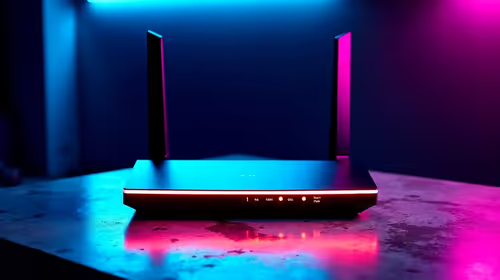
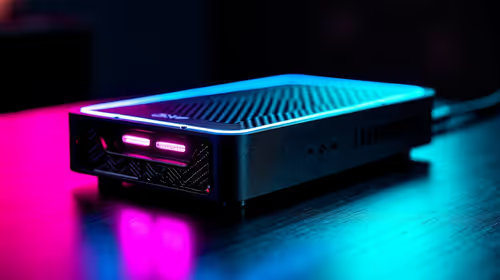
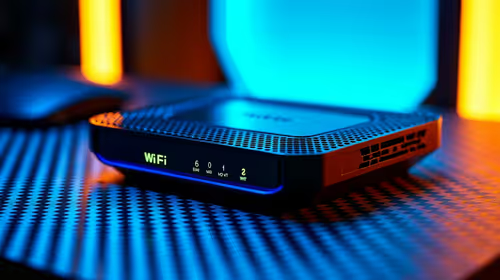
- Position the gateway for signal strength. Because the gateway stays in one spot, you can hunt for the best location, often a window facing the tower or a higher shelf. Stronger, steadier signal means fewer retransmissions and fewer spikes. Move it, watch the signal indicators, and settle where they are highest and most stable.
- Lock to the best NR band. If your gateway allows manual band selection, locking to the strongest 5G NR band your SA carrier offers in your area can stop the constant band-switching that causes brief drops. This is hardware-dependent and worth testing carefully. You can compare gateways and networking gear in the networking range at Evetech if your current unit lacks the controls you need.
- Reduce competing traffic. Large downloads, cloud backups and multiple 4K streams running during a match all eat into the same shared airtime. Pausing them while you play smooths out your latency noticeably.
Setting Realistic Expectations
5G fixed wireless is a genuinely capable gaming connection when the signal is strong and the cell is not saturated, often delivering latency in the same range as many fixed-line options. What it cannot fully escape is the shared, over-the-air nature of the link: peak-hour congestion and weather can still nudge jitter upward. The goal is to remove every controllable source of delay so the only variable left is the network itself. For the cables, switches and gear that tidy up the wired side of your setup, the accessories best sellers at Evetech cover the essentials.
Frequently Asked Questions
Why does my 5G ping spike only sometimes?
Spikes usually trace to congestion or weak-signal retransmissions, both intermittent. The cell is busiest in the evenings, and a marginal signal resends corrupted packets unpredictably, so the delay arrives in bursts rather than as a steady higher ping.
Does using Ethernet really help on 5G?
Yes. Wiring your gaming device to the gateway removes home Wi-Fi interference and gives a clean, low-jitter connection to the 5G link. It is typically the most effective single fix for latency spikes.
Should I lock my gateway to a specific band?
If your hardware supports manual band selection, locking to the strongest NR band in your area can stop disruptive band-switching. It is hardware-dependent, so test it and keep the setting only if your latency improves.
Where should I put my 5G gateway?
Place it where the signal is strongest and steadiest, often near a window facing the tower or up high. A stronger signal means fewer retransmissions, which directly reduces jitter and spikes.
Is 5G good enough for competitive gaming?
It can be, with a strong signal and a wired device, often matching fixed-line latency. Its limit is the shared wireless medium, so peak-hour congestion can still cause occasional jitter that a dedicated line avoids.
Want a steadier connection for online play on 5G? Browse the networking range at Evetech for the cables and gear that lock down the wired side of your setup.