


Quick Answer
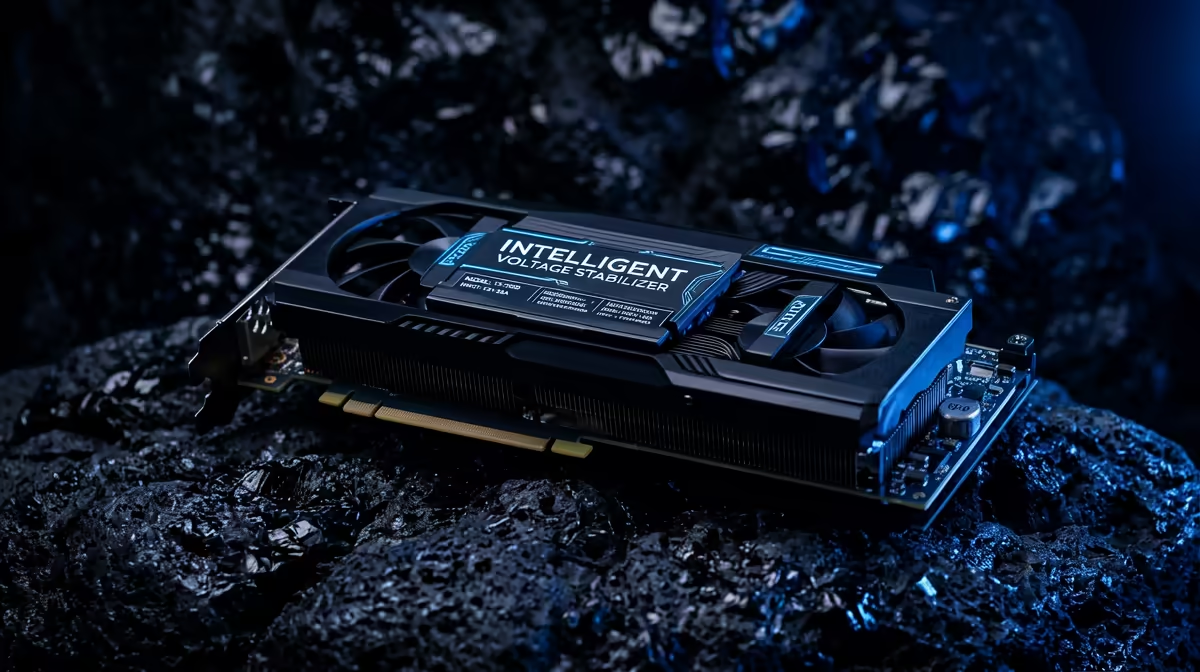
A GPU-First Intelligent Voltage Stabilizer (IVS) is a dedicated fast-response regulation circuit in select premium PSUs that prioritises voltage stability on the 12V GPU rail during transient power spikes. When an RTX 5090 surges power demand in under a millisecond, the IVS circuit responds faster than standard feedback loops, keeping the 12V rail within tighter tolerances and preventing destabilising micro-drops.
How IVS Differs From Standard Voltage Regulation ⚡
Conventional PSU voltage regulation responds to load changes across all rails with a single feedback loop. When an RTX 5090 spikes from 300W to 600W in under a millisecond, standard feedback takes several microseconds to compensate, during which the 12V rail can briefly sag by 0.3V to 0.6V. A GPU-First IVS circuit adds a dedicated fast-response path that monitors the GPU rail specifically and pre-charges capacitor banks before the main loop catches up. The result: a rail that holds within 1 to 2% of 12V nominal during peak transients, versus the 3 to 5% deviation allowed under ATX 3.0. For South African builders running RTX 5090 or high-overclocked RTX 5080 builds, this tighter delivery translates to stability during the most demanding gaming and rendering scenarios.
When IVS Makes a Measurable Difference 🎮
For standard gaming at default GPU settings, a quality ATX 3.1 PSU without IVS provides adequate stability. IVS becomes relevant in three scenarios: extreme overclocking where GPU voltages are pushed beyond stock; multi-GPU NVLink workstations where two high-TDP cards spike simultaneously; and competitive gaming where GPUs rapidly cycle between idle and full load during frequent loading screens. PSUs with GPU-first IVS demonstrated fewer instability events at given overclock voltages versus standard ATX 3.1 units of equal wattage in overclocking benchmarks.
Which PSU Brands Implement IVS and SA Pricing 💰
GPU-First IVS is found primarily in premium PSU lines. ASUS ROG Thor Platinum III and select Seasonic Prime TX variants implement dedicated GPU-rail fast-response regulation. These units sit in the R5,500 to R9,000 range for 1000W to 1200W variants currently stocked at Evetech. IVS is typically accompanied by Japanese-grade capacitors, fully modular cabling, Platinum or Titanium certification, and 10-year warranties. For a build centred on an RTX 5090, the combined IVS, ATX 3.1 compliance, and extended warranty package justifies the premium over a mid-tier Platinum unit.
Pair IVS PSUs With the Included Native 12V-2x6 Cable ⚡
IVS circuit benefits are best realised through the native 12V-2x6 cable included with the PSU, which is rated for low resistance across its full length. Using a third-party generic cable instead of the included cable adds impedance that the IVS circuit cannot fully compensate for, partially negating its advantage during high-current spikes.
FAQ
Is GPU-First IVS the same as OCP (over-current protection)?
No. OCP shuts the PSU down when current exceeds a safety threshold. IVS proactively maintains rail voltage within tight tolerances to prevent the sag that might otherwise trigger OCP. They are complementary features: IVS keeps the system stable; OCP is the last line of defence.
Does IVS help with GPU driver crashes during gaming?
Sometimes. Driver crashes can have multiple causes including thermals, memory errors, or driver bugs. When the root cause is 12V rail instability during high-transient GPU loads, an IVS-equipped PSU can eliminate that specific failure mode. If crashes persist after switching PSUs, the cause lies elsewhere.
Is GPU-First IVS available on PSUs below R5,000 in South Africa?
Currently no. IVS is limited to premium tiers above R5,000. Mid-range ATX 3.1 Platinum units in the R2,500 to R4,500 range use standard regulation circuits fully adequate for the vast majority of SA gaming use cases.
Building a premium GPU rig that demands stable power delivery? Evetech stocks high-end PSUs with advanced voltage regulation for RTX 5000-series and high-wattage GPU builds in South Africa.










