


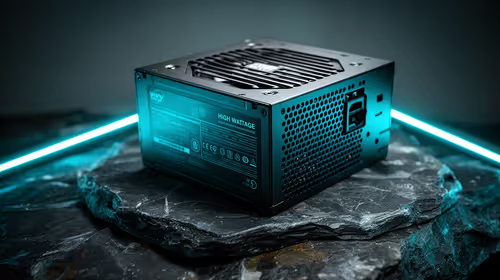
550W PSU Planning for RTX 5080 Super Builds in SA
550W for RTX 5080 Super needs a full-build check, not a simple yes. Review GPU guidance, CPU draw, transient load, connectors, PSU quality, and upgrade plans before deciding.
Read moreStore 3D printing filament sealed, dry and clearly labelled between jobs, then test it before a large print. A simple routine matters more than guesswork in changing local conditions; ELEGOO Galaxy PLA is a R499, 1kg spool of glossy 1.75mm plant-based filament.

South African weather can change sharply between a dry inland afternoon and a humid coastal spell, but storage should not depend on panic. Storing 3D printing filament well means using a sealed routine, clear spool labels and a short condition test before important work. Consistency beats guessing from the forecast.
Keep filament sealed and dry between jobs, protect the loose end and record when each spool was opened or last printed cleanly. At R499 for 1kg, ELEGOO Galaxy PLA deserves the same disciplined storage as any material reserved for visible work. Test the 1.75mm spool on a compact model if its condition is uncertain.
Use a container that closes reliably and organise dry-storage material according to its instructions. Keep spools away from open windows, damp utility spaces and other avoidable exposure. A consistent location makes it easier to notice when handling changes.
Label the material, colour or effect, opening date and last successful print. The note prevents an old issue from being blamed on a new profile. Evetech's 3D printing filament category can help makers plan storage capacity around the range they actually use.
Fasten the filament end so the coil cannot loosen and cross beneath another loop. A tangle may interrupt feeding later and resemble inconsistent material behaviour. Avoid sharp bends when routing the strand back into its holder or storage position.
When returning the spool to service, watch the first unwind and feed. Start from the saved PLA baseline, not a profile that was heavily altered during an unrelated troubleshooting session.
Use a known sample containing the surfaces that matter to the next project. Compare flow, layer texture and geometry with the previous successful piece. For Galaxy PLA, rotate both prints under the same light so the glossy colour shift does not disguise structural differences.
The Evetech 3D printer range provides machine context when a new setup is being assembled. Existing equipment should be loaded and maintained according to its own instructions. Storage is one part of a reliable chain from spool to finished object.
Coastal, inland and seasonal conditions vary, but a postcode does not diagnose a spool. Use the same sealed-storage principles, then respond to observations from the actual room. A reliable container and labelled baseline travel better than a rule copied from a different climate.
Check the storage area after meaningful weather changes or long periods of disuse. If the sample remains consistent, preserve the routine rather than adding unnecessary steps. If it changes, inspect feed, container and printer condition together. This approach respects local variation while keeping the investigation anchored to evidence from the maker's own environment.
For a workshop with several users, assign responsibility for closing containers and updating labels after each session. Shared storage fails when everyone assumes another person secured the spool. A quick sign-off beside the material is more reliable than a complicated rulebook. It also shows who last handled the Galaxy PLA if a tangle or unexpected condition appears at the next print.
Storage protects both print behaviour and presentation value. This Galaxy PLA is designed to run with the approachable dependability of traditional PLA, then leave a brilliant glossy surface carrying rich transitions and moving reflection. Moisture-related roughness would interfere with that finish before the object reaches its display position. A sealed routine therefore preserves more than basic extrusion; it protects the reason for choosing the decorative spool.
The plant-derived biodegradable formulation does not remove the need for careful workshop handling. Label the 1kg spool, secure its loose end and keep its last clean sample nearby. A small known model can then show whether the stored filament still produces the deep-space lustre expected from the material.
Inspect the seal whenever the spool returns to storage and use the same simple handling order each time. Consistency makes changes in feeding or surface clarity easier to notice before an important print consumes substantial material.
Keep that reference under the same inspection light for meaningful comparisons.
Record the material or effect, opening date and last clean print so later troubleshooting has useful history.
A loose coil can cross over itself and snag during printing, creating feed interruption that may be mistaken for another issue.
Run a familiar compact model beside the retained clean reference before starting a long or important job.
Check steady extrusion and layer consistency first, then compare gloss and angle-dependent colour beneath matching light.
Ready to protect every open spool between projects? Browse Evetech's filament and 3D printer choices, then build a labelled sealed-storage routine around the materials you use most.
Record the material or effect, opening date and last clean print so later troubleshooting has useful history.
A loose coil can cross over itself and snag during printing, creating feed interruption that may be mistaken for another issue.
Run a familiar compact model beside the retained clean reference before starting a long or important job.
Check steady extrusion and layer consistency first, then compare gloss and angle-dependent colour beneath matching light.
550W for RTX 5080 Super needs a full-build check, not a simple yes. Review GPU guidance, CPU draw, transient load, connectors, PSU quality, and upgrade plans before deciding.
Read more
8000Hz polling is overrated for most SA gamers because gains can be tiny next to battery drain and monitor limits. Mbombela players should weigh mouse feel, game support, and system stability before chasing the number.
Read more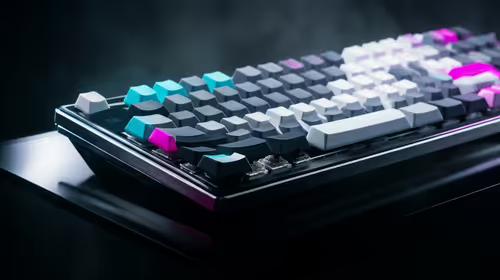
Magnetic switches are taking over SA gaming keyboards because actuation can be tuned. For Sandton gamers, rapid trigger, reset control, and profile depth can help, but layout, key feel, and software quality still matter.
Read more
Polokwane oled monitor value questions need cautious SA context because pricing can move with availability, exchange rates, specs, and warranty support. Treat the trend as a planning signal, not a fixed price promise.
Read more
Arc B580 budget builds for Midrand gamers can shift with exchange rates, supply, specs, and model tier. Treat the title as a buying prompt, then compare SA warranty, timing, and build priorities.
Read more
ROG Ally X may beat the LCD Steam Deck for SA gamers who value stronger handheld performance, more memory, and Windows flexibility. Compare battery life, controls, game libraries, and Polokwane support needs before deciding.
Read more
Minisforum's M2 Pro pairs Core Ultra X7, Arc B390 graphics and 32GB onboard memory in 1.8 litres. SA buyers should weigh its fixed memory and $1,439 launch offer against local mini PCs.

Lenovo says Legion Go failures linked to BIOS N3CN42WW are not user error. Affected SA owners should stop retrying the update, preserve proof and open a support case.

Smart monitors can add apps and convenience, but they also add privacy settings and unwanted-software risk. SA buyers should audit the operating system before paying for extras.

A fake 113GB GTA VI ISO reportedly used empty padding around a small malware payload. SA gamers should delete unofficial builds, keep Windows security active and wait for official channels.

ASUS calls the ROG GT-BN98 the first Wi-Fi 8 gaming router. SA buyers should fix coverage and client limits before paying for a future wireless standard.

Apple's M6 Mac mini adds faster AI, graphics and networking in the same compact format. SA buyers should wait for a rand listing before comparing value.
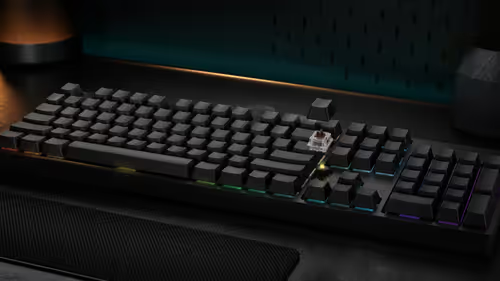
The Vulcan II XP adds hot-swappable switches, sound damping and gaming controls to a full-size wired board. SA buyers should compare feel before features.

Microsoft says Windows on Arm now has over 7,000 verified apps and games. SA buyers should still check each driver, game and work tool before switching.
550W for RTX 5080 Super needs a full-build check, not a simple yes. Review GPU guidance, CPU draw, transient load, connectors, PSU quality, and upgrade plans before deciding.

Skyrim HD texture packs that actually run on RX 9070 helps SA readers plan hardware, settings, compatibility, and upgrade trade-offs. Check GPU, CPU, RAM, storage, monitor, and stability needs without risky performance claims.
8000Hz polling is overrated for most SA gamers because gains can be tiny next to battery drain and monitor limits. Mbombela players should weigh mouse feel, game support, and system stability before chasing the number.

Wi-Fi 7 or Wi-Fi 6e for streaming on twitch and youtube should be judged by fit, not a single winner. Compare compatibility, latency, capacity, upgrade path, cost planning, and South African setup needs.