


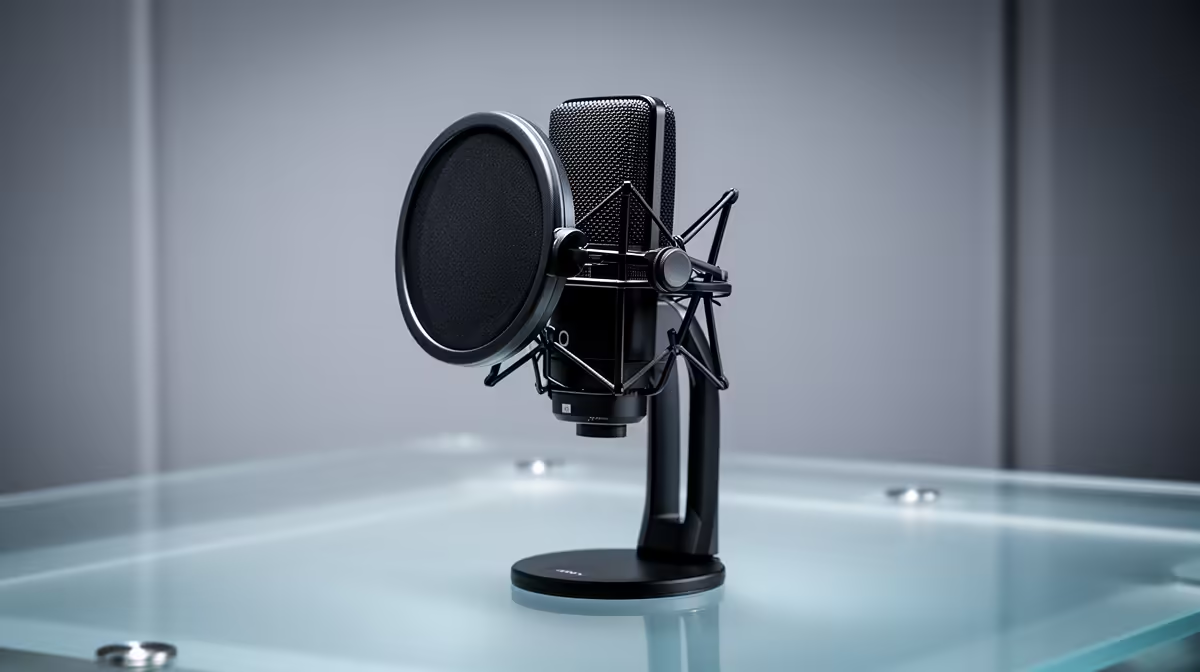
Say the word "podcast" aloud three times quickly and listen back on a recording. That second syllable, the hard plosive burst, is the problem an integrated pop filter in condenser mics is built to solve. The filter helps substantially, but claiming it removes plosives completely is overstating the case. The honest picture is more useful: it handles most of the issue, and the remaining fraction responds to technique.
Quick Answer
An integrated pop filter greatly reduces harsh plosives by breaking the fast air burst from p, b and t sounds before it reaches the capsule. It will not eliminate every plosive at 100 percent. Pairing it with a slight off-axis angle and a 15cm recording distance cleans up the rest.
🔧 How the Mesh Actually Intercepts a Plosive
The science is straightforward. When you produce a hard consonant like "p" or "b", your lips release a concentrated burst of air moving forward at relatively high speed. That burst is not a sound wave, it is a physical pressure event. When it hits a condenser capsule directly, the diaphragm responds to both the burst and the word simultaneously, and the burst registers as a sharp low-frequency thud under roughly 200Hz.
The fine mesh of an integrated pop filter works by breaking that burst into smaller, slower-moving streams before any of them reach the capsule. The sound waves carrying your voice pass through virtually unaffected because they are pressure variations in the air rather than the moving air itself. The result is that the consonant sounds crisp on the recording while the physical burst never registers as a thud.
Most integrated filters diffuse enough of the burst to handle everyday speech and close-mic podcasting. The cases where residual plosives break through are concentrated bursts from very energetic or loud speech, typically certain hip-hop delivery styles, aggressive commentary or close-mic work under 8cm. In those situations the filter catches the bulk of the burst but a fraction passes through.
⚡ Where the Filter Cannot Help
Knowing the limits of a pop filter is as useful as knowing its strengths. The mesh does nothing for room echo, background noise or the hiss of a high gain setting. These are distinct problems that require different solutions.
A South African home office or bedroom studio often has at least one hard-surface issue, bare walls, tile floors or a glass window close to the desk. None of that affects the pop filter's performance, but it does mean the recording still carries room noise that listeners will notice. A rug, heavy curtains or a stocked bookshelf behind the recording position does more for overall perceived clarity than any filter specification.
The filter also does not compensate for technique on words with heavy plosive consonants. "B" sounds in words like "base", "build" and "broadcast" push substantial air at the capsule. "P" sounds in words like "power" and "produce" are the most common problem across most speakers. Knowing your trigger consonants lets you prepare for them.
✨ Getting the Remaining Fraction Right With Technique
Off-axis positioning is the primary technique that handles what the integrated filter leaves over. Speaking at 20 to 30 degrees away from directly in front of the capsule means plosive air travels forward from your mouth past the edge of the mic rather than into its centre. The cardioid pattern still captures your voice clearly at that angle, but the physical burst misses the capsule almost entirely.
Recording at 15cm rather than 5cm also reduces plosive impact substantially. Closer distances push more air volume at the capsule per word. The filter diffuses proportionally, but the more air volume it must handle, the more that slips through. A 15cm distance combined with the off-axis angle and the integrated filter creates three separate layers of plosive reduction working simultaneously.
For very close, loud styles, adding a clip-on mesh approximately 5cm in front of the capsule adds a second physical barrier. For everyday speech, commentary and podcasting, the integrated filter on its own is sufficient.
Frequently Asked Questions
Can a built-in pop filter remove every plosive completely?
Not fully, but it removes the substantial majority. Very hard p and b sounds from energetic delivery may still push some of the original burst through. That residual is much smaller than an unfiltered burst and is often inaudible in final edited audio. Pairing the filter with off-axis angle and appropriate distance handles the remainder without additional hardware.
How does the mesh actually stop a plosive?
The fine mesh breaks the concentrated air burst into smaller, slower streams. Sound waves carrying your voice pass through because they are pressure variations, not physical air movement. Only the physical burst is intercepted. Your consonants arrive sharp and clean, while the thud-causing burst is scattered before it can create a pressure spike.
Does mic angle help beyond what the filter provides?
Yes. Speaking at 20 to 30 degrees off-axis directs plosive air past the edge of the capsule. The cardioid pattern still captures your voice clearly at that angle. Off-axis positioning and an integrated filter address the same problem from two directions, making the combination more effective than either alone.
Is a built-in filter as effective as a separate clip-on screen?
Nearly as effective for everyday use. A quality integrated filter handles normal speech and podcasting without anything extra. A separate clip-on mesh placed 5cm out adds a second barrier for very loud or very close-mic delivery styles. For most creators, the integrated filter is sufficient.
Will backing away from the mic fix plosives without a filter?
Partly. At 25cm the air burst disperses enough to reduce impact, but you lose the proximity warmth that makes cardioid condensers sound full. The better approach is staying at 12 to 15cm where proximity effect is present, using the integrated filter for the burst, and adding slight off-axis angle for the remainder. Distance alone solves one problem by creating another.
Ready to record vocals without fighting plosives every take? Browse the condenser microphone range with integrated pop filters designed for South African podcasters and streamers who record in real home studios.










