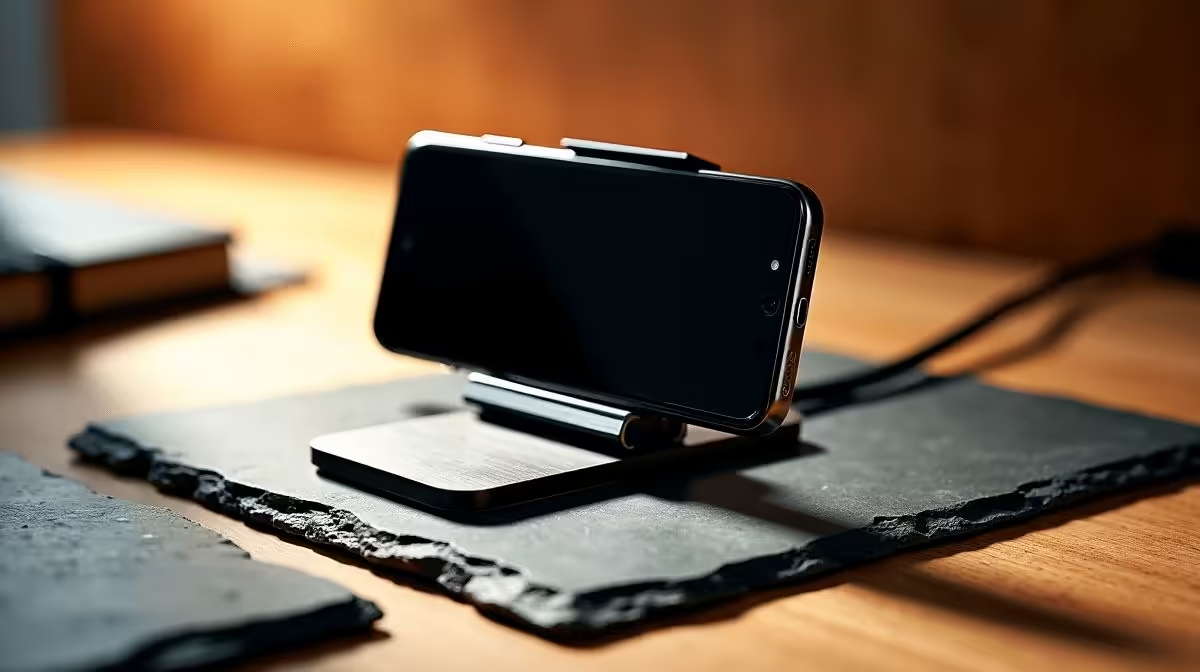
The fear that a magnet on your dashboard will silently wreck your phone is one of the most persistent myths in car accessories. Magnetic car phone mounts have been on South African roads for years, and the concern about damage resurfaces every time someone upgrades to a flagship device worth R15,000 or more. The truth is far less alarming, with one specific exception worth knowing.
Quick Answer
No, a magnetic car phone mount will not damage your smartphone or degrade its signals, with one caveat: a steel plate placed directly over the wireless-charging coil can interrupt Qi charging. Store data, GPS, cellular, and Bluetooth are unaffected by the static magnetic field these mounts produce.
🗂️ Flash Storage: Why Your Data Is Safe
Smartphones hold data on NAND flash memory, a technology that records information as electric charge trapped in transistor gates. There is no magnetic coating, no spinning platter, no read-write head. A strong field from a neodymium mount passes through that circuitry without interacting with it at all.
The concern about magnets corrupting data belongs to the era of spinning hard drives and old floppy disks, which used a magnetised surface that could genuinely be scrambled. Every phone made in the last decade uses flash storage exclusively. Camera memory cards, the phone's internal SSD, and cached app data are all equally immune. You can hold a rare-earth magnet against a flash drive indefinitely and retrieve the file afterwards without a single corrupted byte.
📡 GPS, Cellular, and Bluetooth: The Signal Question
Radio frequency antennas operate on electromagnetic principles entirely separate from static magnetism. Your GPS receiver picks up a 1575 MHz signal from satellites; your cellular radio talks to a tower at frequencies ranging from 700 MHz to over 3 GHz; Bluetooth runs at 2.4 GHz. None of these are sensitive to the static magnetic field sitting at the mount.
The compass sensor, a magnetometer chip, is a different story. A neodymium magnet placed very close to the magnetometer can offset its calibration, which causes compass-based apps and AR features to show an incorrect bearing. The practical effect is minor: removing the phone from the mount and walking a few steps resets the calibration automatically. Navigation apps that use GPS positioning rather than compass heading for turn-by-turn directions are completely unaffected; only the direction arrow in a static compass app misbehaves while the phone is on the mount.
Battery life is also unaffected. Lithium-ion cells store energy chemically through electrode reactions; the chemistry does not interact with an external magnetic field. No heating, no capacity loss, no accelerated wear from a mount magnet.
🔋 The One Real Caveat: Wireless Charging
Qi wireless charging works by coupling two coils electromagnetically. A steel plate placed directly on top of the phone's rear charging coil disrupts that coupling by acting as a shielding layer, reducing power transfer or preventing a charge connection altogether.
This is not a safety issue; it is a convenience issue. There are two straightforward fixes. First, use a ring-shaped plate that surrounds the charging coil rather than covering it. Most mount kits include both a rectangular and a circular ring plate precisely for this reason. Second, use a MagSafe-compatible phone or case, which already integrates the magnetic alignment ring and requires no added plate. Either approach restores wireless charging to normal operation while keeping the magnetic mount fully functional. Wired charging via USB-C is never affected regardless of plate placement.
Frequently Asked Questions
Can a magnetic mount scramble my SIM card?
No. SIM cards use a contact-based chip, not a magnetic stripe. The chip stores data electrically, making it entirely resistant to external magnetic fields. Bank cards with a magnetic stripe are a separate concern, but your phone's SIM is safe.
Will the mount affect my phone's NFC chip?
NFC operates via a near-field electromagnetic field generated by the phone itself when making a tap-to-pay transaction or pairing a device. The static field from a mount magnet does not interfere with NFC function while the phone is mounted, and there is no residual effect after removal.
Does prolonged mounting gradually weaken phone components?
No evidence supports gradual degradation from a static magnetic field at mount strength. The field is constant and passive; it does not cycle on and off or generate heat in phone components. Manufacturers test handsets in far stronger fields during regulatory certification.
My phone feels warm on the mount. Is the magnet causing it?
The heat is almost certainly from screen brightness, active navigation, and cellular data running simultaneously, which is normal during driving. The magnet itself generates no heat. If wireless charging is active and the plate is partially over the coil, slight inefficiency can add minor warmth, but not to harmful levels.
Does a magnetic mount affect the speaker or microphone?
Speakers contain their own small magnets, and a nearby external magnet can occasionally affect the voice-coil gap in cheaper speakers, producing a very faint tonal shift while mounted. Flagship phone speakers are shielded and positioned well away from the mount contact point, so this is essentially a non-issue in practice.
Confident the science checks out?
Explore the full selection of car phone mounts at Evetech and choose a mount that fits your phone, your case, and your car.