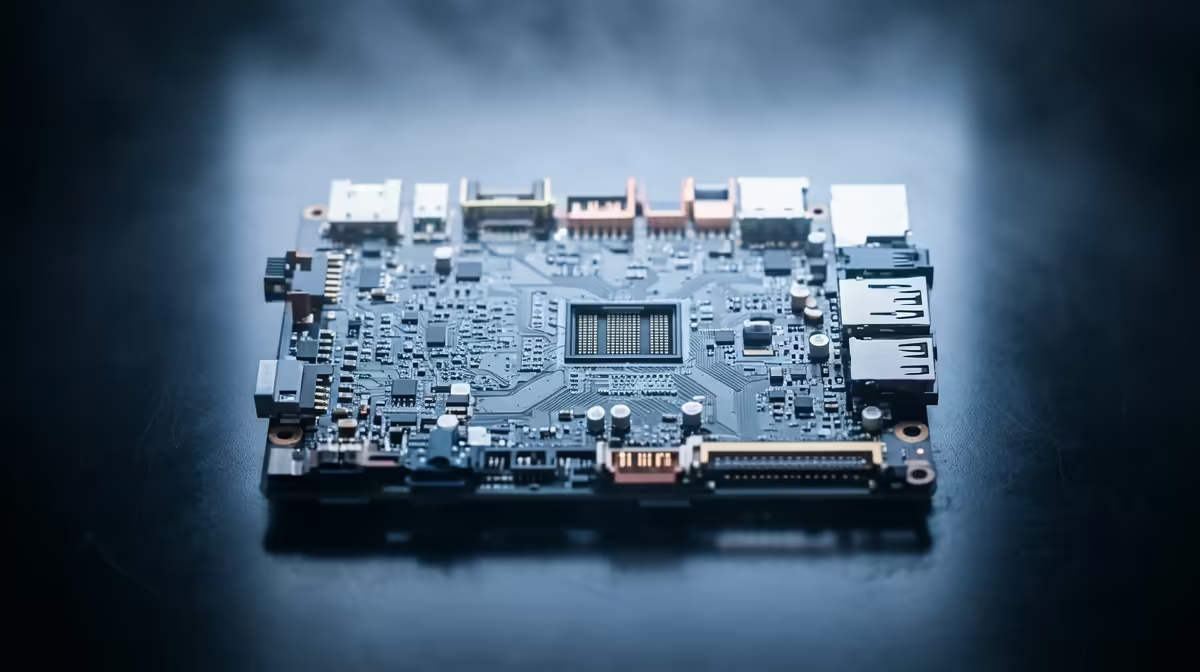
Pick up an Arduino Uno and a Raspberry Pi 5 and they look like cousins, but they are different species. The Uno is a microcontroller: one chip, one program, no operating system, running the instant you power it. The Pi is a single-board computer that boots Linux, multitasks, and behaves like a tiny desktop. Knowing which one a project needs saves money and frustration before you buy a single jumper wire.
Quick Answer
A microcontroller runs a single program on bare metal with no OS, ideal for precise, real-time control of sensors and motors. A single-board computer runs a full operating system and multitasks, ideal for anything needing a screen, networking, or heavier processing. Choose the microcontroller for direct hardware timing, the SBC for general computing.
The Core Difference: Bare Metal vs an Operating System
A microcontroller like the ATmega328P inside the Arduino Uno runs at 16MHz with about 2KB of SRAM. That sounds tiny, and it is, but it is enough to execute one program perfectly and predictably forever. There is no OS to boot, nothing to crash, and timing is rock-steady because nothing else is competing for the chip.
A single-board computer like the Raspberry Pi 5 is a real Linux machine. It boots an operating system, runs multiple programs at once, drives HDMI and USB and Ethernet, and handles Python, C++, Rust and more. That power comes with overhead: it takes time to boot, draws 5 to 15W continuously, and the OS scheduler means hardware timing is never perfectly exact.
Where Each One Shines
Match the board to the job rather than to the spec sheet.
Reach for a microcontroller when the task is reading sensors, driving servos or LEDs, or any job that needs deterministic, instant-on control and low power. A blinking sign, a soil-moisture sensor, a 3D printer mainboard: all microcontroller territory. The Raspberry Pi Pico sits here too, an enhanced microcontroller with a dual-core Arm chip up to 133MHz and 264KB of RAM, far beyond the Uno while still being bare metal.
Reach for a single-board computer when you need an operating system: a retro games console, a home media server, a network ad-blocker, a robot doing computer vision, or anything driving a display and talking to the internet. The Pi 5 handles all of that comfortably.
Plenty of serious builds use both: a microcontroller handling the fast, exact hardware interaction while an SBC manages logic, the interface, networking, and data logging. For smart-home sensors and controllers built on these boards, the smart home and connected device range is a practical starting point.
Cost and Power, Briefly
A Raspberry Pi Pico is one of the cheapest entry points into electronics, while an Arduino Uno costs more but ships with a famously beginner-friendly ecosystem. A full SBC like the Pi 5 costs more again because you are buying a whole computer. Power tracks the same line: a microcontroller sips milliwatts and can run for weeks on a battery, while an SBC draws steady watts and usually wants a wall adapter. To keep a build tidy you will also want cables, cards, and cases, much of which shows up among the best-selling accessories.
Frequently Asked Questions
Is an Arduino a microcontroller or a single-board computer?
An Arduino Uno is a microcontroller board. It runs one program directly on the chip with no operating system, which makes it predictable and instant-on, but it cannot multitask or run desktop software the way a Raspberry Pi can.
Can a Raspberry Pi replace an Arduino?
Sometimes, but not always. A Pi can read sensors and drive pins, yet its operating system makes precise real-time timing harder. For tasks needing exact, jitter-free control, a microcontroller still does the job better.
What is the Raspberry Pi Pico then?
The Pico is a microcontroller, not a single-board computer, despite the Raspberry Pi name. It is essentially a faster, roomier alternative to the Arduino Uno with a dual-core chip and more memory, but it still runs bare-metal code rather than Linux.
Which is better for a beginner?
For learning direct electronics and logic, a microcontroller like the Arduino Uno is forgiving and well documented. For learning computing, programming, and Linux, a single-board computer like the Pi is the better classroom. Many learners end up owning both.
Do I ever need both in one project?
Yes, and it is common. A robot might use a microcontroller for instant motor and sensor control while an SBC handles vision, decision-making, and networking. Pairing them gives you precise timing and real computing power together.