Boot a Raspberry Pi 5 from a microSD card and it works, but it crawls. Switch that same Pi to an NVMe boot drive through an M.2 HAT+ and the difference is night and day: sequential reads jump from tens of megabytes per second into the hundreds, and the whole system feels like a real computer instead of a hobby board waiting on storage.
Quick Answer
NVMe is far faster. A typical microSD on the Pi 5 manages around 40 to 85MB/s, while an NVMe SSD on the M.2 HAT+ hits roughly 800MB/s and beyond in PCIe Gen 3 mode, up to a 20x gain on random reads. The Pi 5's single PCIe lane is rated for Gen 2 by default (about 500MB/s) but can be pushed to Gen 3 for the full speed.
How each option connects
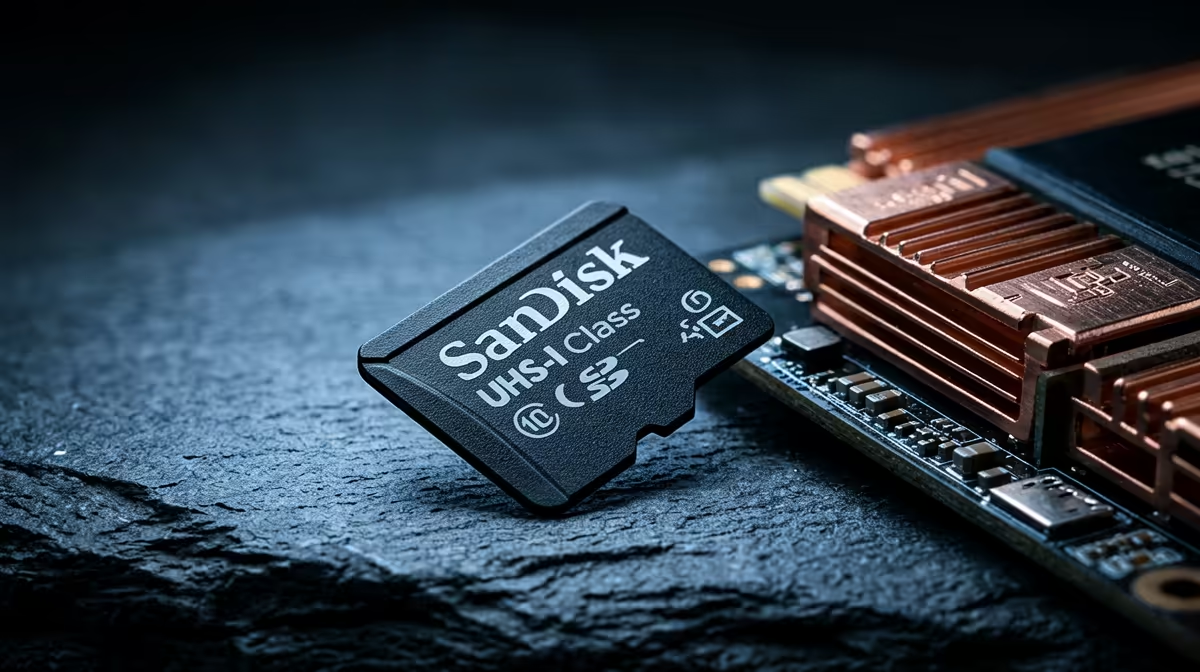
The microSD slot is the simplest path: insert a card, flash an OS, boot. It is cheap and fine for light use, but the card interface is the bottleneck, and microSD cards also tend to wear out under the constant small writes a always-on server generates.
NVMe boot needs an M.2 HAT+, the official add-on board that sits on the Pi 5 and breaks out its single PCIe lane to an M.2 slot. You fit a 2230 or 2242 NVMe SSD onto the HAT+, update the bootloader so the Pi looks to NVMe first, and from then on the Pi boots and runs entirely off the SSD.
The real-world speed gap
The numbers tell the story. Premium microSD cards top out around 85MB/s on the Pi 5. An NVMe SSD on the M.2 HAT+ in Gen 3 mode reaches roughly 837MB/s read and 723MB/s write, and random 4K reads, the operations that make a system feel responsive, jump from about 42MB/s to well over 800MB/s.
That translates into things you actually notice. Boot time drops, apps launch faster, and heavy jobs finish far sooner: compiling a Linux kernel on NVMe took around 42 minutes versus nearly two hours on microSD in published testing. For anything that reads and writes constantly, a home server, a database, a media box, NVMe transforms the experience.
A note on PCIe modes: the Pi 5's lane is officially PCIe Gen 2, which already beats microSD comfortably. Enabling Gen 3 in the config unlocks the 800MB/s-plus figures, and most NVMe drives run stable at Gen 3 on the Pi, though it is technically outside the official rating.
Which should you use?
Stick with microSD if your Pi is a casual tinkering board, you reflash it often, and speed is not a concern. Go NVMe if the Pi is doing real work: hosting services, running a home lab, handling a database, or acting as a desktop. The faster storage and better write endurance pay for themselves the moment the Pi is on around the clock. For Pi-class small-form-factor computing, the mini PC range at Evetech is a useful comparison point, and browsing the top-selling compact PCs at Evetech shows what buyers opt for when they step beyond a single-board build.
Frequently Asked Questions
Can the Raspberry Pi 5 boot directly from NVMe?
Yes. With an M.2 HAT+ fitted and the bootloader updated to prioritise NVMe, the Pi 5 boots straight off the SSD with no microSD card needed at all. You set the boot order in the Pi's bootloader configuration.
How much faster is NVMe than microSD on the Pi 5?
Substantially. NVMe reaches roughly 800MB/s in Gen 3 mode against around 40 to 85MB/s for microSD, with random reads showing up to a 20x improvement. Boot, app launches and heavy I/O all speed up noticeably.
Do I need to enable PCIe Gen 3?
Not strictly. The Pi 5 runs the HAT+ at Gen 2 by default, which is already much faster than microSD. Enabling Gen 3 in the config unlocks the highest speeds, and most NVMe drives handle it reliably even though it sits outside the official rating.
Is NVMe worth it for a 24/7 Pi server?
Definitely. Beyond raw speed, NVMe drives handle constant writes far better than microSD, which can wear out under server workloads. For an always-on Pi, the endurance alone justifies the upgrade.