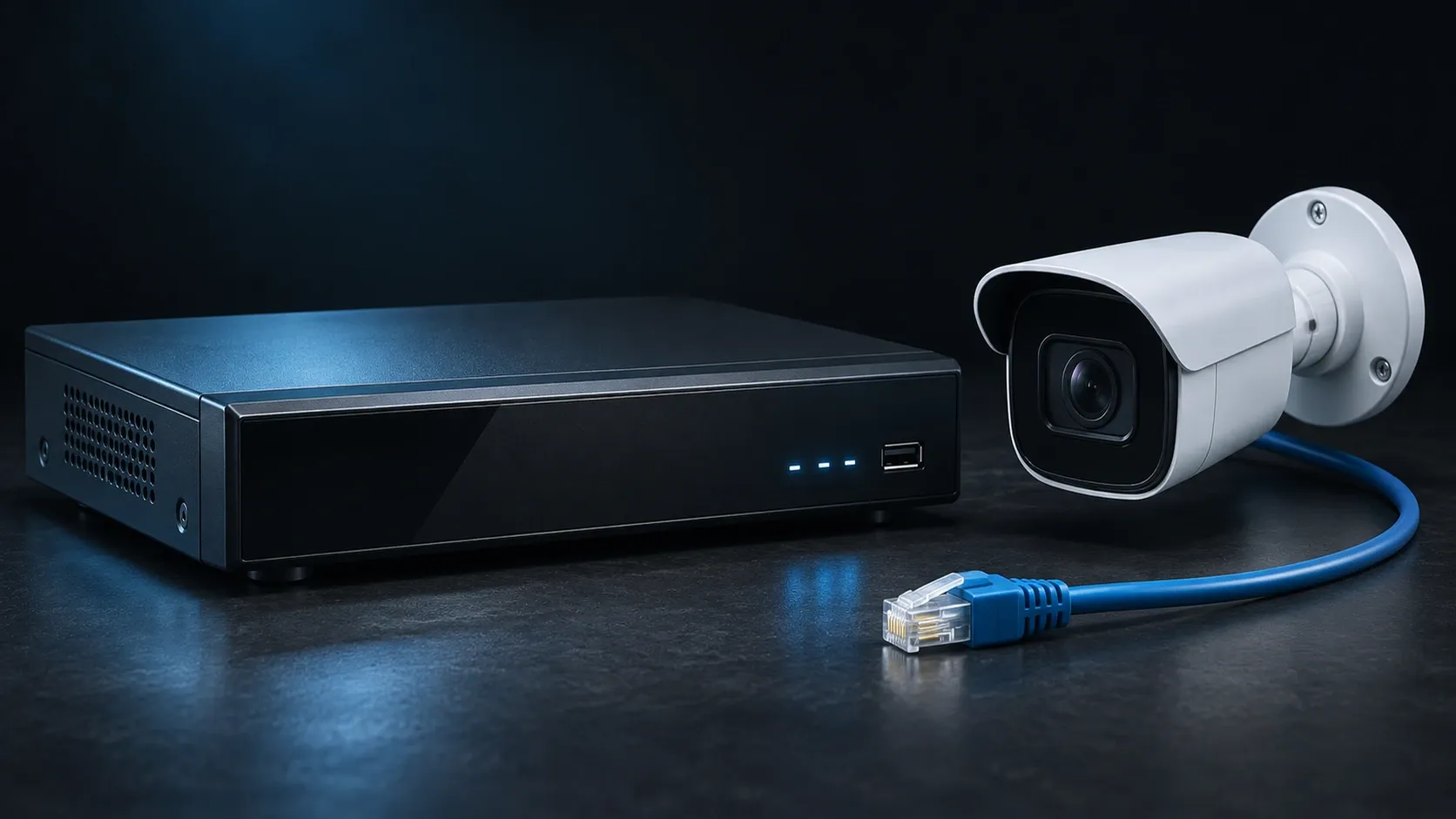
The NVR meaning is network video recorder, and it is the box that turns a handful of separate IP cameras into one organised system. Without it, each camera records on its own or not at all. With it, every feed lands on a single drive that you can search, play back and protect, which is why a yard with several cameras usually ends up with one.
Quick Answer
NVR stands for network video recorder: a device that receives video from IP cameras over your network and stores it on a hard drive. It is the hub of a multi-camera home system. TP-Link's VIGI NVR1104H-4P (R1,799) handles four PoE+ cameras, and the NVR1008H-8P (R2,099) handles eight.
🗄️ What the recorder actually does
An IP camera turns what it sees into digital video and sends it across a cable or Wi-Fi link. The NVR catches those streams, writes them to disk and lets you scrub back through the day. It also gives you one place to set recording rules, rather than visiting each camera in turn.
Because it sits on your network, you can usually watch live views and past clips from a phone app as well.
🔌 How it connects to everything
Cameras
Some recorders include PoE ports, which power and connect a camera through a single cable. Others rely on a separate switch. Either way, each camera needs a good network cable run to the right place.
Your network
The recorder itself plugs into the router or switch so that cameras and your phone can reach it. Check that the cameras and recorder support a common protocol before you buy, because not every pairing works.
📀 Storage decides your history
The drive inside an NVR controls how many days of video you keep. A larger internal hard drive stretches that history, provided the recorder supports the size. Both VIGI recorders above take one SATA drive of up to 10TB and arrive without a disk. Continuous recording eats space quickly, while motion-triggered recording saves clips only when something moves.
If you only plan one or two cameras, a card in the camera might be enough. Once you want steady recordings from several security cameras, the recorder earns its place.
🏠 Is a recorder right for your yard?
One or two cameras rarely need a recorder, because a card inside each camera covers short histories. Three or more cameras, especially around a bigger yard, start to justify a central box.
The recorder gives you one login, one place to search for an event and a larger drive than any camera carries. It also keeps working if a single camera card fails. Weigh that against the extra cabling and a small amount of setup, and you will know quickly which side of the line your property sits on. Think about growth too: a recorder with a few spare channels costs little extra today and saves you swapping the whole box when a fifth camera appears.
Frequently Asked Questions
What does NVR stand for?
Network video recorder. It stores and organises footage sent by IP cameras across your network.
Is an NVR the same as a DVR?
No. A DVR serves analogue cameras, whereas an NVR is made for IP cameras that send digital video.
Where does it plug in?
Connect it to your router or a switch with a network cable so cameras and your phone app can reach it.
Can any camera record to any NVR?
Not always. Both devices must speak a common protocol, so confirm compatibility first.
Why add one if the app shows live video?
The recorder keeps continuous footage on its own drive, so evidence does not hinge on one camera card or your phone.
Ready to build a recorded camera system?
See the security cameras and storage drives at Evetech, and choose the pieces that work together.