Every generation there is a fresh round of arguing over whether graphics bandwidth or storage speed deserves priority on a new build, as if you had to pick one and starve the other. A b650e motherboard with both covered properly makes the question mostly academic rather than a real trade-off.
Quick Answer
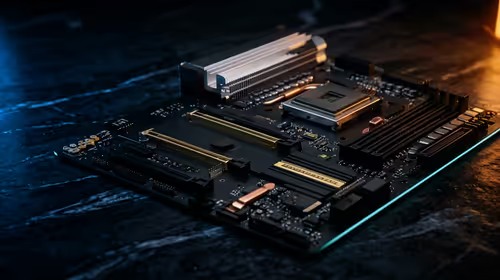
For most gamers, the PCIe 5.0 x16 graphics slot matters more right now than PCIe 5.0 M.2 storage, since GPU bandwidth demand is climbing faster than typical game load times are shrinking. ASUS still fits both onto the R3,499 B650E MAX Gaming WiFi, so neither one gets sacrificed to prioritise the other.
🎮 The Case for Prioritising Graphics Bandwidth
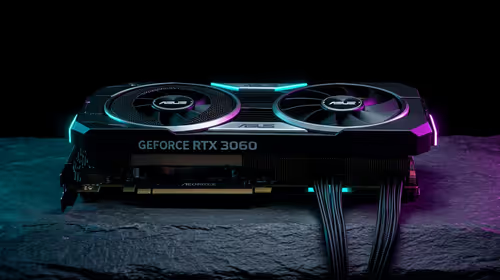
Current and upcoming GPUs are steadily pushing more data across the PCIe bus, particularly at higher resolutions and with frame generation features enabled. A PCIe 5.0 x16 slot gives that headroom now, rather than waiting until a future card actually needs it.
What This Looks Like Day to Day
Most players will not notice a direct frame rate gain from PCIe 5.0 today, since current GPUs do not fully saturate it, but the slot not being the ceiling matters more the longer you keep the same board through a future GPU upgrade.
💾 The Case for Prioritising Storage
Triple PCIe 5.0 M.2 slots on the B650E MAX Gaming WiFi mean faster game installs, quicker level loads in supported titles, and room to add a second drive without bottlenecking. Storage improvements tend to show up more consistently in everyday use than graphics bandwidth headroom does.
Why the Debate Rarely Has a Clean Winner
Both choices solve different problems: graphics bandwidth protects your GPU upgrade path, while storage speed improves daily responsiveness. Since this board includes both at R3,499, the practical answer is to stop treating them as competing priorities.
For the full specification and current price, see the B650E MAX Gaming WiFi page. Builders comparing this decision across other AM5 boards can browse Evetech's AMD B650 lineup, and those open to other AMD chipsets should check the full AMD board catalogue for further comparison.
Frequently Asked Questions
Does my current GPU actually need PCIe 5.0 bandwidth?
Most GPUs today do not fully use PCIe 5.0 bandwidth, so the benefit is mainly future headroom rather than an immediate performance jump.
Will a PCIe 5.0 M.2 drive make games load noticeably faster?
Load time improvements vary by game and how well it is optimised for fast storage, so gains are noticeable in some titles and minimal in others.
Should I choose a board based on graphics or storage priority?
Choosing a board that covers both properly, like this one, removes the need to prioritise one over the other in the first place.
Is it worth paying extra for PCIe 5.0 support I am not using yet?
For a board you plan to keep through at least one GPU or SSD upgrade, yes, since retrofitting PCIe generation later means replacing the whole board.
Does DDR5 speed factor into this graphics versus storage debate?
Not directly, memory speed is a separate consideration from PCIe bandwidth, though the B650E MAX Gaming WiFi also supports DDR5 up to 8000MT/s (OC) alongside both its graphics and storage lanes.
Can I upgrade my GPU and storage separately over time on this board?
Yes, since both the PCIe 5.0 graphics slot and the triple M.2 slots are already in place, you can upgrade either component whenever your budget allows without needing a new motherboard.
Ready to decide where your PCIe 5.0 lanes should go?
The ASUS B650E MAX Gaming WiFi, priced at R3,499, sits near our AMD B650E motherboard shelf, ready to help you weigh a PCIe 5.0 graphics slot against extra M.2 storage.