


Quick Answer
Reinforced sleeved tubing on a closed-loop AIO cooler extends service life by reducing coolant permeation through tube walls, resisting kink formation during routing, and protecting the inner rubber core from UV exposure and physical abrasion inside the case. It is a meaningful quality indicator on AIOs intended for long-term use beyond five years.
The Role of Tubing in a Closed-Loop AIO 🔧
In a sealed AIO liquid cooler, the tubes connecting the pump block to the radiator carry coolant continuously for the device's entire service life, often five to seven years without maintenance.
Plain rubber tubing handles these demands adequately for three to four years in most conditions.
How the Sleeve Improves Durability 🏗️
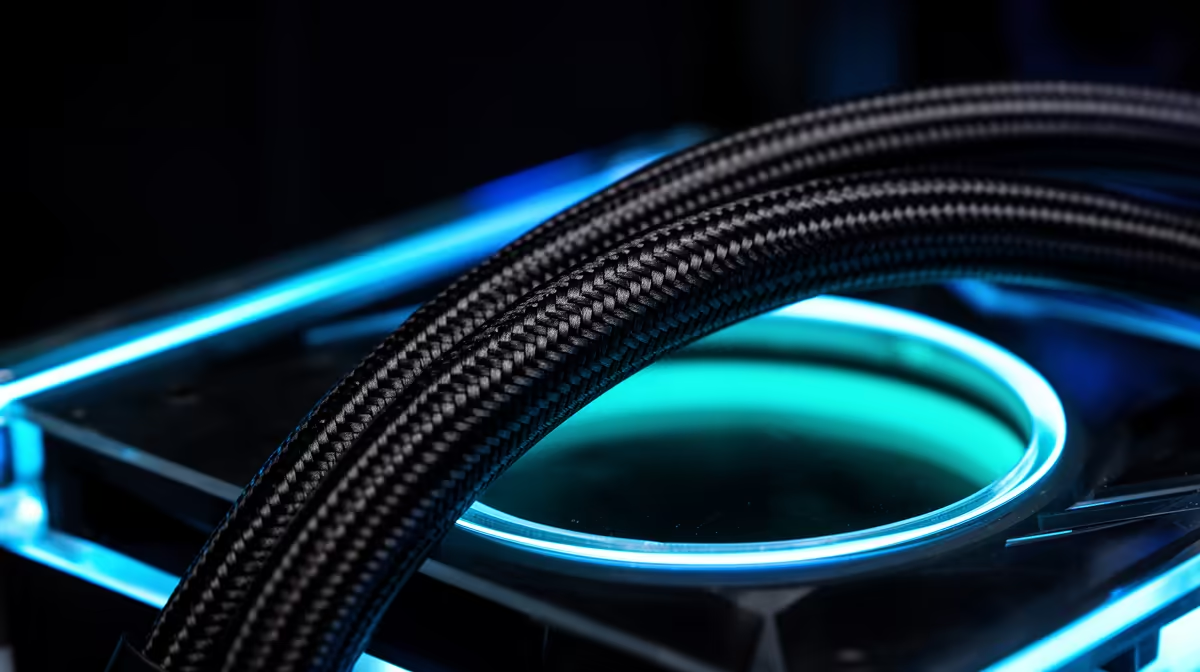
The braided or woven sleeve bonded to the outer surface of quality AIO tubing addresses all three main failure modes. Against permeation, the sleeve adds a physical barrier layer that significantly slows moisture migration through the wall. Independent material tests show sleeved AIO tubes losing 50 to 65 percent less coolant volume per year through permeation compared to equivalent plain rubber tubes.
Against kinking, the textile reinforcement adds hoop strength to the tube cross-section.
For abrasion protection, the outer sleeve material (typically PET braid or nylon weave) is many times more resistant to surface wear than bare rubber. In cases where the tube runs near a cable routing slot edge or metalwork corner, the sleeve sustains contact wear that would abrade through a plain tube within one to two years of vibration from thermal cycling.
What to Look for When Buying ✅
When evaluating AIO coolers at Evetech in the R2,500 to R6,000 range, check whether the product listing specifies reinforced, braided, or sleeved tubing in the specifications.
For South African builders who expect to run the same cooler through two CPU platform upgrades (a realistic scenario given rand-dollar pricing on high-end hardware), the sleeved tubing premium of R500 to R1,000 over a basic AIO is a sound investment toward consistent cooling performance at year six of ownership.
Do Not Force Tube Routing Angles ⚡
Even reinforced sleeved tubing has a minimum bend radius, typically 30 to 50mm. Forcing a tube around a tighter bend than the sleeve can accommodate creates permanent deformation at the kink point. During installation, find a routing path that accommodates gentle curves rather than forcing the tubes around case obstructions. If the routing path is too tight, consider relocating the radiator mounting position before tightening mounting screws.
FAQ
Does sleeved tubing feel noticeably stiffer than plain rubber during installation?
Yes, mildly. Reinforced sleeved tubing has more rigidity at the same tube diameter. During installation you will notice it requires slightly more deliberate positioning to route, but it also holds its routed shape better once positioned. The stiffness does not create installation difficulties in standard full-tower or mid-tower cases.
Can the sleeve on AIO tubing be replaced if it frays?
The bonded sleeve cannot be separated from the tube without damaging the inner rubber core. External aftermarket PET braid can be added over an existing unsleeved tube to provide surface protection, but it does not replicate the permeation resistance of a factory-bonded sleeve.
Are there any AIO coolers with metal-armoured tubing for maximum durability?
Metal braid-reinforced tubing is used in some custom loop components but is rare on retail AIOs due to weight and flexibility requirements. The standard textile-braid sleeved tubing on premium retail AIOs provides the best practical balance of flexibility, permeation resistance, and kink resistance for an installed sealed loop.
Building for the long term and want durable cooling? Browse premium AIO coolers at Evetech, with reinforced sleeved tubing and extended warranty coverage, for builds that need to last across multiple CPU generations.










