Every month a quiet debit order leaves your account for cloud storage, photo backups, and a handful of apps you barely think about. Self-hosted vs cloud is the question of whether that arrangement is worth it, and the answer turns on one thing: where your data actually lives, and who controls it.
Quick Answer
Cloud keeps your data on a provider's servers behind a recurring subscription. Self-hosted runs the same kinds of apps on your own hardware at home, with no monthly fee and your files staying in your house. Cloud is hands off and convenient; self-hosting trades some setup effort for lower long term cost, stronger privacy, and full control.
What each one really means
With cloud services, your photos, documents, and app data sit in a company's data centre. You pay monthly or yearly, the provider handles maintenance and uptime, and you reach your data from anywhere through their app. It is genuinely convenient, and for many people that convenience is worth the fee.
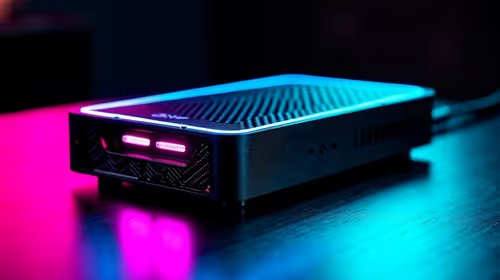
Self-hosting flips it. You run the apps yourself on a small machine at home, often a low power mini PC, and your data never leaves your network unless you choose to expose it. There is no subscription and no third party holding your files. The trade is that you become the administrator: setup, backups, and security are now yours to manage.
The cost picture
Self-hosting usually costs more upfront and less over time. A modest one time hardware spend on a mini PC replaces an ongoing pile of subscriptions, and the savings compound month after month. People who consolidate several paid services onto a single home server often recover the hardware cost within a year or two, after which the running cost is mostly a few Rand of electricity, since efficient mini PCs draw as little as 10 to 15 watts and run silent and fanless.
Cloud has no upfront cost and predictable monthly billing, which suits anyone who would rather not own or maintain hardware. The catch is that the meter never stops, and as your storage needs grow so does the bill. The compact, low power machines in the mini PC range at Evetech are exactly the kind of hardware that makes the self-hosted maths work, sipping power while running quietly out of sight.
Privacy, control, and the honest trade-offs
Privacy is the strongest argument for self-hosting. Your data stays on your own hardware, so no provider scans it, mines it, or analyses it, and you are not locked into one vendor's ecosystem. You decide what runs, when it updates, and who can reach it.
But control cuts both ways. A managed cloud provider patches vulnerabilities and configures security for you. Self-host, and that responsibility is yours; a missed update or a misconfigured firewall can leave you less secure than a professional service would. You are also the one who restores from backup when a drive fails. Self-hosting rewards people comfortable with a little technical work, while cloud rewards those who would rather it just happen. For a sense of what compact, capable home machines are going for, the PC best sellers give a useful reference point before you commit.
Who should pick which
Choose cloud if you value zero maintenance, want guaranteed uptime without lifting a finger, and do not mind a recurring fee. Choose self-hosting if you want to cut subscriptions, keep your data private and in your own home, and are happy to spend a weekend setting things up and the occasional hour keeping them current. Plenty of people end up running both, self-hosting the data they care about most and leaving the rest in the cloud for convenience.
Frequently Asked Questions
Is self-hosting cheaper than cloud?
Over time, usually yes. You pay more upfront for the hardware but eliminate recurring subscriptions, and an efficient mini PC adds only a small electricity cost. Most people recover the hardware outlay within a year or two and save steadily after that.
Is self-hosting hard to set up?
It takes some technical comfort but is far more approachable than it used to be. Cheap mini PCs, containerised apps, and large helpful communities mean a reliable private setup is realistic for a motivated beginner willing to follow guides.
Is my data safer self-hosted or in the cloud?
It depends on you. Self-hosting keeps data private and off third party servers, but security becomes your job, and a missed patch can leave you exposed. A managed cloud provider handles security professionally, so the safer option hinges on how diligently you maintain your own setup.
What hardware do I need to start self-hosting?
A low power mini PC is the popular starting point, drawing as little as 10 to 15 watts and running silently. It can comfortably handle file storage, media streaming, and a stack of self-hosted apps for a household.
Tired of stacking up monthly subscriptions? Take a look at the mini PC range at Evetech and build a quiet home server that keeps your data yours.