If your content stays exclusively on YouTube or Twitch in standard 16:9, this is a short conversation. But the moment you start publishing Shorts, Reels, or TikTok clips alongside your desktop stream, vertical and horizontal camera mounting stops being a novelty and becomes a production efficiency question with real resolution implications.
Quick Answer
Dual mounting matters if you publish both landscape desktop content and portrait short-form video. Rotating the sensor to 9:16 uses the full pixel array. Cropping a 16:9 frame to portrait instead discards over half the captured resolution, leaving noticeably softer portrait footage at identical settings.
🎯 Who Actually Needs Dual Mounting
The honest answer is: not everyone. A streamer who publishes exclusively to platforms displaying 16:9 content has no practical need for vertical capability. A fixed horizontal camera covers the entire use case without any rotation hardware or additional setup complexity.
The creator who benefits from dual mounting is one running a deliberate multi-format strategy: desktop streams in landscape going to YouTube or Twitch simultaneously with portrait clips going to a short-form platform. That content workflow requires the same camera to produce full-quality output in both orientations, and the quality gap between rotating the sensor and cropping post-capture is significant enough to justify the hardware capability.
Dual mounting also suits anyone building a setup that needs to adapt as platform strategy evolves. Short-form portrait content drives substantial organic reach on most major platforms in 2026. A creator who is not yet publishing portrait content but expects to within the next year benefits from having the capability already built into the rig.
📺 The Resolution Argument for True Vertical
Cropping is not the same as rotating. When software crops a 1920 by 1080 landscape frame to a 9:16 portrait ratio, the result is approximately 607 pixels wide by 1080 pixels tall. That is around a third of the original horizontal resolution repurposed into the portrait frame, which appears noticeably soft at full screen on a mobile device.
A camera that physically rotates its sensor to portrait captures the full 1080 horizontal pixel count across the portrait width instead, producing a 1080 by 1920 frame with all available detail intact. Viewed side by side on a phone screen, the difference between a true vertical capture and a cropped landscape one is visible and meaningful, particularly in motion.
Higher resolution cameras narrow this gap somewhat. A 4K source cropped to portrait produces roughly 1080 pixels wide and 1920 tall, which is equivalent to true 1080p vertical capture. But at 1080p native, cropping leaves the portrait footage well short of what a physical rotation delivers.
🔧 Mounting Hardware for Dual Orientation
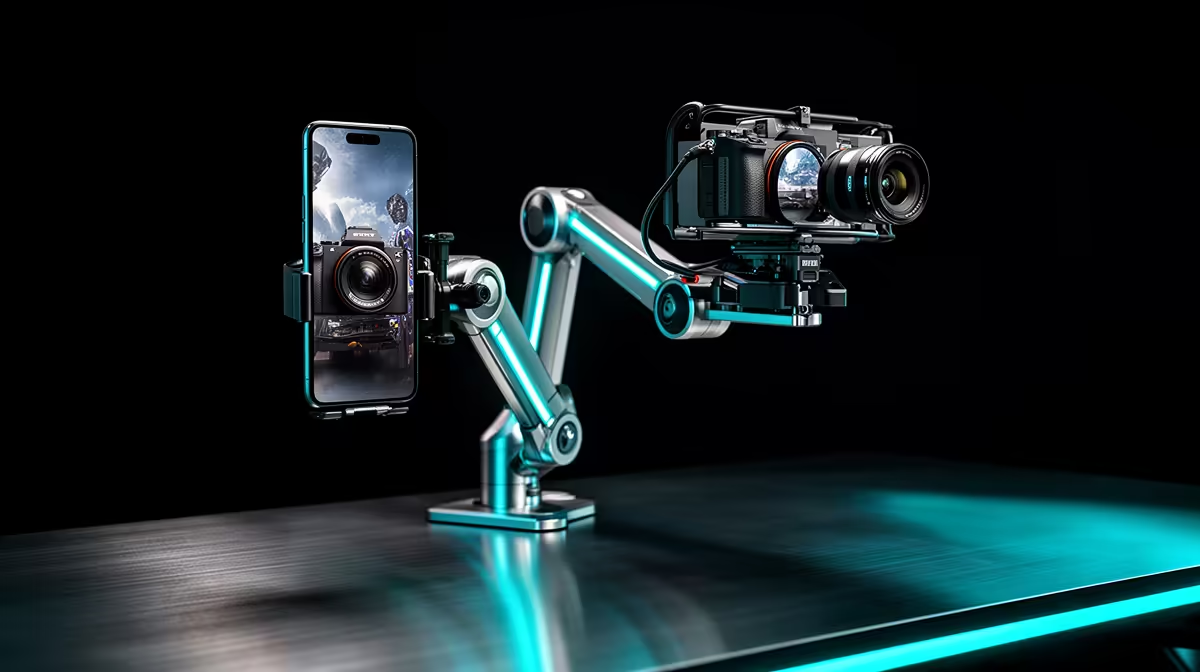
A capable dual-mount setup needs a tripod head that rotates a full 90 degrees on the roll axis and locks firmly at both positions. A ball head that drifts under the camera body's weight will not hold portrait orientation reliably during a long session.
Purpose-built 90-degree brackets are more rigid than ball head locks and suit fixed-position shooting. For content that moves between positions regularly, a fluid head with positive detents at 0 and 90 degrees is the more practical option. Also check connector positions before buying: HDMI and USB-C ports that exit downward in landscape may become awkward when the body rotates to portrait.
Frequently Asked Questions
What pixel count does cropping a 1080p landscape frame to portrait produce?
Cropping a 1920 by 1080 frame to a 9:16 portrait ratio yields approximately 607 pixels wide, since only the centre third of the landscape width maps to the portrait frame's width. Viewed at full screen on a typical smartphone, this is visibly softer than a native 1080p vertical capture. The difference is less apparent in thumbnail size but obvious at full screen playback.
Which creators benefit most from having both orientations available?
Creators who produce desktop gaming or commentary content for 16:9 platforms and simultaneously publish highlight clips to TikTok, YouTube Shorts, or Instagram Reels are the primary audience. A single camera covering both orientations removes the need for a second device dedicated to portrait capture, which saves cost and keeps both output streams from the same camera quality level.
Does streaming software need special configuration for portrait output?
Yes. OBS and similar tools need a canvas sized for 9:16 rather than 16:9 when capturing portrait output. The camera source in the scene needs to match the physical rotation. Some software also applies an automatic rotation correction that must be disabled when outputting intentional portrait content, since it assumes horizontal orientation as the default.
Is portrait streaming growing enough to justify planning for it now?
Short-form vertical content consistently produces high organic reach across the major platforms that support it. For a creator building audience in 2026, portrait clip distribution from existing desktop content is a low-effort way to extend reach without producing separate content. Dual-mount capability built into the original rig makes that workflow available immediately rather than requiring a hardware addition later.
Ready to future-proof your setup for both landscape streams and portrait clips? Browse the dual-mount cameras, tripod heads, and rotation hardware available for South African creators, and build a rig that covers every format you publish.