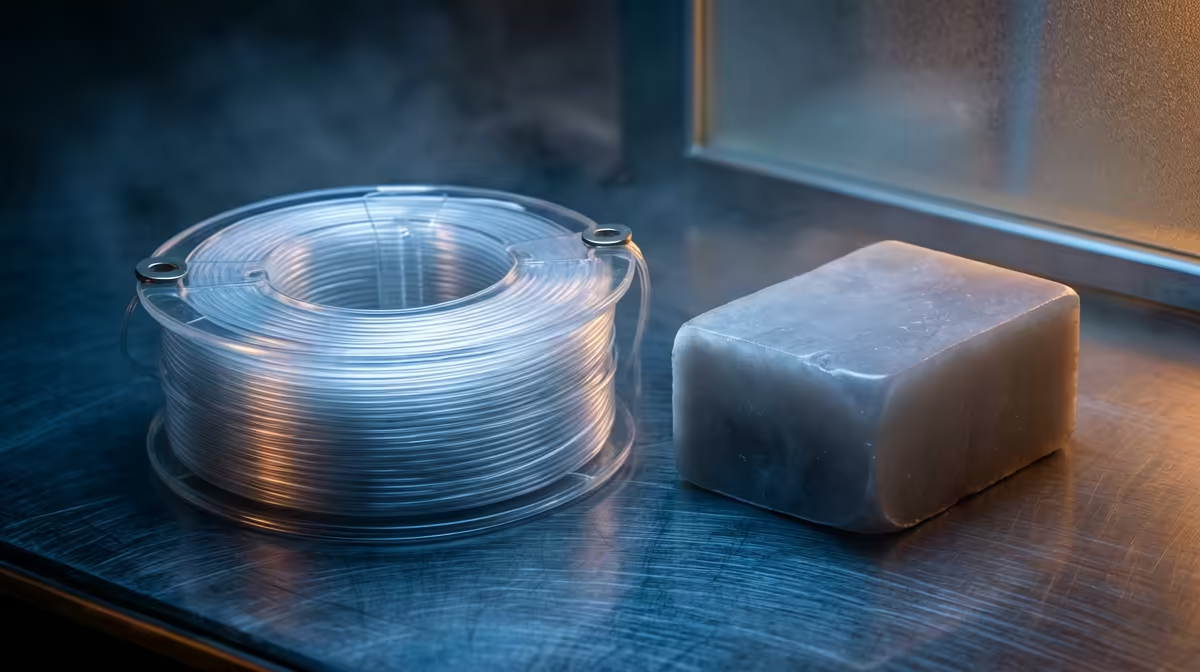
Pick up a spool of PLA and a bottle of resin, and you are holding two materials that behave in opposite ways at the chemical level. The difference between a thermoplastic and a thermoset is not academic trivia. It decides whether a failed print can be re-melted and reused, how a finished part survives heat, and which printing technology you reach for in the first place.
Quick Answer
FDM filament (PLA, PETG, ABS) is a thermoplastic that softens and re-melts every time you heat it. Cured resin is a thermoset that locks into a permanent solid once UV light triggers the reaction, and reheating only degrades it. Re-meltable versus permanently set is the whole story.
What the molecules are actually doing
A thermoplastic is built from long polymer chains that slide past one another when warmed. Heat them past the glass transition point and the chains loosen, the material flows through a hot nozzle, then it stiffens again as it cools. Nothing chemically permanent happens, so the cycle repeats. That is why an FDM machine can lay molten plastic line by line and why a tangled misprint can be ground up and re-extruded.
A thermoset works differently. Liquid photopolymer resin contains small molecules that, when struck by UV light, bond into a single rigid lattice known as a cross-linked network. Once that lattice forms during curing, the part is set for good. Apply heat afterwards and it will scorch or warp long before it ever flows again. Resin printers from the entry-level machines through to the larger units you will find among the 3D printers stocked at Evetech all rely on this one-way reaction.
Why the difference shapes your choices
Recycling is the obvious one. Thermoplastic offcuts, supports and failed prints can in principle be reprocessed. Cured resin scrap cannot go back into the bottle, so it has to be disposed of as a finished solid.
End use matters just as much. A thermoset part holds its shape under heat and load far better, which is why cured resin gives crisp miniatures and dimensionally stable jigs. A thermoplastic part stays tougher and less brittle, and it is easier to print large without cracking. Matching the chemistry to the job, rather than the colour or price, is what separates a part that lasts from one that fails. A few well-chosen printing accessories and finishing tools make either material easier to work with.
Frequently Asked Questions
Is PLA a thermoplastic or a thermoset?
PLA is a thermoplastic. It melts at FDM printing temperatures, re-solidifies on cooling, and can be re-melted again, which is exactly the behaviour an extrusion printer needs.
Can I melt down cured resin prints to reuse them?
No. Cured resin is a thermoset with a permanent cross-linked structure. Heating it will char or distort the part rather than return it to a liquid you can reprint.
Which type is stronger?
Strength depends on the job. Thermosets resist heat and hold tight tolerances, while thermoplastics absorb impact better and crack less under stress. Choose based on what the part has to survive.
Does this affect which printer I buy?
Yes, directly. FDM machines run thermoplastic filament, while resin machines cure thermoset photopolymer. The material chemistry and the printer technology are tied together.
Knowing whether your material re-melts or sets for good is the first step to printing parts that actually last. Browse the full range of 3D printers at Evetech and match the technology to the parts you want to make.