


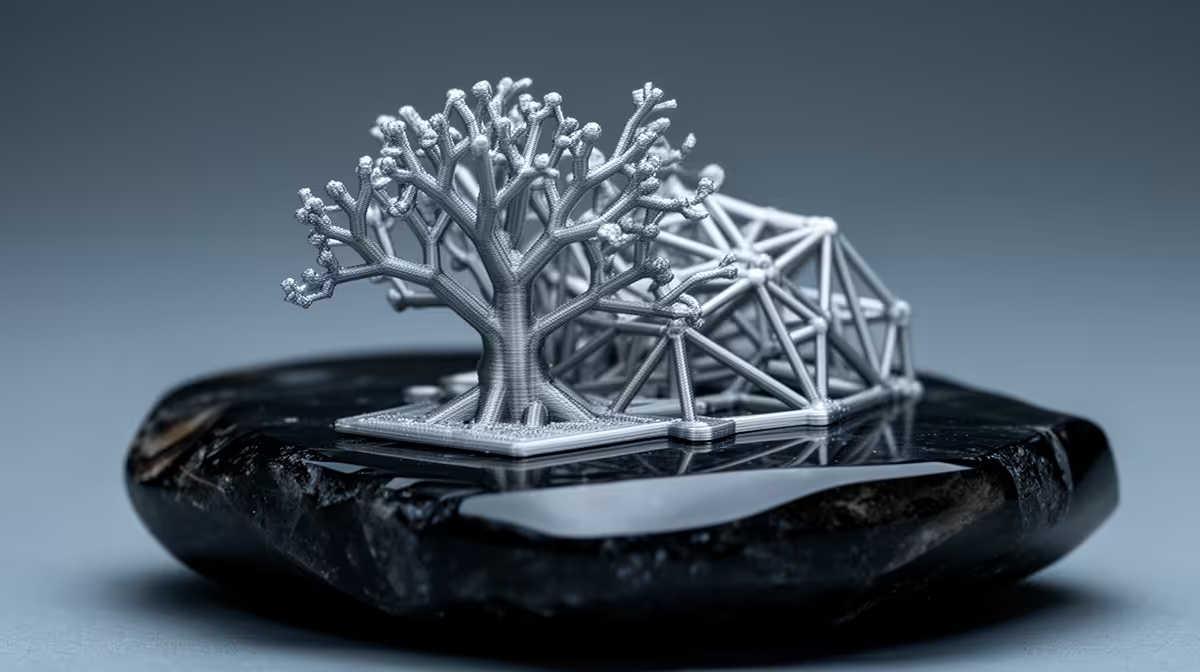
Pull a freshly printed model off the bed, snap away the scaffolding, and the difference between a clean surface and a pockmarked mess often comes down to one slicer decision made minutes earlier. The split between tree supports vs normal supports is not about which one is better overall. Each is built for a different shape, and picking the wrong one wastes filament, ruins surfaces, or leaves a print that simply will not stand up to removal.
Quick Answer
Use tree supports for organic, curved, and figurine-style models where they save filament and leave fewer scars. Switch to normal grid supports for wide flat overhangs, bridges, and deep internal cavities, because the consistent column pattern holds those areas down where branches sag and fail.
How the Two Support Types Actually Differ
Normal supports build a dense vertical grid straight up from the bed or from lower parts of the model, contacting the underside of an overhang across its whole footprint. That is reliable, but it burns through filament and leaves a textured witness mark wherever the support touched.
Tree supports instead grow as thinned branches that reach up and over toward only the points that genuinely need holding. They use far less material, touch the model in fewer places, and usually peel away with less force. The catch is that a branch is a cantilever: the further it reaches sideways and the more weight it carries at the tip, the more it flexes and droops mid-print.
Where Tree Supports Win
Tree supports shine on shapes that curve and taper. Think tabletop miniatures, busts, dragons, cosplay props, and anything with sculpted detail. The branches snake between fingers, around a raised arm, or up under a chin without smothering the surrounding surface in scaffolding. Because the contact area is small, the visible scarring after removal is minor, which matters when the model is meant to be painted or displayed.
They are also kinder to delicate features. A thin sword blade or a protruding antenna gets a single light branch rather than a wall of grid pressed against it, so you are far less likely to crack the part while clearing supports.
Where Tree Supports Fail and Normal Wins
The branch design breaks down in three situations.
Broad Flat Overhangs
A wide ceiling, such as the underside of a horizontal arm on a mechanical part or a large flat lid printed face-down, needs even support across its full width. Tree branches only reach discrete touch points, so the unsupported spans between branches droop and the flat surface comes out wavy. A normal grid plants a column under the whole area and keeps it flat.
Deep Internal Cavities
Enclosures, housings, and any model with a hollow pocket are a classic trap. Branches struggle to grow cleanly down into a narrow, deep cavity and often cannot reach the surfaces that need holding. Normal supports fill the void with a predictable lattice that does the job, even if it is fiddly to dig out afterward.
Trickier Filaments
Tree supports are most consistent in standard PLA. With PETG, ABS, ASA, and nylon, the branches are more prone to detaching mid-print or fusing too hard to the model. If you are running one of those materials, normal supports tend to behave more predictably. Whichever route you take, having spare reels and the right finishing tools on hand makes cleanup far less painful, and the print accessories and tools worth keeping at the bench cover most of what you reach for after a print finishes.
A Quick Decision Rule
Curved, sculpted, or figure-like, printed in PLA, and you care about the surface? Start with tree supports. Flat overhangs, bridges, enclosed cavities, or an engineering-style functional part in a tougher filament? Use normal supports. When a model has both, many slicers let you paint support on per-region or run a hybrid, so you are not locked into one for the whole plate. If you are still choosing hardware before any of this matters, the 3D printers at Evetech span everything from beginner FDM machines up to larger build volumes.
Frequently Asked Questions
Do tree supports use less filament than normal supports?
Yes, almost always. Because branches only reach the specific points that need holding rather than filling the whole area under an overhang, they typically use noticeably less material. That saving is one of the main reasons they are popular for tall figurine prints.
Why do my tree supports keep collapsing?
The usual cause is a branch reaching too far sideways or carrying too much weight at the tip, which makes it flex and fall over. Reduce the branch angle, increase branch density, or switch that region to normal supports if it is a wide or heavy overhang.
Are tree supports good for flat overhangs?
No. Flat overhangs need even contact across the whole surface, and tree branches only touch at scattered points, so the spans between them sag. Normal grid supports are the safer choice for any wide, flat, downward-facing surface.
Which support type is easier to remove?
Tree supports are generally easier and leave fewer marks because there is less contact area. Normal supports hold better but press against more of the model, so removal takes more force and leaves a rougher surface that may need sanding.
Choosing your first machine or upgrading to handle finer support work? Browse the 3D printer lineup at Evetech and pair it with the right tools so every print comes off the bed clean.










