Quick Answer
TrueBlack OLED delivers effectively infinite contrast by switching individual pixels off completely. Standard IPS monitors reach around 1,000:1 to 1,500:1 native contrast; VA panels reach 3,000:1 to 6,000:1. The gap is visible in everyday gaming, not just in lab comparisons.
How OLED Contrast Works at the Pixel Level 🖥️
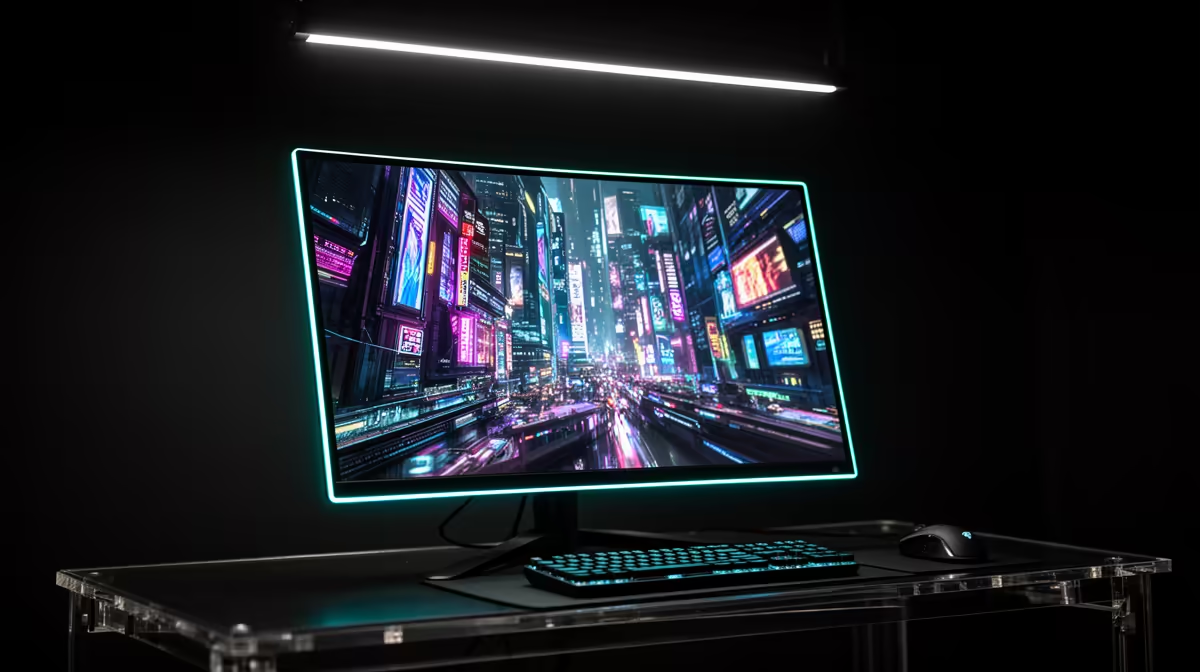
Every pixel on an OLED panel is its own emitter. When a scene requires pure black, those pixels draw zero power and produce zero light, which is why spec sheets list the ratio as infinite. There is no backlight to bleed through, so there is no halo around bright objects on dark backgrounds. In Starfield or Cyberpunk 2077, stars appear as pinpoints against genuine darkness and HDR highlights pop without washing out surrounding shadow detail.
How Standard Panels Struggle With Dark Scenes 🔧
IPS panels rely on a constant backlight filtered through liquid-crystal cells. Even fully closed, some light bleeds through, capping native contrast at roughly 1,000:1 to 1,500:1. VA panels do better at 3,000:1 to 6,000:1 by using a different cell alignment. Both use local dimming zones on premium models, but zones cover large pixel areas. A bright HUD element can lift the surrounding zone, raising visible black levels across a wide region. For cinematic single-player gaming or video editing, this limitation is noticeable on large screens.
ZAR Cost of OLED Contrast vs Standard Panels 💰
OLED 27-inch to 32-inch models in South Africa currently sit in the R12,000 to R20,000 range. High-quality IPS panels at the same size land closer to R4,000 to R8,000. For competitive multiplayer at 144Hz or above, a fast IPS may serve you better per rand. For AAA story games, HDR movies and creative work, the OLED contrast advantage pays off over the monitor's lifespan.
Test Contrast in a Dim Room First ⚡
Contrast differences between OLED and IPS are far less obvious under bright overhead lighting. Evetech often has display units running in-store. Ask to view a dark-scene video clip in a dim area before deciding, as the OLED advantage is most visible precisely when ambient light is low.
FAQ
Does infinite OLED contrast mean colours are always more accurate?
No. Contrast and colour accuracy are separate specs. An OLED can have infinite contrast but still need calibration to hit accurate sRGB or DCI-P3 targets. Many ship with a warm or saturated default profile that benefits from adjustment.
Is burn-in a real concern on OLED gaming monitors?
With varied gaming content and the built-in pixel-refresh cycles on current panels, burn-in during a standard two-to-three year warranty period is very unlikely under normal use. Avoid leaving a static HUD on screen for many hours daily.
Is 1,000:1 IPS contrast sufficient for HDR?
For HDR400 certification, technically yes, but the HDR experience looks flat compared to OLED. True HDR impact requires deep contrast alongside peak brightness. A 600-nit IPS at 1,000:1 shows detail but does not deliver the visual punch of an OLED at 1,000 nits with infinite contrast.
Ready to compare OLED and IPS contrast in person? Evetech stocks OLED and premium IPS gaming monitors across 27-inch and 32-inch sizes. Browse the monitor category at Evetech to compare specs and find the contrast level that fits your gaming and creative needs.