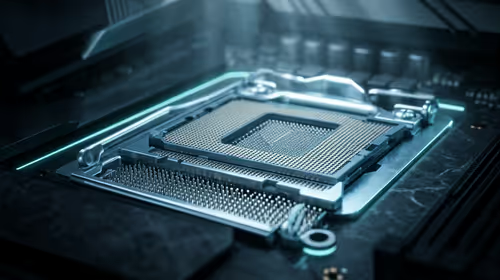
Buying the most exciting component first can leave the real slowdown untouched. What to upgrade first on an AM4 gaming PC depends on evidence from the games and settings that matter: processor, graphics, memory and storage produce different symptoms. The R7,199 Ryzen 7 5800X3D is a focused CPU option, not a replacement for missing graphics capability.
Quick Answer
Start with the component preventing the intended experience. A CPU upgrade makes sense when processor work limits frame delivery; graphics deserves priority when the GPU is saturated; memory or storage should be addressed when capacity or loading is the issue. The R7,199 5800X3D offers eight cores and 100MB cache but still needs a discrete GPU and separate cooler.
🔍 Diagnose before spending
Choose a repeatable game scene and keep its resolution, settings and background conditions constant. Note average FPS, frame consistency and graphics-card load. Lowering graphics pressure can reveal whether the CPU has room to deliver more frames, while unchanged performance may point to a processor-side limit.
Memory shortage can create stutter and excessive storage activity, while slow or constrained storage often affects loading and asset access more than sustained rendering. Do not assign every pause to the processor. Change one variable, repeat the same route and record the result.
🧠 Put the 5800X3D in the CPU lane
The Ryzen 7 uses eight Zen 3 cores, supports 16 threads and contains 100MB cache. That large cache can help suitable games, but each engine responds differently. Browse Evetech's AMD CPU choices when testing shows that processor work is the genuine constraint.
At R7,199, the CPU includes no cooler and carries a 105W rating. Add an AM4-compatible thermal solution that fits the case; Evetech's CPU cooler range can be assessed against those dimensions.
🎮 Keep graphics in its own lane
The 5800X3D cannot produce display output. A discrete GPU is essential, and the monitor connects to the card. If the current graphics card cannot meet the intended resolution or settings, changing the CPU cannot render the missing frames for it.
Balance the budget around the measured limit. Several modest upgrades may improve usability, but compare their combined outcome with one targeted change. Evetech's complete processor selection helps keep CPU alternatives visible during that calculation.
An AM4 socket is only the first condition for the 5800X3D. The exact motherboard and BIOS must support it, and any firmware work should be prepared while the existing CPU still runs. Keep a record of the working configuration and retain the old processor through validation.
The CPU runs at a stated 3.5GHz base and can boost as high as 4.5GHz. Those clocks, eight cores and 16 threads describe processor resources, but they do not prove that the CPU should be first in the queue. Use the measured limitation to assign priority.
Write down the problem each proposed upgrade addresses and the cost required to complete it. A memory expansion, storage change and modest GPU improvement may solve several annoyances, while one CPU purchase can be the cleaner answer to a specific frame-delivery ceiling. There is no useful rule that always favours one large or several small changes.
After the work, repeat the original test. Confirm hardware detection, safe CPU temperatures and the intended memory configuration first. Then use the same game scene to decide whether the money changed the experience that prompted the upgrade.
Frequently Asked Questions
How can a gamer identify the first upgrade target?
Test a representative scene with controlled settings and monitor frame behaviour, GPU load, memory pressure and storage activity. Look for a repeatable constraint rather than one isolated reading.
When is the processor a sensible first replacement?
Choose the CPU first when evidence shows processor work is delaying frames and the graphics card has unused capacity at the intended target.
When should the graphics card receive priority instead?
Give graphics priority when the GPU is the sustained limit at the desired resolution and visual settings. A faster CPU cannot perform the card's rendering work.
Can the Ryzen 7 5800X3D solve a missing display output?
The CPU cannot create an image on its own. Seat and power a discrete graphics card, then attach the monitor to an output on that card.
Why do BIOS and cooler checks belong before purchase?
The exact motherboard needs documented support and the correct BIOS. The 105W processor also has no included cooler, so compatibility and cost must be established first.
How should R7,199 be compared with several smaller upgrades?
Compare the completed outcomes. Add cooling to the processor path, total the alternative changes, and choose the plan that addresses the tested limitation most directly.
Want to spend the AM4 budget on the part your games actually need?
Diagnose the constraint, compare Evetech's processor and cooling choices, and place the R7,199 Ryzen 7 only where it solves the result.