Quick Answer
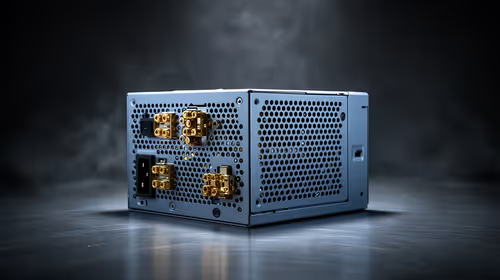
A high-end South African gaming build centred on an RTX 5080 or RTX 5090 paired with a Ryzen 9 or Core Ultra 9 processor requires a minimum 1000W PSU, with 1200W recommended for headroom and South African ambient conditions. Budget R4,500 to R8,000 for a quality 80 Plus Platinum ATX 3.1 unit at this tier.
Component Power Draw Breakdown 🔧
Mapping out your system's power requirements starts at the GPU and CPU, which together account for 75 to 85 percent of total system load. The RTX 5090 has a reference TDP of 575W; the RTX 5080 draws around 320W. Pair either with a Ryzen 9 9950X (170W TDP) or Core Ultra 9 285K (250W TDP) and you are already at 490 to 745W before accounting for RAM, multiple NVMe drives, case fans, RGB controllers, and a liquid cooling pump. A fully kitted high-end build with a 360mm AIO, three case fans, two NVMe drives, and 64GB DDR5 adds roughly 80 to 120W of additional draw. RTX 5090 builds therefore sit at 820 to 950W total under sustained load, making 1200W the rational PSU choice for the comfortable headroom that protects component longevity.
Why South African Climate Adds Wattage Considerations 🌡️
South African gaming environments often push ambient temperatures higher than European or North American markets where many PSU specifications are written. Gauteng summers regularly sustain indoor temperatures of 28 to 35 degrees Celsius in poorly air-conditioned rooms. At elevated ambient temperatures, PSUs operate closer to their thermal limits, and capacitor derating becomes more aggressive. Buying a 1200W unit for a system that draws 900W at peak means the PSU operates at 75 percent of rated capacity, with its fan spinning at lower speeds and internal temperatures staying well within safe range. This buffer is particularly important in SA gaming setups where the PC may run for 5 to 8 hours during weekend gaming sessions or LAN events.
Choosing the Right ATX Standard and Features 💡
For an RTX 5090 build, an ATX 3.1 PSU with a native 12V-2x6 cable is the only appropriate choice. ATX 3.1 handles the 300 percent TDP transient spikes that the RTX 5090 generates without triggering overcurrent protection shutdowns. Full modular cabling helps manage the thick cable runs that a 1200W unit includes, and keeps airflow clean around the GPU at the top of a large tower case. Prefer units with 80 Plus Platinum or Titanium certification to minimise the heat added to the chassis, and choose brands that publish their cross-load voltage regulation data showing the 12V rail within plus or minus 1 percent across all load levels.
Calculate Before You Commit ⚡
Before finalising your PSU choice, add your CPU TDP, GPU TDP, and 100W for all other components, then multiply by 1.25. That figure is your minimum PSU wattage. For a high-end SA build, this calculation almost always points to 1000W or 1200W, and the cost difference between 1000W and 1200W units at Evetech is typically only R500 to R1,000.
FAQ
Can I run an RTX 5090 on an 850W PSU?
NVIDIA's official minimum for RTX 5090 systems is 1000W. Running an 850W PSU risks triggering overcurrent protection shutdowns during transient spike events, particularly at high framerates in demanding titles. An 850W unit is firmly in RTX 5080 territory for high-end builds.
Does adding a 360mm AIO cooler significantly increase power requirements?
A 360mm AIO pump draws 6 to 12W and the three fans add around 15 to 30W combined at full speed. The total is 20 to 42W, which is worth including in your PSU calculation but rarely changes the wattage tier you select.
What is the most future-proof PSU choice for a high-end SA build right now?
A 1200W ATX 3.1 80 Plus Platinum unit with a native 12V-2x6 connector and full modular cabling covers every current and near-future GPU AMD or NVIDIA currently produce. It also positions you to add a second display, additional storage, or a more powerful CPU cooler without revisiting the PSU.
Building a high-end SA gaming rig?
Evetech stocks 1000W and 1200W ATX 3.1 power supplies from trusted brands, ready for RTX 5090 and top-tier Ryzen builds.