Quick Answer
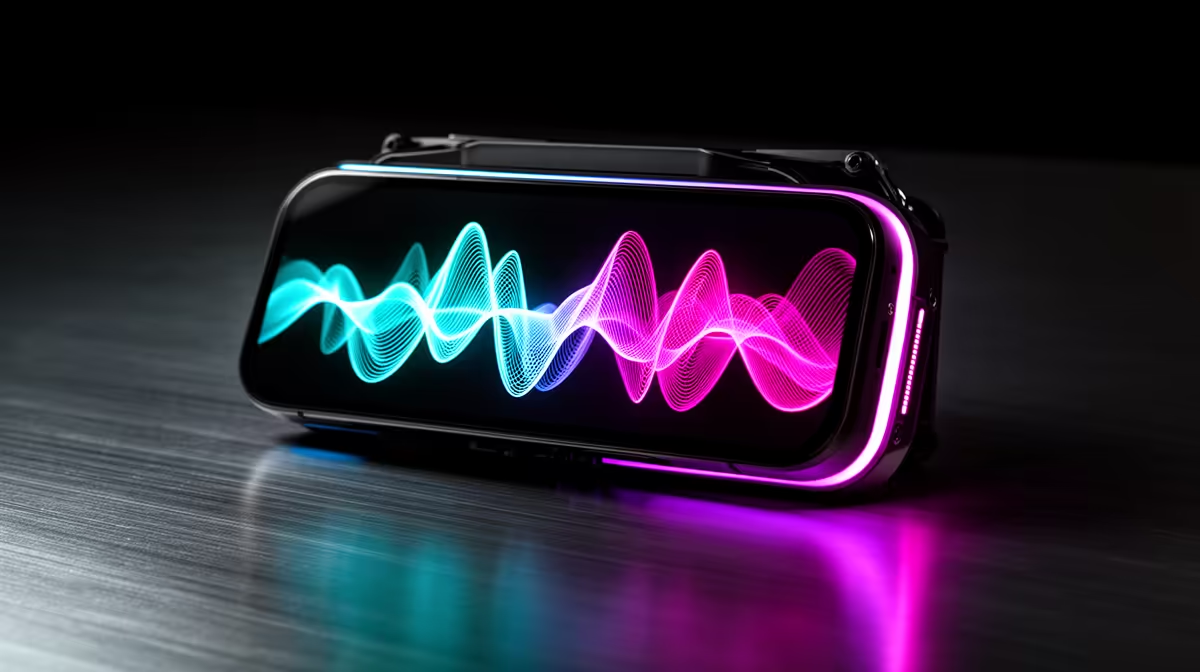
A 6.67-inch curved 2K AMOLED display on an AIO cooler's pump head delivers a vivid, high-contrast screen for system stats, custom animations, or artwork, but adds no thermal benefit. It is a premium aesthetic and information-display feature that pushes the AIO into the R6,000 to R9,000 price bracket in South Africa.
What the AMOLED Panel Actually Displays 🖥️
AMOLED pump-head screens on AIO coolers typically show CPU temperature, clock speed, fan RPM, and system load as a live dashboard. Higher-end implementations let you upload custom GIFs, short video loops, or wallpapers.
The Engineering Trade-Offs of a Large Pump Head 🔧
A display of this size adds substantial weight and bulk to the pump head. This can create two practical problems. First, the heavier head puts more mechanical stress on the CPU's integrated heat spreader (IHS) mounting points, especially on Intel LGA1851 motherboards where the IHS is soldered and load is spread differently than AM5. Second, the larger physical footprint of the pump head can conflict with tall RAM modules, large VRM heatsinks, and capacitors near the socket area. Confirming case internal dimensions and CPU socket surroundings before purchase is critical. The display assembly also draws power from a USB 2.0 internal header on the motherboard and requires companion software to manage content. Both ASUS and MSI have released AIOs in this category, with pump heads roughly the size of a large smartphone.
Is the Premium Justified for SA Builders? 💰
In South Africa, AIO coolers with large AMOLED displays typically land at R6,500 to R9,000, compared to R2,500 to R4,500 for a premium standard 360mm AIO. The R2,000 to R4,500 price gap buys no additional cooling performance. For builders who prioritise showcase aesthetics, especially in content creation and streaming setups where the PC is on camera, the AMOLED display can serve as a dynamic visual element. For pure gaming performance builds where the case is under a desk, the premium is harder to justify. The practical lifespan of the AMOLED panel (typically rated 20,000 to 30,000 hours) is long enough to outlast the typical four to six year build cycle.
Check USB Header Availability Before Buying ⚡
Large display AIOs require an internal USB 2.0 header to power and communicate with the pump screen. Many budget and mid-range motherboards have only one or two internal USB 2.0 headers, which may already be occupied by your RGB controller or front panel USB hub. Count your free headers before committing to a display AIO.
FAQ
Does a larger pump head AMOLED display affect CPU cooling performance?
Not directly. The radiator, fans, and pump flow rate determine thermal performance, and those components are separate from the display assembly. However, the added weight of a large display increases mechanical load on the motherboard socket, which is worth monitoring over a multi-year build.
Can I display custom content on the AMOLED screen?
Yes. Most AIOs with large AMOLED displays include a companion application that lets you upload custom GIFs, images, or short video clips. Some also support hardware monitoring overlays that mix custom artwork with real-time sensor data.
What is the practical difference between LCD and AMOLED on an AIO pump head?
AMOLED produces true blacks and higher contrast ratios versus LCD, and viewing angles are wider. In a dark room or PC setup with dim lighting, AMOLED displays look noticeably richer. LCD panels can appear washed out at certain angles. For pure information display, both work well; for showcase aesthetics, AMOLED is a clear step up.
Want a showpiece AIO with a large display for your build? Evetech stocks premium AIO coolers including models with advanced pump-head displays. Browse the CPU cooler section to find a display AIO that fits your socket, case, and budget.