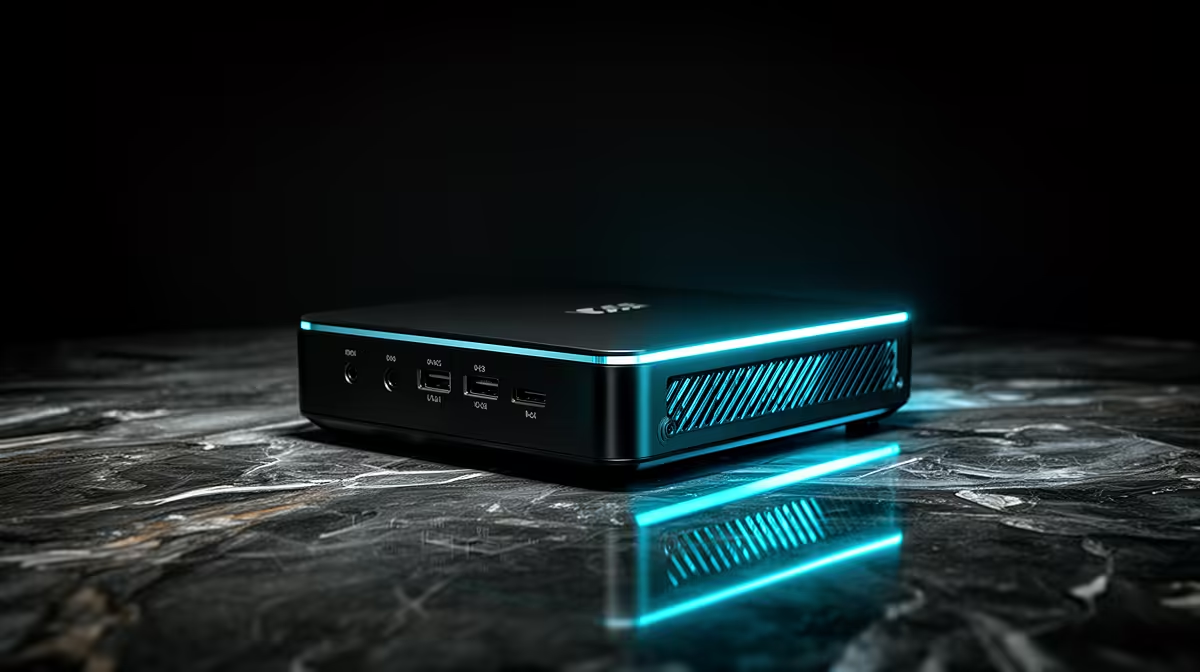
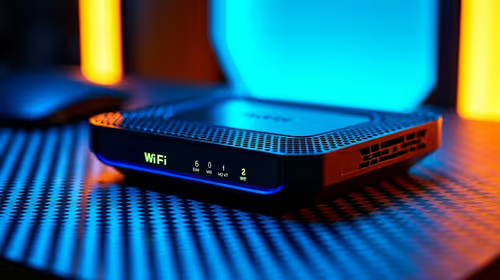
For years the NUC was Intel's own little box, the tiny barebones PC that defined the small-form-factor category. Then Intel walked away from it. Rather than the line dying, ASUS stepped in, took over the product range, and has been developing it under its own banner ever since. So the NUC did not disappear; it changed owner, and in 2026 it is very much alive with a fresh lineup.
Quick Answer
Intel exited the NUC business and ASUS took over the product line. ASUS now designs and sells NUC mini PCs under its own branding, inheriting Intel's small-form-factor engineering and extending it with new models. The 2026 range spans entry-level boxes up to a gaming-focused ROG NUC, with both Intel and AMD processor options.
What happened to the NUC
NUC stands for Next Unit of Computing, Intel's name for the compact, roughly palm-sized PCs it launched to show what its chips could do in a tiny chassis. Intel decided to step back from making them directly, and handed the line to ASUS, which formally took over the product range and the engineering behind it. The handover kept a decade of NUC design alive rather than letting it lapse.
The practical result for buyers is continuity. The NUC name, the small chassis philosophy, and the focus on a lot of computer in very little space all carried over. What changed is the company behind the warranty, the support, and the new models.
The ASUS NUC lineup in 2026
ASUS has not let the line stagnate. The current range runs from compact productivity machines up to a serious gaming option. At the top sits an ROG-branded NUC aimed at gaming, pairing a high-end AMD Ryzen processor with a laptop-class NVIDIA GeForce RTX GPU squeezed into the small chassis, which is a real shift for a category once associated mainly with office and media duties.
The mainstream NUC Pro models lean on Intel's latest Core Ultra processors, with a clear emphasis on on-device AI performance, while ASUS has also brought AMD Ryzen options into adjacent mini PC lines. The headline is choice: the NUC is no longer a single Intel-only product but a family with different chips for different jobs, from a quiet desktop replacement to a compact gaming machine. If you are weighing one up, you can browse the mini PC range at Evetech to compare small-form-factor options side by side on current specs and price.
Should the ownership change affect your buying decision?
Not negatively. A NUC today is an ASUS product with ASUS support behind it, and the lineup is broader than it was under Intel. The thing to focus on is the same as with any mini PC: match the processor, memory and storage to what you will actually do, whether that is a tidy office box, a home-theatre machine, or a small gaming rig. For the gaming-capable end especially, it is worth seeing how a NUC stacks up against full systems in the best-selling PCs at Evetech before you commit.
Frequently Asked Questions
Did Intel discontinue the NUC?
Intel exited the NUC business, but the product line did not end. ASUS took over the range and continues to design and sell NUC mini PCs under its own branding.
Are ASUS NUCs the same as the old Intel ones?
They build on the same small-form-factor engineering and keep the NUC name, but ASUS now develops them with new models, fresh processor options, and its own support and warranty.
Can a NUC handle gaming in 2026?
The gaming-focused ROG NUC pairs a high-end AMD Ryzen CPU with a laptop-class NVIDIA RTX GPU, so yes, the gaming end of the lineup is genuinely capable, unlike the office-oriented NUCs of the past.
Do ASUS NUCs use Intel or AMD chips?
Both, depending on the model. The mainstream NUC Pro line uses Intel Core Ultra processors, while ASUS offers AMD Ryzen options across its wider mini PC range, including the ROG gaming model.