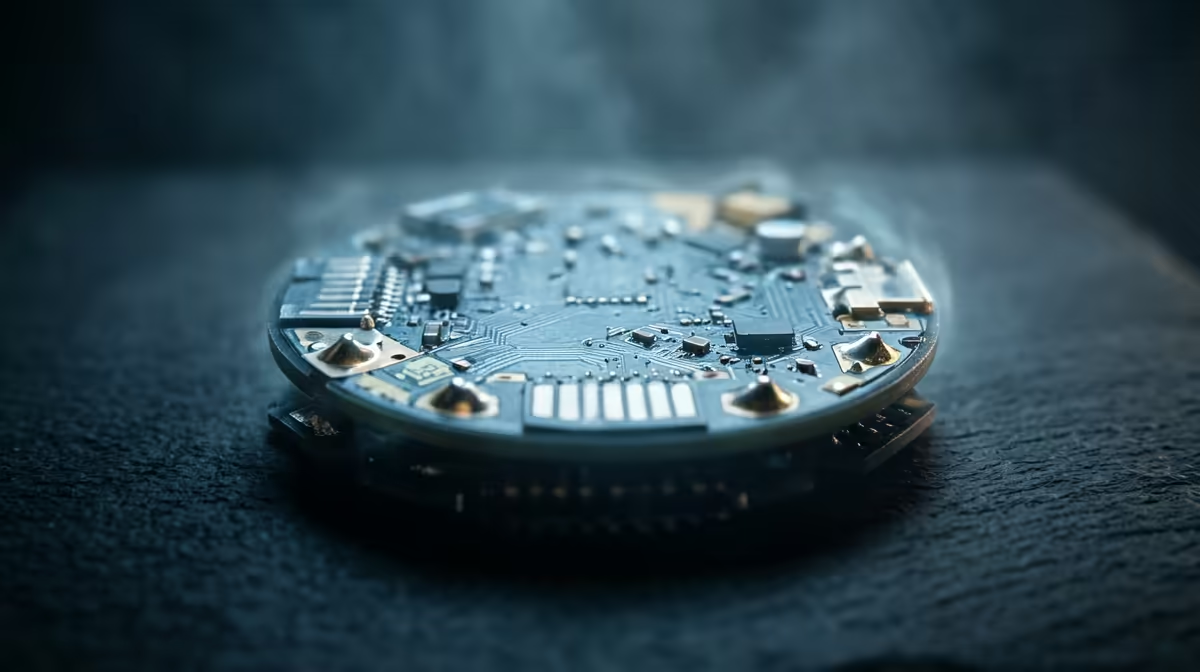
Snap a board onto your Raspberry Pi's pin header and it suddenly gains NVMe storage, or Power-over-Ethernet, or a screen. That board is a HAT, short for Hardware Attached on Top, and it is the cleanest way to extend what a Pi can do without soldering anything.
Quick Answer
A HAT is a standardised add-on board that mounts onto the Raspberry Pi's 40-pin GPIO header to add hardware features, from NVMe storage via an M.2 HAT+ to Power-over-Ethernet via a PoE HAT. A small EEPROM chip on the HAT lets the Pi recognise and auto-configure the board the moment it boots, so most HATs work with little or no manual setup.
What Makes a HAT a HAT
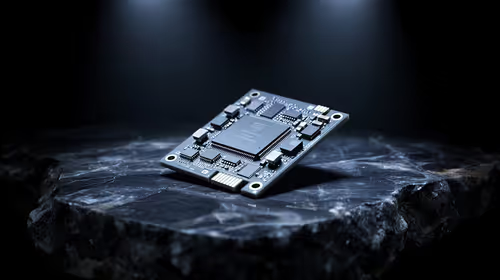
The HAT specification, introduced with the Raspberry Pi B+, defines more than "a board that plugs in." To qualify, an add-on follows a set mechanical shape, lines up with the Pi's mounting holes, and connects through the full 40-pin GPIO header. Crucially, it carries an EEPROM, a tiny memory chip storing the board's identity and configuration. At boot, the Pi reads that EEPROM, learns what the HAT is, and sets up the relevant pins automatically.
That auto-configuration is the real convenience. Instead of editing config files to tell the Pi what is attached, a compliant HAT announces itself, which feels closer to plugging in a peripheral than wiring up a circuit. The newer HAT+ standard updates this for the Raspberry Pi 5, adding support for the Pi 5's PCIe connector, which is what makes fast NVMe storage possible.
HATs Worth Knowing
A few categories cover what most people actually add.
The M.2 HAT+ is the standout for the Pi 5. It uses the new PCIe connection to attach an NVMe SSD, turning the Pi into a far faster and more reliable machine than running everything off a microSD card. For anyone using a Pi as a small server or always-on box, this is often the first upgrade.
A PoE HAT lets the Pi draw both power and network over a single Ethernet cable from a PoE-capable switch. That removes the separate power brick entirely, which is ideal for a Pi tucked away in a cupboard or mounted on a wall.
Beyond those, there are audio HATs with proper DACs for cleaner sound, display HATs with small or e-ink screens, real-time clock HATs that keep time offline, and cooling HATs with fans. These sit alongside Pi-class hardware in the broader small-form-factor space, and the mini PC range at Evetech is a useful reference if you are weighing a Pi project against a ready-built compact machine.
A Few Things to Check Before You Buy
Not every add-on board is a true HAT. Some are simply GPIO boards that lack the EEPROM and the standard footprint, which means more manual configuration. If easy setup matters to you, look for boards that explicitly claim HAT or HAT+ compliance.
Compatibility with your Pi model matters too. A HAT+ that relies on the Pi 5's PCIe connector will not deliver its headline feature on an older Pi 4, so check the supported models, especially for anything storage-related. To see what compact hardware South African buyers are choosing, the best-selling compact machine listing is worth a glance.
Frequently Asked Questions
What does HAT stand for on a Raspberry Pi?
HAT stands for Hardware Attached on Top. It is a standardised add-on board that mounts onto the Pi's 40-pin GPIO header to add features like storage, networking or audio.
What is the difference between a HAT and a HAT+?
HAT+ is the updated standard for the Raspberry Pi 5. It adds support for the Pi 5's PCIe connector, which enables fast NVMe storage through boards like the M.2 HAT+. The older HAT standard does not cover PCIe.
Do HATs work automatically when plugged in?
Compliant HATs carry an EEPROM chip that the Pi reads at boot, so it identifies and configures the board automatically. Non-compliant GPIO boards may need manual setup.
Can I add NVMe storage with a HAT?
Yes, using an M.2 HAT+ on a Raspberry Pi 5. It connects an NVMe SSD over the Pi 5's PCIe interface, giving much faster and more durable storage than a microSD card.
Will any HAT fit any Raspberry Pi?
Not always. HATs share a standard footprint, but features that depend on the Pi 5's PCIe connector, like NVMe HATs, will not work fully on older models. Check the supported model list.
Planning a Raspberry Pi build or weighing up a compact machine? Browse Evetech's mini PCs and small-form-factor hardware, starting with the mini PC range, and find the right base for your project.