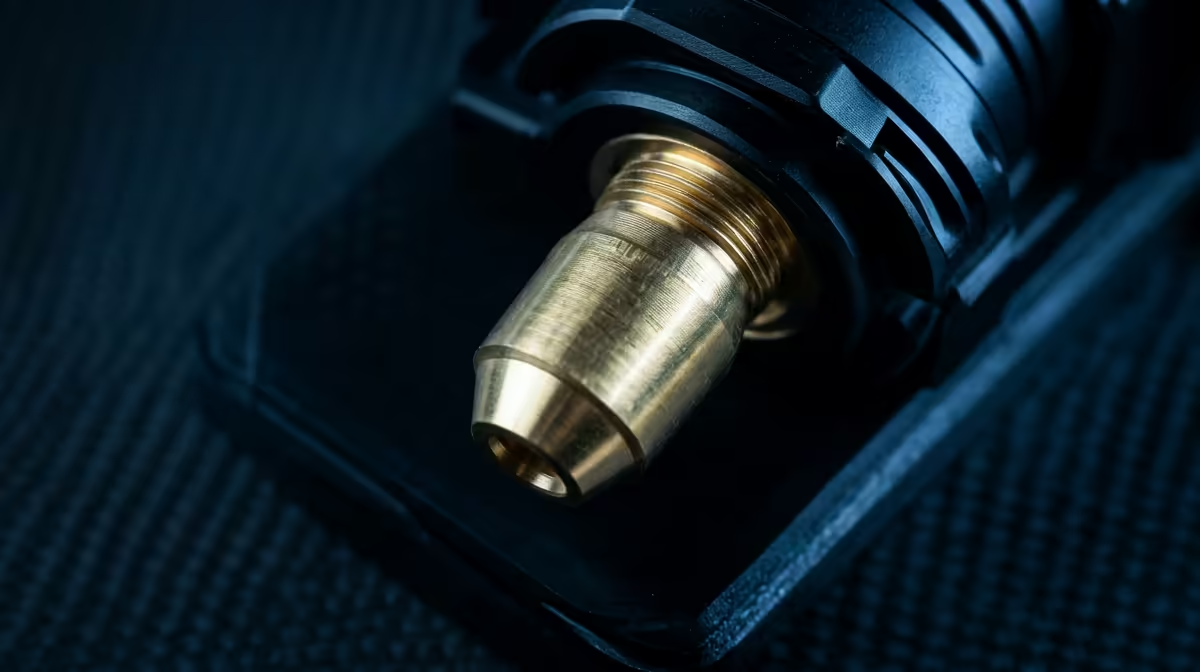
That tiny brass tip threading into the end of your hotend does more to shape print quality than almost any other single part. The 3D printer nozzle is the final gate molten filament passes through before it lands on the build plate, and its diameter, material and condition decide how fine your detail gets, how fast a job finishes, and how soon you start chasing under-extrusion gremlins.
Quick Answer
A 0.4mm brass nozzle is the standard fitted to most printers because it balances detail and speed for everyday PLA and PETG. Swap to hardened steel (roughly R150 to R400) the moment you print carbon fibre, glow-in-the-dark or any abrasive filament, since brass wears out in a few spools.
What the nozzle actually does
The nozzle screws into the heater block at the bottom of the hotend. Filament is pushed in cold from above, melts inside the block, and is forced out through the nozzle's orifice as a controlled bead. The width of that orifice sets your minimum line width, which in turn sets how crisp text, small logos and thin walls can be. A worn or partially blocked tip throws off the whole chain, so it is usually the first thing to check when prints suddenly go rough.
Why 0.4mm became the default
A 0.4mm orifice hits the sweet spot. It lays down lines fine enough for figurines, functional parts and lettering, while still moving enough plastic per second to finish a model in a sensible time. Go smaller, to 0.2mm or 0.25mm, and you gain detail for miniatures but jobs can take two to three times longer and clog more easily. Go larger, to 0.6mm or 0.8mm, and you trade fine detail for much faster draft prints and stronger layer bonding, which suits brackets, jigs and big functional parts. Most slicers ship with 0.4mm profiles ready to go, which is another reason it stays the comfortable starting point. You will find compatible printers and starter gear in the Evetech 3D printer range.
Brass versus hardened steel
Brass conducts heat brilliantly and machines to a clean, sharp orifice, which is why it ships as standard. Its weakness is softness. Abrasive filaments, carbon fibre, glass fibre, glow-in-the-dark and some metal-fill blends, sand the orifice wider over time. A widened orifice quietly ruins dimensional accuracy long before it fully fails.
Hardened steel resists that abrasion and lasts far longer with tough materials. The trade-off is slightly poorer heat conduction, so you often nudge the printing temperature up by 5 to 10 degrees Celsius. For plain PLA and PETG, brass is genuinely the better choice. For anything abrasive, hardened steel pays for itself fast. Keep a spare or two on hand so a blockage never stalls a long overnight job, and stock up on printer consumables and accessories while you are at it.
Frequently Asked Questions
How often should I replace a brass nozzle?
With standard PLA and PETG, a brass nozzle commonly lasts several hundred print hours before quality drops. Switch to abrasive filament and that window shrinks to a handful of spools, so inspect the tip regularly and replace it once lines start looking inconsistent.
Can I print carbon fibre with a brass nozzle?
You can, but only briefly. The fibres grind the soft brass orifice wider within a spool or two, which wrecks accuracy. A hardened steel nozzle is the correct tool for carbon fibre and similar filaments.
Does a bigger nozzle make prints stronger?
Often, yes. A wider nozzle lays thicker lines that bond better between layers and across walls, which boosts strength on functional parts. You sacrifice fine surface detail, so it suits brackets and jigs more than display models.
Why does a fresh nozzle fix under-extrusion?
A partial clog or a worn, widened orifice disrupts the steady flow of plastic, showing up as gaps and weak walls. Fitting a clean nozzle of the correct size restores a consistent bead, which is why it is the first fix to try.
What nozzle size suits a beginner?
Stick with the 0.4mm brass nozzle your printer arrived with. It handles the widest range of models and materials, and every default slicer profile is tuned for it, so you can learn the basics before experimenting with other sizes.
Ready to start printing or need spares before your next big job? Browse the full 3D printer range at Evetech and grab nozzles, filament and tools to keep every print sharp.