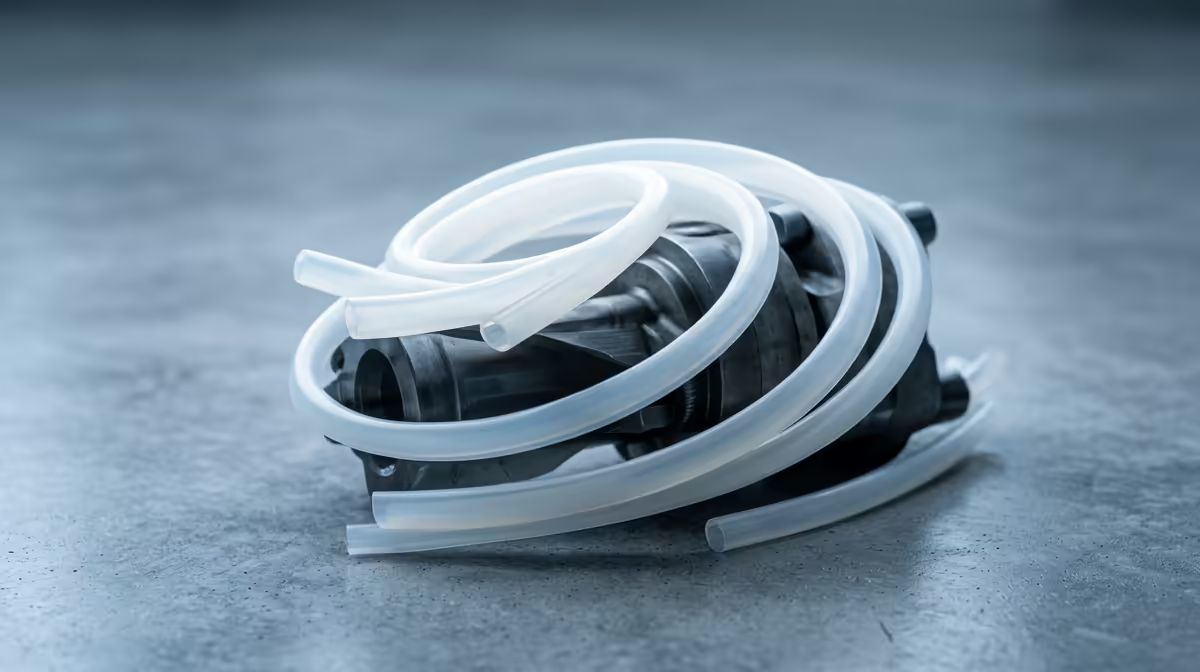
Filament has to travel a guided path from your extruder gears to the hot nozzle, and the tube that carries it matters more than most first-time printer owners expect. A PTFE tube is the slick white guide that does this job, and the Capricorn variant tightens the internal bore so filament wobbles less on its way down. On a Bowden machine, where the extruder motor sits away from the hotend, that tightness changes how cleanly your retractions behave.
Quick Answer
A PTFE tube guides filament with a low-friction inner bore. A standard tube runs about a 2mm bore, while Capricorn-style tubing tightens it to roughly 1.9mm, which reduces side-to-side filament play and makes retraction more consistent, especially on Bowden printers. Expect to spend roughly R150 to R400 for a quality length locally.
What PTFE Actually Does in the Filament Path
PTFE (polytetrafluoroethylene) is prized for one property above all: an extremely slippery surface. As filament is pushed through it, the material slides with very little drag, which keeps the force your extruder motor needs to apply low and predictable. On a direct-drive setup the tube is short, often just bridging into the heatbreak. On a Bowden setup the tube can be 300mm or longer, so every bit of internal friction and slack compounds over that distance.
The bore is the hole the filament rides through. 1.75mm filament inside a 2mm bore has a quarter-millimetre of room to wander. Over a long Bowden run, that play turns into lag between when the motor reverses and when the filament tip actually moves.
Why Capricorn's Tighter Bore Matters
By bringing the bore down to about 1.9mm, Capricorn tubing cuts that wander roughly in half. The practical payoff shows up in retraction. When the printer pulls filament back to stop oozing during travel moves, a looser bore lets the filament flex and buffer inside the tube, so the retraction is partly absorbed instead of acting at the nozzle. Tighten the bore and that motion transfers more directly, which means cleaner travel moves and fewer stringing artefacts hanging between printed islands.
Capricorn tubing also tends to use a higher grade of PTFE with more consistent wall dimensions, so the bore stays uniform along the whole length rather than drifting wider in spots.
The Heat Limit You Should Respect
PTFE has a real ceiling. Above roughly 240 to 250 degrees Celsius it begins to degrade, and the fumes it releases at those temperatures are not something you want to breathe. This is why all-metal hotends exist: they pull the PTFE back out of the highest-heat zone so you can safely print materials that need 250 degrees or more, such as some nylons or polycarbonate. If your tube runs all the way into the nozzle, keep your temperatures in PLA and PETG territory and inspect the tube end periodically for browning or deformation. A scorched, flared tube tip causes jams.
If you are still building out your toolkit, a spare length of tube and a set of fittings live alongside the rest of the best-selling printer accessories worth keeping on the shelf.
Frequently Asked Questions
Is Capricorn tubing worth it on a direct-drive printer?
The benefit is smaller because the tube run is so short that filament play barely accumulates. The upgrade pays off most on Bowden machines with long tube lengths. On direct drive it is a minor refinement rather than a meaningful fix.
How do I know when to replace my PTFE tube?
Replace it when the bore end nearest the nozzle looks browned, flared, or melted, or when you start getting jams that clear after a fresh tube. Worn tube ends are a common hidden cause of inconsistent extrusion.
Can I just cut the tube ends square myself?
Yes, and you should. A clean, perfectly square cut seated firmly against the nozzle prevents a gap where molten filament can pool and clog. Use a sharp PTFE cutter or a fresh blade rather than scissors, which pinch the bore.
Does a tighter bore make filament loading harder?
Slightly, with very flexible filaments like TPU, which can buckle in a tight bore over a long Bowden run. For standard PLA and PETG the difference in loading effort is negligible.
Building or upgrading a printer and want the consumables sorted in one go? Browse Evetech's range of 3D printers and components and pick up the spares that keep your prints clean.