Filament does not pull itself into the hotend. A small geared motor grips it and shoves it forward, and that motor is the extruder. Where the maker puts that motor, right behind the nozzle or way back on the printer frame, decides how cleanly your prints behave: how far the printer has to retract to stop oozing, whether soft rubbery filament jams, and how fast the toolhead can fling itself around without wobbling.
Quick Answer
Direct-drive mounts the extruder motor at the nozzle, so retraction distances drop to roughly 0.5 to 2 mm and flexible filament like TPU feeds without buckling. Bowden parks the motor on the frame and pushes filament down a long PTFE tube, needing 4 to 7 mm of retraction but giving you a lighter, faster toolhead. Neither is "better"; they trade stringing control against speed.
How an extruder actually grips and pushes
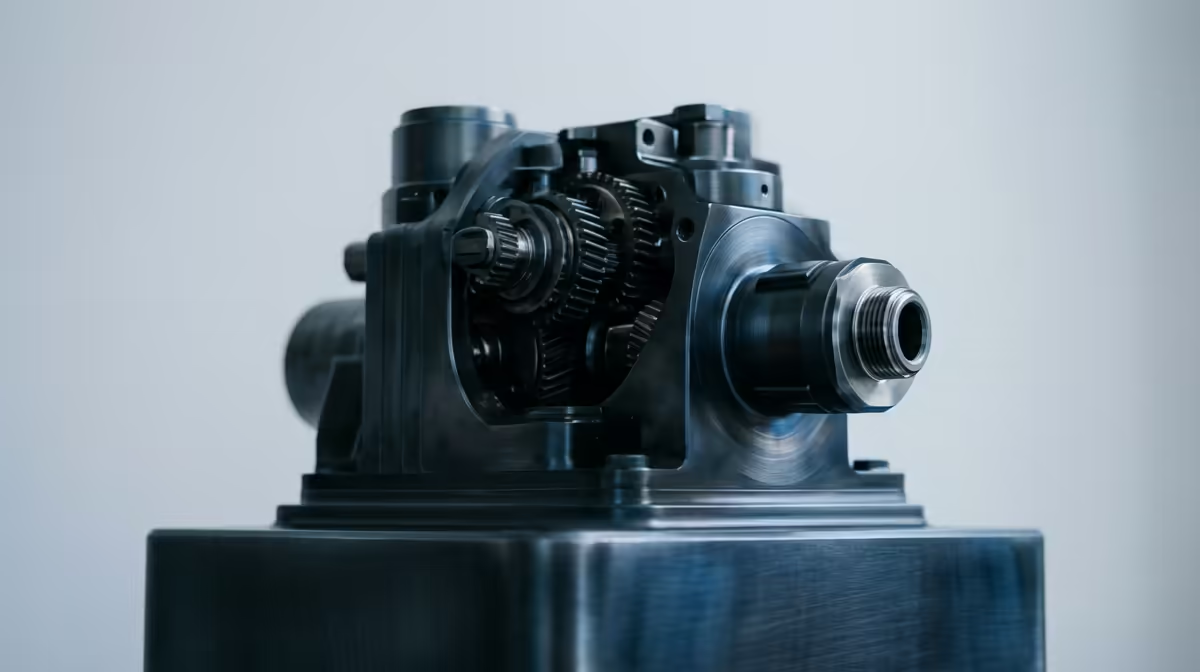
Inside any extruder sits a hobbed gear (or a pair of them) with teeth that bite into the filament. The motor turns the gear, the gear drags the filament forward through the melt zone in the hotend until it exits the nozzle. When the print needs to skip a gap, the motor reverses briefly to pull molten plastic back from the nozzle tip. That reverse move is retraction, and it is the single biggest reason the extruder design matters.
Dual-gear extruders grip from both sides, so they slip less under pressure, which helps most with abrasive or soft filaments. You can browse compatible machines and toolhead options across the 3D printer range at Evetech to see which extruder style each model ships with.
Direct-drive: short retraction, soft filament, heavier head
With the motor sitting right above the nozzle, the gear is millimetres from the melt zone. There is almost no slack between the grip point and the hotend, so a tiny reverse move is enough to relieve pressure. That short path is exactly why direct-drive handles TPU and other flexible filaments: a soft filament has nowhere to coil up and bunch, so it feeds straight through.
The cost is mass. You have just bolted a stepper motor onto the moving toolhead, and all that weight has to start and stop on every direction change. At very high speeds that extra inertia shows up as ringing or ghosting, faint echo lines beside sharp corners. It is manageable with tuning, but it is a real trade-off.
Bowden: light head, fast moves, longer retraction
A Bowden setup leaves the motor on the frame and runs the filament through a PTFE tube to the hotend. The toolhead carries only the lightweight hotend, so it accelerates faster and rings less at speed, which is why many fast bed-slinger and CoreXY machines favour it.
The catch is the tube. Filament inside it can compress slightly under push, so you need a longer retraction (often 4 to 7 mm) to relieve nozzle pressure, and soft filaments tend to buckle against the tube walls instead of feeding. Bowden is happiest with rigid filaments like PLA and PETG.
Which one suits your printing
If you print TPU, do detailed miniatures where stringing is obvious, or simply want fewer cleanup headaches, lean direct-drive. If your priority is raw speed on PLA and PETG, Bowden earns its place. Upgrade nozzles, tubes and spare gears live in the printer accessories aisle if you want to retune whichever setup you land on.
Frequently Asked Questions
Can I print TPU on a Bowden extruder?
You can, but slowly and with patience. Soft filament tends to compress inside the PTFE tube and buckle, so you drop speed sharply and tune retraction carefully. Direct-drive removes most of that struggle.
Why does my direct-drive printer still string?
Retraction distance is only part of it. Print temperature, travel speed and a wet filament spool all cause stringing too. Dry your filament and drop the nozzle temperature by 5 to 10 degrees before blaming the extruder.
Is direct-drive always slower than Bowden?
Not always, but the heavier toolhead lowers the ceiling for clean high-speed moves. With input-shaping tuned, a good direct-drive machine still prints quickly; it just hits ringing sooner than an equivalent Bowden head.
How do I know which type my printer has?
Look at where the extruder motor sits. If it is bolted to the moving carriage right above the nozzle, that is direct-drive. If it sits on the frame with a tube running to the hotend, that is Bowden.
Picking your first or next printer? Compare extruder styles and current stock in the Evetech 3D printer range and match the machine to the filaments you actually want to print.