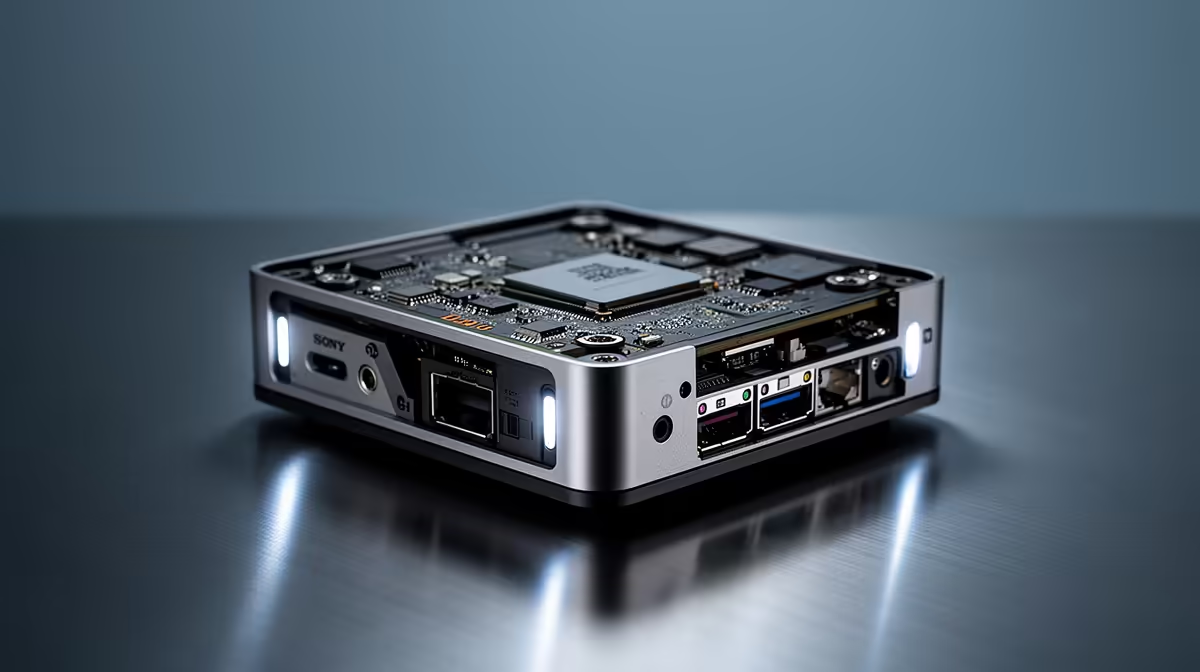
That tiny PC sitting behind your TV or on your desk almost certainly has no separate graphics card, yet it plays 4K video and handles light gaming just fine. The reason is the iGPU, the integrated graphics engine baked into the main chip. In mini PCs it does the work a bulky graphics card would do in a tower, and on Intel models it quietly powers a media-server trick that punches far above the box's size.
Quick Answer
An iGPU is the graphics processor built into a CPU's SoC or APU, handling display output, 4K video decoding and light gaming without a discrete graphics card. On Intel mini PCs it also runs Quick Sync, enabling efficient hardware transcoding of 4K Plex streams at very low CPU load.
What an iGPU does inside a mini PC
In a desktop tower, graphics usually come from a separate card with its own memory and fans. A mini PC has no room for that, so the graphics live inside the same chip as the processor. On Intel that combined chip is called an SoC; on AMD it is an APU. Either way, the iGPU shares system memory rather than carrying its own, which keeps the box small, cool and power-light.
For everyday use this is more than enough. The iGPU drives your monitor or TV, decodes 4K video smoothly, runs a snappy desktop, and plays older or lighter games at modest settings. For web browsing, office work, media playback and a home server, you simply do not need a discrete card, and that is why mini PCs can be so compact. The current mini PC range at Evetech shows the chip families and their integrated graphics so you can match a box to what you plan to run.
The Quick Sync advantage for media servers
Here is where Intel mini PCs earn their reputation as home-server boxes. Intel's iGPUs include Quick Sync, a dedicated block that handles video encoding and decoding in hardware. For anyone running Plex or Jellyfin, this is the feature that matters most.
When a Plex client cannot play a file directly, the server has to transcode it on the fly. Done on the CPU, transcoding a 4K stream can max out the processor and still stutter. Quick Sync offloads that job to the iGPU's dedicated hardware, so a small Intel mini PC can transcode multiple 4K streams at once while the CPU stays cool and idle. That turns an inexpensive, silent little box into a capable media server.
AMD APUs have strong iGPUs too, often better for light gaming, but Intel's Quick Sync remains the standout for transcoding-heavy home servers. If a media library is your main goal, that distinction is worth weighing.
Where an iGPU falls short
An iGPU is not a gaming graphics card. Demanding modern titles at high settings need a discrete GPU, and an iGPU will struggle there. It also borrows system memory for graphics, so on a memory-light machine, heavy graphics work eats into what your apps can use. For serious gaming or GPU-accelerated creative work, a tower with a dedicated card is the right tool. For everything else a mini PC handles daily, the iGPU is exactly enough. Browse the best-selling PCs at Evetech to compare where an integrated-graphics mini PC fits against a full desktop.
Frequently Asked Questions
What does iGPU stand for?
It stands for integrated graphics processing unit. It is the graphics engine built directly into the CPU's chip package, on Intel as part of the SoC and on AMD as part of the APU, rather than a separate card.
Can a mini PC with an iGPU play 4K video?
Yes. Modern iGPUs decode 4K video in hardware, so a mini PC plays 4K streams and local files smoothly. This is one of the main reasons mini PCs work so well as media-playback boxes.
What is Quick Sync and why does it matter?
Quick Sync is Intel's dedicated hardware video encoder and decoder built into its iGPUs. It lets a mini PC transcode 4K Plex or Jellyfin streams efficiently at very low CPU load, which is ideal for a home media server.
Can you game on an iGPU?
You can play older and lighter games at modest settings, and AMD APUs are noticeably stronger here. For demanding modern titles at high settings, you still need a discrete graphics card in a larger system.
Does an iGPU use system RAM?
Yes. An iGPU shares the system memory rather than having its own dedicated pool. On machines with limited RAM, heavy graphics use can reduce what is available to your other applications.
Looking for a compact, quiet machine for media, browsing or a home server? Explore the mini PC range at Evetech to find an integrated-graphics box that does the job without a bulky tower.