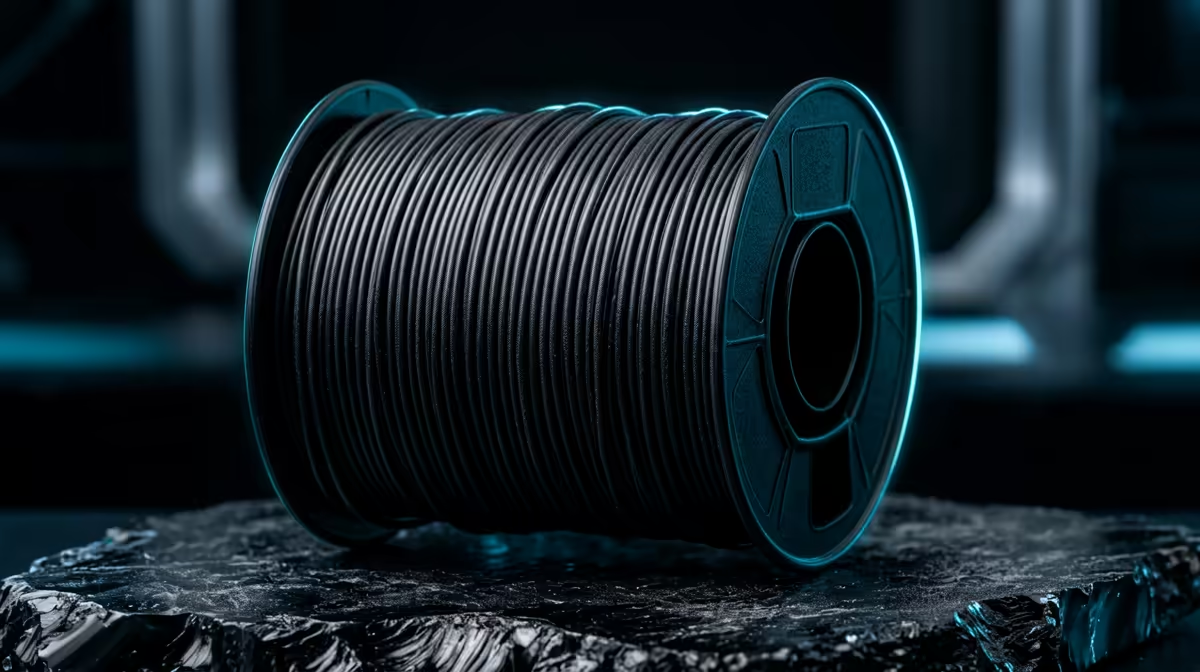
Pull a PLA-printed phone mount off a dashboard after one hot Highveld afternoon and you learn the hard way what glass-transition temperature actually controls. That number, written as Tg, is the temperature at which a 3D printing filament stops behaving like a solid and starts going soft and rubbery, long before it ever properly melts. It is the single spec that decides whether your print survives a car, a window sill, or a warm garage in summer.
Quick Answer
Glass-transition temperature is the point where a thermoplastic shifts from rigid to pliable. For PLA it sits around 60C, for PETG around 80C, and for ABS roughly 105C. Pick your filament by the hottest temperature the finished part will face, not by how the print looks fresh off the bed.
What Tg Actually Describes
Plastics used in printing are amorphous, meaning their molecules are tangled rather than neatly stacked. Below the glass-transition temperature those tangled chains are locked in place and the part feels hard. Heat it past Tg and the chains gain enough energy to slide over each other, so the part sags, warps, or loses its shape under any load. This is different from the melting point, which is much higher and is where the material flows for printing. Tg is the practical ceiling for use, while melt temperature is the printing concern.
Why PLA Softens So Early
PLA is the easy starting filament because it prints cool, smells mild, and barely warps. The trade-off is that 60C ceiling. A closed car in a Durban summer easily passes that on the dashboard, which is why PLA brackets, clips, and phone holders deform there. For desk ornaments, prototypes, and indoor parts that never get hot, PLA is ideal. For anything in sun, heat, or near electronics, it is the wrong choice.
Choosing By the Part's Real Environment
Map the job to the material before you load a spool. PETG, with a Tg near 80C, handles outdoor brackets, water-adjacent parts, and warm rooms while still printing fairly easily. ABS and ASA, near 105C, suit engine-bay-adjacent and genuinely hot applications, though they need an enclosure to print cleanly. If you are still building out your kit, the current range of 3D printers and filament stocked at Evetech covers the machines and materials for each of these tiers. A heated chamber and a sturdy printer matter far more for ABS than for PLA.
Small Upgrades That Help
A glass bed, a quality nozzle, and good cooling all change how reliably each material prints. If you are after the consumables and add-ons that make the difference, the top-selling printer accessories at Evetech are a sensible place to compare spools and tooling. Matching filament to environment first, then dialling in the printer, saves wasted prints.
Frequently Asked Questions
Is glass-transition temperature the same as melting point?
No. Tg is where the plastic goes soft and loses rigidity, while the melting point is much higher and is where it flows for printing. A part fails at its glass-transition temperature long before it would actually melt.
Why does my PLA print warp in the car but not indoors?
PLA softens around 60C, and a closed car in SA summer can pass that on the dashboard. Indoors the air rarely gets near 60C, so the same part stays rigid. Switch to PETG or ABS for in-car parts.
Which filament is best for outdoor SA use?
PETG (Tg near 80C) or ASA is the practical pick for outdoor parts because both resist heat and sun far better than PLA. ASA also handles UV exposure well, which matters under strong South African sunlight.
Does a higher Tg mean a stronger print?
Not directly. Tg measures heat resistance, not mechanical strength. A high-Tg material survives heat better, but layer adhesion, infill, and wall count determine how much load the part can carry.
Picking the right filament starts with matching Tg to where the part will live. Browse the 3D printer and filament range at Evetech (https://www.evetech.co.za/components/3d-printers-130) to match your next project to a material that survives real South African conditions.