


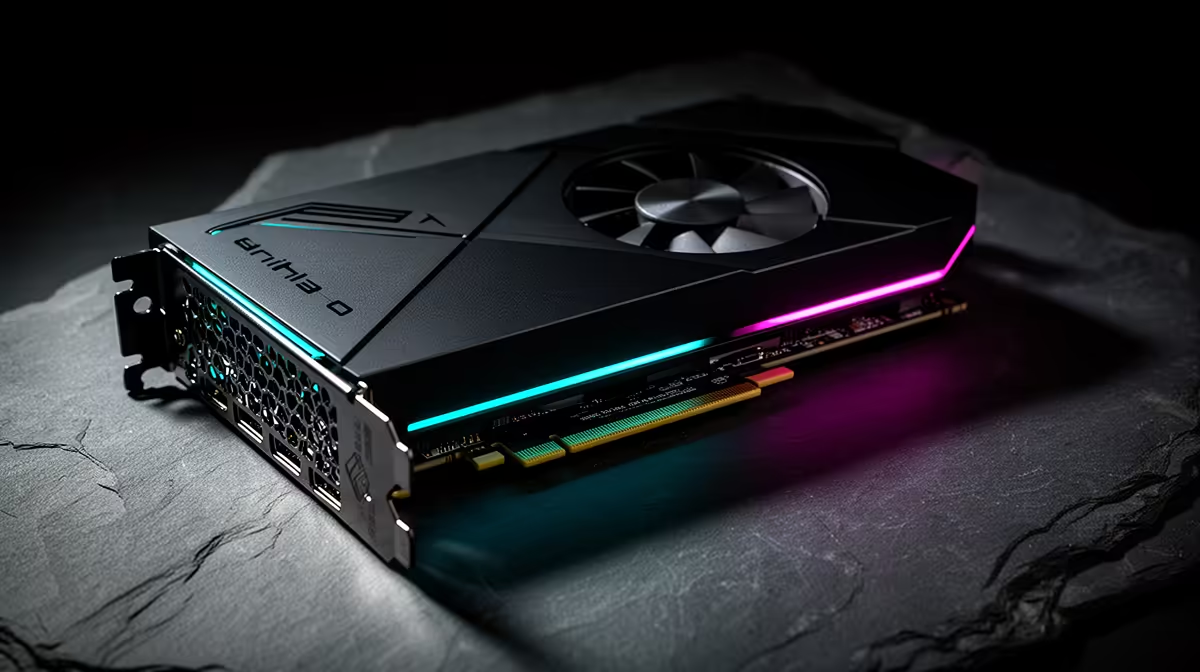
For years, running an NVIDIA card on Linux meant leaning on NVIDIA's closed proprietary driver. NVK changes that picture. It is the open-source Vulkan driver for NVIDIA GPUs built inside the Mesa graphics stack, and by mid-2026 it has grown from an experiment into a genuinely usable option, even gaining early DLSS support. For Linux gamers who value an open graphics stack, that is a real shift.
Quick Answer
NVK is Mesa's community-built, open-source Vulkan driver for NVIDIA GPUs, created to give NVIDIA cards a proper open graphics stack on Linux. It is a conformant Vulkan 1.4 implementation supporting Kepler through Ada and consumer Blackwell cards, and as of Mesa 26.2 it has experimental DLSS support. It is an alternative to NVIDIA's proprietary driver, not a replacement for everyone yet.
How NVK Differs From the Proprietary Driver
NVIDIA's official driver is closed source, tightly tuned, and the historic default for performance on Linux, but it sits outside the open Mesa ecosystem that powers AMD and Intel graphics. NVK lives inside Mesa, which means it ships and updates alongside the rest of the open Linux graphics stack and integrates cleanly with distributions that prefer open components.
That open footing matters for the immutable and gaming-focused distros gaining ground, where a driver baked into the system image is far simpler than layering a proprietary blob. NVK started in 2022 and has matured steadily, reaching a stable, conformant state and widening its hardware reach across recent GeForce generations.
What NVK Means for Gaming
The big 2026 development is DLSS. NVK now implements a Vulkan extension that lets it load NVIDIA's prebuilt CUDA binaries directly, so it can run the DLSS components bundled with games rather than rebuilding the feature from scratch. The support is currently gated behind an experimental environment variable, with a stable release expected later in the year, and it should help narrow the performance gap with the proprietary driver in titles that lean on upscaling.
For now the honest position is that the proprietary driver still leads on raw performance in many games, while NVK offers the openness, easier integration and rapid community progress that some Linux users prefer. If you game on Linux with an NVIDIA card and want to see what hardware suits these driver paths, the graphics cards stocked at Evetech and full PC range are a sensible starting point for matching a GPU generation NVK supports.
Frequently Asked Questions
Which NVIDIA cards does NVK support?
NVK covers Kepler GPUs (GeForce 600 and 700 series) up to and including Ada (RTX 4000 series), plus consumer Blackwell cards (RTX 5000 series). It is a conformant Vulkan 1.4 driver across its officially supported range.
Is NVK faster than NVIDIA's proprietary driver?
Not generally, at least not yet. The proprietary driver still leads on performance in many titles, though NVK is improving quickly and DLSS support should help close the gap where upscaling does the heavy lifting.
Do I need to do anything special to use DLSS on NVK?
For now, yes. DLSS support is experimental and hidden behind an environment variable rather than enabled by default. A stable rollout is expected later in 2026.
Why would I choose NVK over the official driver?
You would choose NVK for an open-source graphics stack, smoother integration with Mesa-based and immutable distributions, and fast community development. Users who prioritise openness over peak performance benefit most.
Whether you run the proprietary driver or experiment with NVK, it starts with the right GPU. Explore Evetech's best-selling gaming PCs and pick a system with an NVIDIA card in a generation NVK fully supports.










