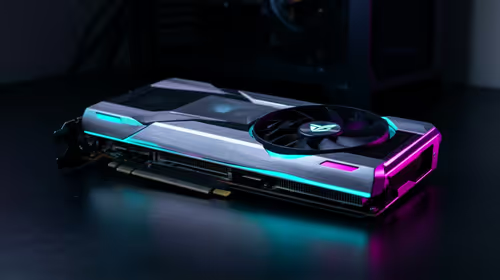
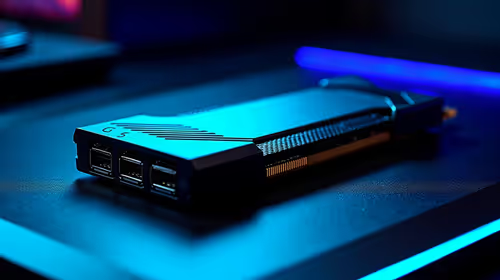
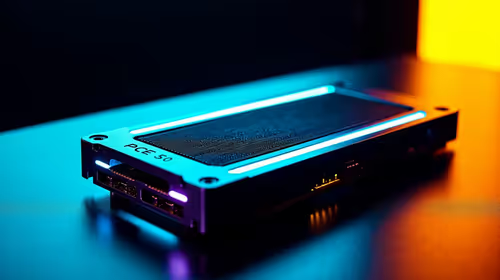
External graphics have always carried a tax: route a desktop GPU's signal through a tunnelled protocol and you pay for the translation in lost performance. OCuLink skips that tax. It carries a raw PCIe signal straight off the host, behaving like an internal slot on a cable rather than a protocol with overhead, and that is why it has become the connection of choice for serious eGPU setups on mini PCs and gaming handhelds.
Quick Answer
OCuLink carries a direct PCIe 4.0 x4 signal rated at roughly 64 Gbps, with no tunnelling overhead. Because it exposes the PCIe link itself instead of wrapping it in another protocol, an external GPU connected over OCuLink performs closer to one installed in a desktop slot than any tunnelled alternative.
What Makes OCuLink Different
Most external connections wrap the PCIe signal inside another protocol, then unwrap it at the far end. That tunnelling adds latency and overhead, which is why a tunnelled eGPU rarely matches the same card in a desktop.
OCuLink does away with the wrapper. It hands the PCIe 4.0 x4 lanes straight to the external device, so the GPU sees something almost identical to being plugged into a motherboard slot. The cable is effectively an extension of the internal bus rather than a translator sitting between two worlds. That directness is the entire reason performance holds up.
Building an eGPU setup also means a dock or enclosure to house the card and the connection, and Evetech's docking station range is a practical place to explore the hardware that sits between your system and the graphics card.
Where OCuLink Shines
OCuLink has found its home in a specific set of devices where the extra performance is worth a dedicated port.
- Mini PCs: a compact system with no room for a graphics card can drive a full desktop GPU externally over OCuLink, turning a small box into a capable gaming or workstation machine.
- Gaming handhelds: dock a handheld to an external GPU through OCuLink and it plays like a desktop at home, then unplugs to stay portable.
- Performance-first eGPU builds: for anyone chasing the smallest possible gap between external and internal graphics, the direct PCIe link is the closest you get.
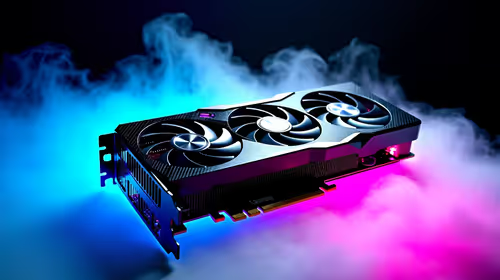
The trade-off is convenience. OCuLink is not as universal as more common ports, the cable carries video and data but not power or other peripherals, and connecting it is a more deliberate plug-in than a single do-everything cable. You give up some flexibility to gain raw throughput. For the cards themselves, the top-selling graphics cards right now reflect what local buyers are choosing for eGPU builds.
Frequently Asked Questions
What bandwidth does OCuLink provide?
OCuLink carries a PCIe 4.0 x4 signal rated at roughly 64 Gbps. Just as important as the number is that it delivers this without tunnelling overhead, so more of that bandwidth reaches the GPU in practice.
Why is OCuLink faster than tunnelled eGPU connections?
Tunnelled connections wrap the PCIe signal in another protocol, adding latency and overhead. OCuLink exposes the PCIe link directly, so an external GPU behaves much closer to one in a desktop slot, with less performance lost in translation.
What devices use OCuLink?
It is most common on mini PCs and gaming handhelds that need to connect an external graphics card, along with performance-focused eGPU enclosures. These are the cases where the direct PCIe link is worth a dedicated port.
What is the downside of OCuLink?
It is less universal than mainstream ports, the cable carries video and data but not power or other devices, and plugging in is more deliberate. You trade some everyday convenience for the strongest external GPU performance.
Thinking about an external GPU for a mini PC or handheld? Browse the docking station range at Evetech to find the enclosures and connections that get your graphics card running at close to desktop speed.